


Civic groups yesterday delivered to the Central Election Commission more than 520,000 signatures collected for a referendum proposal to change the national sports team’s name from “Chinese Taipei” to “Taiwan” for the 2020 Tokyo Olympics.
At a news conference in front of the commission headquarters, Olympic medalist and campaign spokeswoman Chi Cheng (紀政) thanked supporters for helping them reach the threshold of 281,745 signatures and urged people to vote on the referendum, which is to take place alongside the nine-in-one local elections in November.
The proposal, which garnered 526,688 signatures, is the seventh proposal to have reached the threshold this year. Nine referendums are expected to be held on Nov. 24, including two proposals on promoting gender equality that are expected to be submitted to the commission this week.
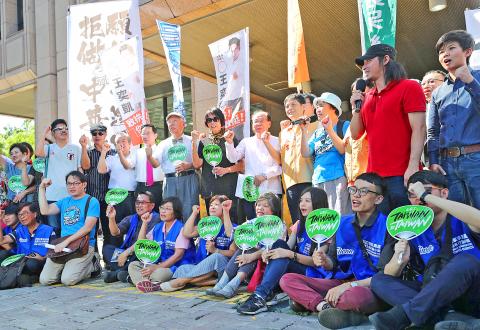
Photo: CNA
“Taiwan has great athletes, but we do not have a great brand. While the name ‘Taiwan’ is widely used, less than 1 percent use the name ‘Chinese Taipei.’ Great athletes deserve to represent a great name,” Control Yuan member Peter Chang (張武修) said, adding that the referendum would give Taiwanese the right to vote on their own “brand name.”
Despite having no support from the government, the proposal has garnered great momentum among the public, as many people support the idea of having the nation known as “Taiwan” in the international community, said former Tainan mayor George Chang (張燦鍙), who also took part in the grassroots campaign.
At the news conference, New Power Party Executive Chairman Huang Kuo-chang (黃國昌) praised the groups’ efforts to promote the campaign and their ability to gather “possibly the most signatures any proposal launched by a civil group has ever collected,” despite facing significant opposition.
Pro-unification groups and their supporters have criticized the proposal as an attempt to promote Taiwanese independence, saying that it could provoke China into further restricting Taiwan’s already limited international space.
The KMT has submitted three referendum proposals: phasing out fossil fuel power plants, halting the construction of a coal power plant in New Taipei City’s Rueifang District (瑞芳) and maintaining the ban on food products from five Japanese prefectures, which was imposed after the 2011 Fukushima Dai-ichi nuclear disaster.
The Happiness of the Next Generation Alliance has submitted three referendum proposals: maintaining the definition of marriage in the Civil Code as a union between a man and a woman, protecting the right of same-sex couples to live together without amending the Civil Code and banning education about homosexuality in elementary and junior-high schools.
For a referendum to pass, at least one-quarter of the nation’s eligible voters must cast an affirmative vote, with the “yes” votes outnumbering the “no” votes.

PROVOCATIVE: Chinese Deputy Ambassador to the UN Sun Lei accused Japan of sending military vessels to deliberately provoke tensions in the Taiwan Strait China denounced remarks by Japan and the EU about the South China Sea at a UN Security Council meeting on Monday, and accused Tokyo of provocative behavior in the Taiwan Strait and planning military expansion. Ayano Kunimitsu, a Japanese vice foreign minister, told the Council meeting on maritime security that Tokyo was seriously concerned about the situation in the East China and South China seas, and reiterated Japan’s opposition to any attempt to change the “status quo” by force, and obstruction of freedom of navigation and overflight. Stavros Lambrinidis, head of the EU delegation to the UN, also highlighted South China Sea
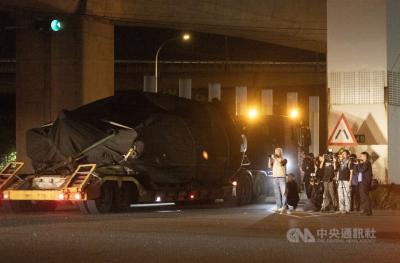
The final batch of 28 M1A2T Abrams tanks purchased from the US arrived at Taipei Port last night and were transported to the Armor Training Command in Hsinchu County’s Hukou Township (湖口), completing the military’s multi-year procurement of 108 of the tanks. Starting at 12:10am today, reporters observed more than a dozen civilian flatbed trailers departing from Taipei Port, each carrying an M1A2T tank covered with black waterproof tarps. Escorted by military vehicles, the convoy traveled via the West Coast Expressway to the Armor Training Command, with police implementing traffic control. The army operates about 1,000 tanks, including CM-11 Brave Tiger
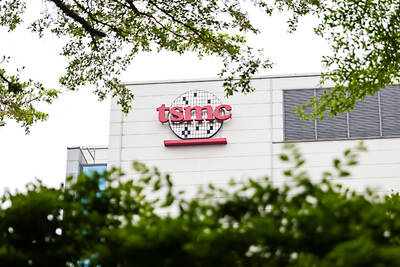
Taiwan Semiconductor Manufacturing Co (TSMC, 台積電), the world’s largest contract chipmaker, said it expects its 2-nanometer (2nm) chip capacity to grow at a compound annual rate of 70 percent from this year to 2028. The projection comes as five fabs begin volume production of 2-nanometer chips this year — two in Hsinchu and three in Kaohsiung — TSMC senior vice president and deputy cochief operating officer Cliff Hou (侯永清) said at the company’s annual technology symposium in Silicon Valley, California, last week. Output in the first year of 2-nanometer production, which began in the fourth quarter of last year, is expected to

Taiwan’s drone exports surged past US$100 million in the first quarter, exceeding last year’s full-year total, with the Czech Republic emerging as the largest buyer, the Ministry of Economic Affairs said. Exports of complete drones reached US$115.85 million in the period, about 1.2 times the total recorded for all of last year, the ministry said in a report. Exports to the Czech Republic accounted for about US$100 million, far outpacing other markets. Poland, last year’s top destination, recorded about US$11.75 million in the first quarter. Taiwan’s drone exports have expanded rapidly in the past few years, with last year’s total


 RSS
RSS