

Legislative Speaker Su Jia-chyuan (蘇嘉全) on Friday had a one-on-one meeting with US House of Representatives Speaker Paul Ryan in Washington, marking the first such meeting since the US severed diplomatic ties with Taiwan in 1979.
Although the US’ Taiwan Relations Act does not forbid the speakers from having public meetings, the US was concerned that doing so would cause political speculation.
However, since the US Congress passed the Taiwan Travel Act earlier this year, interactions between senior-level government officials from the two sides have become more frequent and public.
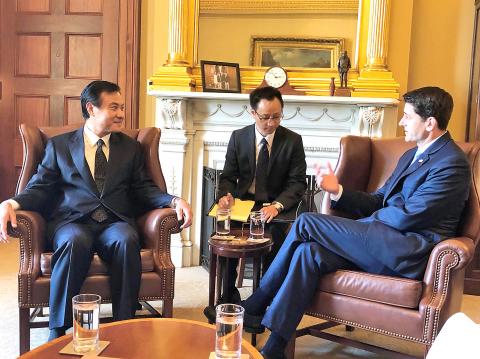
Photo courtesy of the Taipei Economic and Cultural Representative Office in the US
In 2008, then-legislative speaker Wang Jin-pyng (王金平) met with then-US House speaker Nancy Pelosi and other US representatives at the US Capitol, local media reported.
During the meeting, Wang invited Pelosi to visit Taiwan.
Su met with Ryan on the sidelines of two memorial services for US senator John McCain on Friday and Saturday. Su represented Taipei at the ceremonies.
Su in a Facebook post on Saturday said he had met with Ryan, as well as US Senator Cory Gardner and several US representatives.
Su said that in addition to paying his respects to McCain, he also expressed gratitude to the US Congress for its staunch support for improving relations between Taiwan and the US, as well as for peace and stability across the Taiwan Strait.
Su arrvied in Washington on Thursday, leading a delegation to McCain’s lying-in-state ceremony at the US Capitol on Friday, and a national memorial service that took place at Washington National Cathedral the following day.
At Saturday’s ceremony, Su met with US politicians and foreign dignitaries as they recalled McCain’s life of service, the Taipei Economic and Cultural Representative Office in the US said in a statement.
McCain passed away from brain cancer on Saturday last week at the age of 81.
Su’s delegation is scheduled to return to Taipei today.
Additional reporting by Lu Yi-hsuan

The Philippine Coast Guard yesterday said it has deployed its largest vessel and an aircraft to challenge a Chinese research ship operating off northern Batanes near Taiwan, adding that a Chinese coast guard vessel had also moved in. The Philippine operation “disrupted the vessel’s unauthorized marine scientific research and compelled it to leave its loitering position,” said Jay Tarriela, Philippine Coast Guard spokesperson on South China Sea issues. The Philippine Coast Guard said the BRP Teresa Magbanua and an aircraft were deployed to counter the Chinese vessel, which it said had remained about 37 nautical miles northwest of Itbayat Island since Monday. The
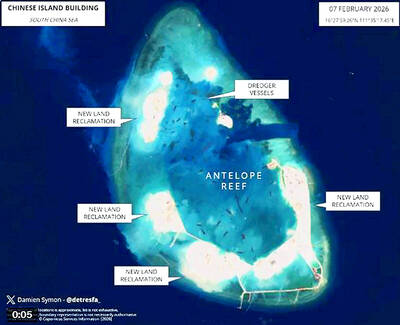
RUNWAY: Analysts said the first aircraft landing is expected by the middle of next year, while Chinese state media said it would serve civilian needs Chinese construction of a runway on Antelope Reef (Lingyang Reef, 羚羊礁) in the Paracel Islands (Xisha Islands, 西沙群島), is well under way with analysts estimating it could be completed by the middle of next year, strengthening Beijing’s military control over the disputed South China Sea. Satellite images reviewed by Reuters show grading work, piles of gravel and concrete, and compaction cranes in operation to build a full-scale runway that military attaches and security analysts say could be one of China’s most important offshore bases in the region. The images, taken on Friday last week by commercial satellite imagery provider Vantor, also show

SHIFTING COOPERATION: With the new arrangement, US representatives would be able to participate directly in defense discussions, including weapons procurement Taiwan-US military cooperation is deepening, with the Pentagon expected to station personnel at the Ministry of National Defense (MND), sources said. The NT$470 million (US$14.77 million) joint program is scheduled to run from this year through 2028, under which the Pentagon would dispatch representatives from the Office of the Under Secretary of Defense for Policy and the Institute for Defense Analyses, a senior military official said on condition of anonymity, adding that one representative from each organization would be stationed at the ministry’s headquarters. The Office of the Under Secretary of Defense for Policy is one of the US’ bodies responsible for

The Presidential Office today condemned China's transnational repression after an alleged Chinese foreign agent was arrested in California yesterday on suspicion of surveilling President William Lai's (賴清德) son, Lai Ting-yu (賴廷與), the FBI said. The 34-year-old woman, named Wanying Heather Zhang (張婉瑩), was arrested on suspicion of acting as an unregistered foreign agent, US news agency CBS reported. She was apprehended at Los Angeles International Airport yesterday attempting to fly to Shanghai, it said. This represents a “typical case” of China’s transnational repression, Presidential Office spokeswoman Karen Kuo (郭雅慧) said today. "Our country expresses the strongest condemnation of such barbaric conduct that


 RSS
RSS