


The Chinese government’s new residency permit cards for Taiwanese, which are to bear the fingerprints of the cardholder, pose privacy and national security risks, Executive Yuan Department of Cybersecurity Director Jian Hong-wei (簡宏偉) said yesterday.
Jian made the remarks after Chinese authorities earlier in the day published a preview of regulations for issuing residency permit cards for people from Taiwan, Hong Kong and Macau, which are to go into effect on Saturday next week.
The cards would bear the cardholder’s name, date of birth, photograph, fingerprints, address and an 18-digit serial number, employing the same identification system Beijing uses for Chinese nationals, according to the regulations.

Photo: Chung Lee-hua, Taipei Times
“Fingerprints are private biometric data and there is no end to the ways Chinese authorities could use them once they get hold of them,” Jian said.
After obtaining fingerprints of Taiwanese, the Chinese government could link them to other biometric data and store them in digital archives, he said.
Taiwanese who give their biometric data to Chinese authorities would render themselves vulnerable to Beijing’s human rights violations, he added.
Mainland Affairs Council Deputy Minister Chiu Chui-cheng (邱垂正) said the increasing power and sophistication of Chinese surveillance technologies pose potential risks to Taiwanese seeking employment or education in China.
President Tsai Ing-wen (蔡英文) on Saturday said China’s issuance of residency permits to Taiwanese is “motivated by a certain political agenda.”
China’s Taiwan Affairs Office and the Ministry of Public Security said that with the new residency permit, people from Taiwan, Hong Kong and Macau would be identified with a six-digit address code starting with 83, 81 and 82 respectively.
People from Taiwan, Hong Kong and Macau may apply for a residency permit if they are employed in a stable job, have lived in China for at least half a year, have a permanent place of residence and satisfy at least one requirement for continuing education, the agencies said.
Taiwanese who have held a Taiwan Compatriot Permit for at least five years may directly apply for a permit, they said.
The permits would record data about the issuing office, and border entry and exit dates, they added.
The Mainland Affairs Council issued a statement later in the evening, saying that it would investigate whether applying for a residency permit in China contravenes the Act Governing Relations Between the People of the Taiwan Area and the Mainland Area (臺灣地區與大陸地區人民關係條例).
Article 9 of the act forbids Taiwanese nationals to hold China-issued household registration documents or a passport at the pain of losing Republic of China citizenship and its rights and privileges.
China is a repressive regime with a poor human rights record and the public should consider the consequences before surrendering sensitive personal data to Beijing, Democratic Progressive Party Legislator Wang Ding-yu (王定宇) and Taiwan Association for Human Rights policy director Shih Yi-hsiang (施逸翔) said separately.

CREDIT-GRABBER: China said its coast guard rescued the crew of a fishing vessel that caught fire, who were actually rescued by a nearby Taiwanese boat and the CGA Maritime search and rescue operations do not have borders, and China should not use a shipwreck to infringe upon Taiwanese sovereignty, the Coast Guard Administration (CGA) said yesterday. The coast guard made the statement in response to the China Coast Guard (CCG) saying it saved a Taiwanese fishing boat. The Chuan Yu No. 6 (全漁6號), a fishing vessel registered in Keelung, on Thursday caught fire and sank in waters northeast of Diaoyutai Islands (釣魚台). The vessel left Keelung’s Badouzih Fishing Harbor (八斗子漁港) at 3:35pm on Sunday last week, with seven people on board — a 62-year-old Taiwanese captain surnamed Chang (張) and six

RISKY BUSINESS: The ‘incentives’ include initiatives that get suspended for no reason, creating uncertainty and resulting in considerable losses for Taiwanese, the MAC said China’s “incentives” failed to sway sentiment in Taiwan, as willingness to work in China hit a record low of 1.6 percent, a Ministry of Labor survey showed. The Directorate-General of Budget, Accounting and Statistics (DGBAS) also reported that the number of Taiwanese workers in China has nearly halved from a peak of 430,000 in 2012 to an estimated 231,000 in 2024. That marked a new low in the proportion of Taiwanese going abroad to work. The ministry’s annual survey on “Labor Life and Employment Status” includes questions respondents’ willingness to seek employment overseas. Willingness to work in China has steadily declined from

LEVERAGE: China did not ‘need to fire a shot’ to deny Taiwan airspace over Africa when it owns ‘half the continent’s debt,’ a US official said, calling it economic warfare The EU has raised concerns about overflight rights following the delay of President William Lai’s (賴清德) planned state visit to the Kingdom of Eswatini after three African nations denied overflight clearance for his charter at the last minute. Taiwanese allies Paraguay and Saint Kitts and Nevis, as well as several US lawmakers and the Inter-Parliamentary Alliance on China (IPAC) condemned China for allegedly pressuring the countries. Lai was scheduled to fly directly to Taiwan’s only African ally from yesterday to Sunday to celebrate the 40th anniversary of King Mswati III’s accession and his 58th birthday, but Seychelles, Mauritius and Madagascar suddenly revoked
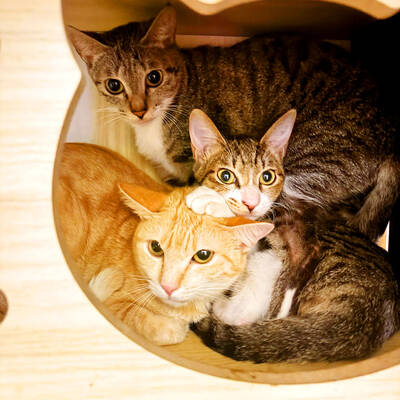
The number of pet cats in Taiwan surpassed that of pet dogs for the first time last year, reaching 1,742,033, a 32.8 percent increase from 2023, the Ministry of Agriculture said yesterday, citing a survey. By contrast, the number of pet dogs declined slightly by 1.2 percent over the same period to 1,462,528, the ministry said. Despite the shift, households with dogs still slightly outnumber those with cats by 1.2 percent. However, while the number of households with multiple dogs has remained relatively stable, households keeping more than two cats have increased, contributing to the overall rise in the feline population. The trend


 RSS
RSS