

Kinmen County yesterday began importing water from China’s Fujian Province to stabilize its water supply, while county Commissioner Chen Fu-hai (陳福海) said he hopes to boost bilateral ties with the Chinese province through what he called “three new links.”
Separate ceremonies were held in Kinmen and China’s Jinjiang City to mark the opening of the water supply system, with Chen and other local politicians attending the ceremony in Kinmen.
The county government held the ceremony as scheduled, despite calls by the Mainland Affairs Council (MAC) to delay it after Beijing pressured members of the East Asian Olympic Committee to revoke Taichung’s right to host the East Asian Youth Games next year.
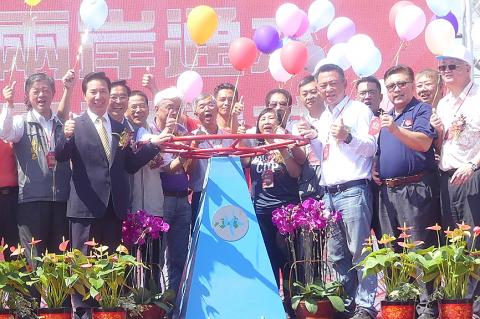
Photo: Wu Cheng-ting, Taipei Times
The “water link” — one of Chen’s “three new links” — is the result of an agreement that Taiwan and China signed in 2015 to provide Kinmen with water for 30 years, Chen said.
It is followed by an “electricity link” and “bridge link” between Kinmen and China, he added.
Chen also referred to the “small three links” — postal, transportation and trade connections between Taiwan and China that started in 1991.
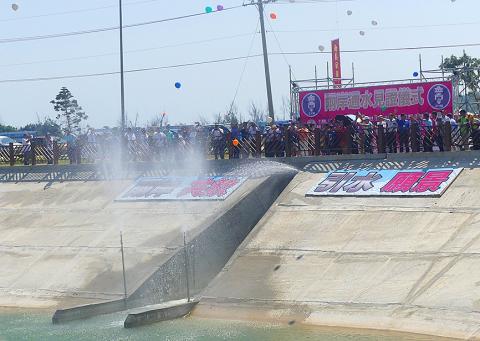
Photo: Wu Cheng-ting, Taipei Times
According to the water purchase agreement, Kinmen is to import up to an average of 34,000 tonnes of water a day at a cost of NT$9.86 per cubic meter, and the daily supply could reach 55,000 tonnes a day, the Kinmen County Waterworks said.
The ceremony in Jinjiang was attended by China’s Taiwan Affairs Office Minister Liu Jieyi (劉結一), along with China’s Fujian Province Governor Yu Weiguo (于偉國), and a Taiwanese delegation of more than 20 councilors led by Kinmen County Council Speaker Hung Li-ping (洪麗萍).
The water connection signals the development of peaceful cooperation between Kinmen and Jinjiang, which were previously divided by military conflicts, Liu said at the ceremony.
“Only if cross-strait relations are good will Taiwanese be better off,” Liu said.
Liu criticized Taiwanese who opposed the system out of “malicious political purposes,” saying they would “meet their doom” for neglecting the well-being of their compatriots.
The MAC in a statement congratulated Kinmen, while condemning Beijing for using the system for political gains.
The water system — a commercial agreement — was politicized by China as a “gift” to Taiwan in a bid to split Taiwanese, it said.
The government has displayed its utmost goodwill by allowing the system to be launched as scheduled, at a time when cross-strait relations are tense, the council said.
Executive Yuan spokeswoman Kolas Yotaka said more deliberation is needed regarding the “three new links,” but added that the government would prioritize the needs of Kinmen residents.
Additional reporting by Chen Yu-fu
GEOPOLITICAL SIGNIFICANCE: The CGA’s nonmilitary role makes it a tool to avert diplomatic issues, an official said, while confirming the donation of a ship to Manila Coast Guard Administration (CGA) ships are scheduled to sail to the Philippines bearing the words “Taiwan Coast Guard” in a high-profile visit in October next year, the first such visit by a Taiwanese maritime law enforcement vessel to the Southeast Asian nation, the agency said yesterday. The CGA also confirmed that it had donated one of its decommissioned patrol vessels to the Philippines in a rare transfer of a retired ship to a nondiplomatic ally. The Republic of China (ROC) Navy last made such a visit in 1974, shortly before the Philippines switched diplomatic recognition to the People’s Republic of China in
CALL FOR CHANGE: They urged the UN to facilitate Taiwan’s involvement in the body, recognize its peace efforts and to work with members in preventing military conflict Representatives to the UN from five of Taiwan’s diplomatic allies sent a joint letter to UN Secretary-General Antonio Guterres on Friday, calling for the country’s inclusion in the body. Allies in the letter sent ahead of the 81st session of the UN General Assembly General Debate made three demands in support of Taiwan: inclusion, recognition and camaraderie. They implored the UN to seek an appropriate way to facilitate Taiwan’s meaningful involvement in the world governing body, saying that UN Resolution 2758, which accepted the People’s Republic of China (PRC) as a member of the UN, does not exclude Taiwan. Beijing claims that the

‘GLOBAL WARNING’: The infiltration is not just a local problem, as Beijing has been deploying the same tactics worldwide against Western democracies, a report said Between 50,000 and 100,000 Chinese spies are operating in Taiwan, far more than the National Security Bureau’s previous estimate of 5,000, German journalist and author Jurgen Kremb said on Monday. Kremb presented his research, titled “The War of Spies: How China’s Intelligence Services Are Infiltrating Taiwan — and What Europe Must Learn from It,” at a joint event held by the Taiwan offices of the Friedrich Naumann Foundation and the European Values Center for Security Policy. The report was published in June in the Ministry of Justice Investigation Bureau’s Prospect & Exploration Monthly (展望與探索月刊). By spies, he said he was referring to informants,

SOFT TENNIS: Yu Kai-wen and Huang Shih-yuan narrowly defeated their Japanese rivals to capture Taiwan’s first gold at the Asian Games in Nagoya Yu Kai-wen (余凱文) and Huang Shih-yuan (黃詩媛) won Taiwan’s first gold of this year’s Asian Games, defeating a Japanese duo in a nail-biter in the soft tennis mixed doubles final in Nagoya, Japan, while Johnny Sun (孫家閎) won silver in wushu and Shih Cheng-chung (石政中) won bronze in men’s kumite. Yu and Huang narrowly defeated Japan’s Toshiki Uematsu and Rena Temma 5-4 (2-4, 5-3, 4-2, 1-4, 1-4, 4-0, 1-4, 4-1, 7-5) to give Taiwan its first gold in soft tennis mixed doubles at an Asian Games since 2018. Sun secured Taiwan’s first wushu medal at this year’s game, with a combined score


 RSS
RSS