


Taichung Mayor Lin Chia-lung (林佳龍) is willing to go to Beijing to resolve the cancelation of the East Asian Youth Games, if the Chinese government approves his visit, he told an international news conference in Taipei yesterday.
The Taichung City Government has lodged an official complaint with the East Asian Olympic Committee (EAOC) over its decision to cancel Taichung’s right to host the first East Asian Youth Games in August next year, he said.
The committee cited a proposed referendum on changing the name of Taiwan’s national team when it participates in the 2020 Olympic Games and other international events as its reason for canceling next year’s competition in Taichung.
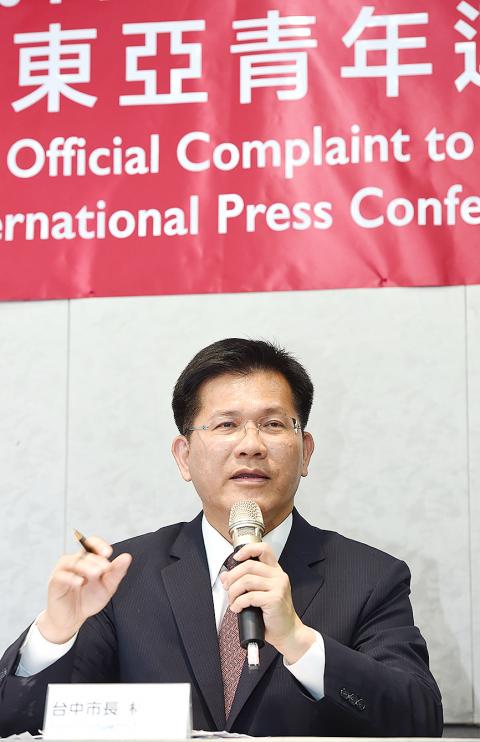
Photo: Fang Pin-chao, Taipei Times
“If it [China] lets me go, I will go,” Lin said. “We will not spare any effort. “
Lin was asked if he might make a statement similar to that made by Taipei Mayor Ko Wen-je (柯文哲), who last year said that Taiwan and China are part of one family, which some speculate might be why Beijing did not interfere with the Taipei Universiade last summer.
“I will tell China that cross-strait relations should begin with mutual respect and communication with one another, and that both sides can resolve disputes rationally. What terms we would use to describe the relationship is not the point. What matters are the actual relations between the two sides,” he said.
The damage caused by the incident could leave an indelible stain on cross-strait relations, despite Taiwan’s attempt to build a friendly relationship with Beijing, he said.
Asked if Olympic bronze medalist Chi Cheng (紀政) should resign as the honorary chief consultant of the organizing committee, as she is one of the main advocates for the referendum, Lin said Chi and International Olympics Committee member Wu Ching-kuo (吳經國) serve as chief consultants because of their sports expertise.
Chi’s work for the organizing committee and her exercising her right to propose a name-change referendum should be treated as separate matters, he said, adding that the proposal has yet to become a referendum question.
“In Taiwan, democracy, freedom, human rights and proposing a referendum are our rights. If we blame our own people for exercising their democratic rights, we will never hear the end of it,” he said.
The city has exercised its rights, based on the East Asian Games Association Constitution and the host city contract for the Games, to file a complaint, Lin said, adding that it hopes that the complaint would be handled as soon as possible.
“If we voice our objection, then more people will know about the situation, even though it might not change the result,” he said.
Taiwan’s existence could never be more meaningful at this difficult time, he said.
The main points in the city’s complaint to the EAOC are: One, the abrupt cancelation of the East Asian Youth Games contravened the EAOC’s constitution; two, prior to the committee’s resolution on July 25 to cancel the Games, it failed to inform Taichung of any contravention of or failure to comply with the contract; three, Taichung was not given any opportunity to explain or defend itself against the accusations related to the name-change referendum; four, the EAOC’s letter to Taichung did not give a substantial reason for its resolution, nor did it explain any contravention on the part of the city.
Meanwhile, President Tsai Ing-wen (蔡英文) said Taiwan would never back down on its democratic way of life in the face of relentless pressure and threats from China, but would continue to contribute to regional peace and stability.
“Taiwan, as a responsible member of the international community, will not back down under pressure,” she said yesterday when she met a group led by Juli Minoves-Triquell, president of Liberal International, a political international federation for liberal political parties, at the Presidential Office.
“Taiwan will continue to play a constructive role in maintaining regional peace and stability, and working with like-minded countries and international organizations to defend shared values,” she said.
Additional reporting by CNA

‘NO SECURITY RISK’: The Railway Bureau reassured the public that the technicians’ activities were limited to technical guidance and did not involve sensitive systems The Railway Bureau yesterday said it had invited eight Chinese technicians to assist with an airport MRT construction project. The bureau issued the confirmation after an Internet user said Chinese nationals had entered the construction zone of Taiwan Taoyuan International Airport’s Terminal 3 project. They asked why “individuals from an enemy state” were allowed access to such a major national infrastructure project, which raised serious concerns over Taiwan’s industrial safety, sensitive systems and information security. The bureau’s Northern Region Engineering Branch Office said subcontractor Taiwan Handle Industrial Co (台灣手把工業) of the Taoyuan airport MRT’s “Contract No. CU05 Project A14 Station Civil, MEP &

The National Chungshan Institute of Science and Technology yesterday showcased its locally developed variants of the Vision 60 robotic patrol dog, which it plans to deploy on the nation’s outlying territories in the South China Sea. The variants were produced under the Joint Lab project — created by the institute and domestic companies — and assembled with domestically produced motors, lenses and artificial intelligence (AI) systems alongside licensed tech from the US, Missile and Rocket Systems Research Division deputy director Jen Kuo-kang (任國光) told the media event at a military base in Taipei’s Dazhi (大直) area. Taiwan has built up its strengths

TIT-FOR-TAT: The US allegedly revoked the visa of a Chinese national working at Xinhua News Agency in the US in response to Beijing’s expulsion of Vivian Wang The Presidential Office yesterday condemned China for expelling a New York Times correspondent from Beijing following the newspaper’s interview with President William Lai (賴清德), saying the move highlighted Beijing’s suppression of press freedom and its threat to international news media. Taiwan has noted a series of recent incidents in which Beijing used similar tactics to “threaten and pressure international media outlets and journalists,” Presidential Office spokeswoman Karen Kuo (郭雅慧) said in a statement. “This concerns not only press freedom and freedom of expression, but also the safety of journalists, and Taiwan and relevant partners are paying close attention to the situation,” she

NOT IMMEDIATE: Taiwan has a chance to appeal the proposed 10 percent tariff before it starts, while other countries face a 12.5 percent tariff from the trade office Taiwan is among 60 economies determined by the US to have failed to impose or enforce a ban on the importation of goods produced with forced labor, according to a notice released on Tuesday by the Office of the US Trade Representative (USTR), which proposed imposing an additional 10 percent or more tariff on them. The USTR in a statement said that following an investigation, it had determined under Section 301 of the Trade Act of 1974 that the failure of the 60 economies to impose and effectively enforce a prohibition on the importation of goods produced with forced labor is


 RSS
RSS