


Without continuing US military support, Taiwan would be vulnerable to an armed takeover from Beijing, Minister of Foreign Affairs Joseph Wu (吳釗燮) said in an interview with CNN that aired yesterday.
CNN correspondent Matt Rivers asked Wu: “If the United States continues to increase its support — militarily — for Taiwan as you foresee, does that not increase the potential risk of confrontation — militarily — with China?”
“No, the opposite is true,” Wu said.
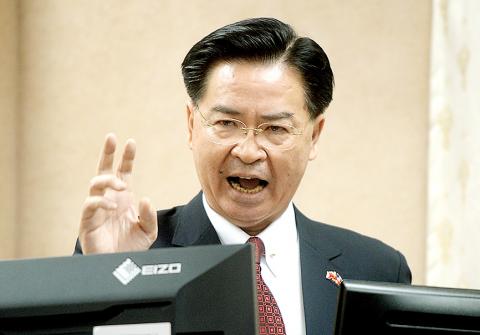
Photo: Lin Cheng-kung, Taipei Times
Stronger Taiwan-US security ties would “become a barrier for the Chinese to think about the future military scenarios against Taiwan,” Wu said.
The Chinese government says it wants to “win the hearts and minds of the Taiwanese people,” Wu said. “However, what they are doing ... is to create hatred among the regular Taiwanese people toward the Chinese government.”
Asked whether there is any concern among the Taiwanese leadership over the reliability of US President Trump Donald as a partner, Wu said that while “some people in Taiwan do worry ... what we believe, and what they told us they believe in, is that Taiwan is not tradable, and democracy is not tradable.”
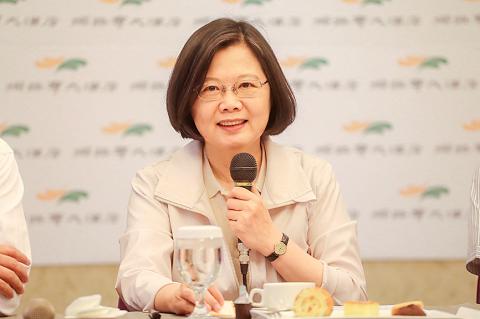
Photo: CNA
Asked whether President Tsai Ing-wen (蔡英文) would push for independence, Wu said Tsai is “determined to maintain the status quo.”
“By itself, Taiwan exists outside China; Taiwan exists by itself, so there is no need for Taiwan to go beyond what it is right now,” CNN quoted Wu as saying.
In terms of diplomatic relations, which have taken a hit due to pressure from China, Wu said that “Some countries [who switched diplomatic allegiance to China] are coming back to us and saying they did not get what China promised.”
Separately yesterday, Tsai said the government would do everything in its power to defend the nation, adding that ensuring a strong national defense and self-defense capabilities are “our responsibility.”
Tsai made the remarks in response to media queries on a report by the Chinese-language China Times that said the Ministry of National Defense did not deny that the military’s revised national defense plan indicates that in the event of conflict with China, the US would not send troops to Taiwan.
Instead, Taiwan would ask the US to provide intelligence so it has a better grasp of the movements of enemy forces, the report said.
Tsai said that maintaining regional peace and stability is also the government’s responsibility and it would do its utmost to defend Taiwan and effectively deter Chinese military ambitions.
However, it is too early to say what countermeasures government agencies would take in the event of enemy action, she said.
The ministry said in a statement that Taiwan has played an important role in maintaining peace, stability and security in the Asia-Pacific region, and a robust national defense provides support for peace across the Taiwan Strait.
In the face of external threats and challenges, Taiwan will stick to its strategy of securing territory with resolute defense and utilizing multi-domain deterrence with joint capabilities, the ministry said.
Other strategic guidelines include rejecting an arms race, integrating national defense resources and continuing to bolster key national defense and combat capabilities to deter enemy forces, it said.

LEVERAGE: China did not ‘need to fire a shot’ to deny Taiwan airspace over Africa when it owns ‘half the continent’s debt,’ a US official said, calling it economic warfare The EU has raised concerns about overflight rights following the delay of President William Lai’s (賴清德) planned state visit to the Kingdom of Eswatini after three African nations denied overflight clearance for his charter at the last minute. Taiwanese allies Paraguay and Saint Kitts and Nevis, as well as several US lawmakers and the Inter-Parliamentary Alliance on China (IPAC) condemned China for allegedly pressuring the countries. Lai was scheduled to fly directly to Taiwan’s only African ally from yesterday to Sunday to celebrate the 40th anniversary of King Mswati III’s accession and his 58th birthday, but Seychelles, Mauritius and Madagascar suddenly revoked
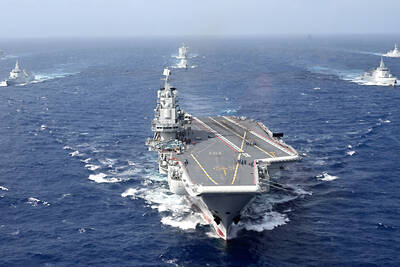
PROVOCATIVE: Chinese Deputy Ambassador to the UN Sun Lei accused Japan of sending military vessels to deliberately provoke tensions in the Taiwan Strait China denounced remarks by Japan and the EU about the South China Sea at a UN Security Council meeting on Monday, and accused Tokyo of provocative behavior in the Taiwan Strait and planning military expansion. Ayano Kunimitsu, a Japanese vice foreign minister, told the Council meeting on maritime security that Tokyo was seriously concerned about the situation in the East China and South China seas, and reiterated Japan’s opposition to any attempt to change the “status quo” by force, and obstruction of freedom of navigation and overflight. Stavros Lambrinidis, head of the EU delegation to the UN, also highlighted South China Sea
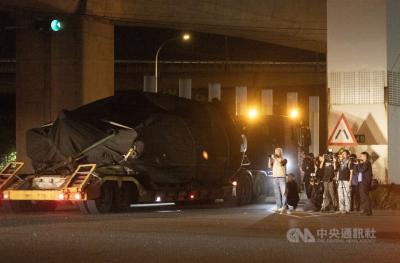
The final batch of 28 M1A2T Abrams tanks purchased from the US arrived at Taipei Port last night and were transported to the Armor Training Command in Hsinchu County’s Hukou Township (湖口), completing the military’s multi-year procurement of 108 of the tanks. Starting at 12:10am today, reporters observed more than a dozen civilian flatbed trailers departing from Taipei Port, each carrying an M1A2T tank covered with black waterproof tarps. Escorted by military vehicles, the convoy traveled via the West Coast Expressway to the Armor Training Command, with police implementing traffic control. The army operates about 1,000 tanks, including CM-11 Brave Tiger
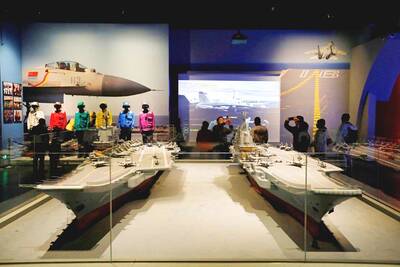
China on Wednesday teased in a video an aircraft carrier that could be its fourth, and the first using nuclear power, while making an allusion to Taiwan and vowing to further build up its islands, as it looks to boost maritime power, secure resources and bolster territorial claims. The video, issued on the eve of the 77th founding anniversary of the Chinese People’s Liberation Army Navy, featured fictional officers with names that are homophones of three commissioned aircraft carriers, the Liaoning (遼寧), Shandong (山東) and Fujian (福建). Titled Into the Deep, it showed a 19-year-old named “Hejian” (何劍) joining the group, sparking


 RSS
RSS