


The commissioning of the nation’s Apache attack helicopters is a critical step in equipping the armed forces to mount a “multiple deterrence” strategy in the event of an enemy invasion, President Tsai Ing-wen (蔡英文) said yesterday.
Presiding over a ceremony that saw the commissioning of 29 Apaches into the Taoyuan-based Army Aviation and Special Forces Command, Tsai said the new helicopters would play an important role in the military’s “multiple deterrence, resolute defense” strategy.
“The commissioning of the helicopters is an important milestone in boosting the ROC Armed Forces’ combat readiness. The government will fully support the military to follow up and further enhance the helicopters’ capabilities,” Tsai said.
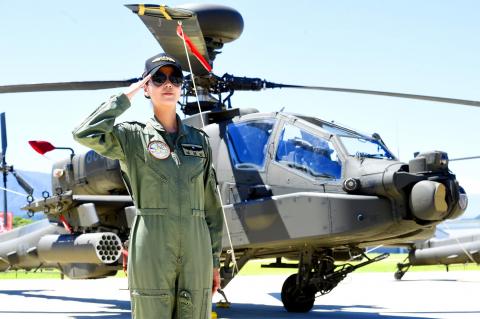
Photo: George Tsorng, Taipei Times
“Multiple deterrence” means having the ability to attack and defend on various fronts and prevent enemy forces from entering Taiwan by air, land or sea, according to the Ministry of Defense.
Taiwan originally purchased 30 Apache helicopters from the US in 2008 for NT$59.31 billion (US$1.94 billion at the current exchange rate), in a deal that included personnel training and logistics.
The Taiwanese military was the first force outside the US to use the latest variant of Boeing’s Apache AH-64, which was delivered to the nation between November 2013 and October 2014.
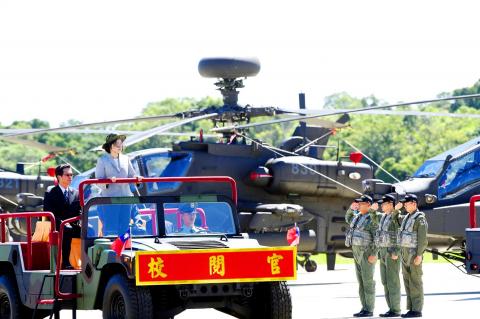
Photo: George Tsorng, Taipei Times
Boeing describes it as “the world’s most advanced multi-role combat helicopter” and it has been sold to countries including Japan and the UK.
One of the helicopters was wrecked in a crash during a training flight in Taoyuan in April 2014. The other 29 have been allocated to the command’s 601st Brigade.
Tsai said it took four years and nine months for the army to complete the required training for its pilots, ground crews and logistics personnel and to build the necessary infrastructure.
A qualified Apache pilot requires 84 weeks of training and 300 flight hours, she added.
Also attending the 601st Air Cavalry Brigade’s full combat readiness ceremony yesterday were representatives from the American Institute in Taiwan, Boeing Co, the Japan-Taiwan Exchange Association and the South Korean Representative Office in Taipei, as well as retired Japanese Self-Defense Forces major general Kinz Watanabe.
Despite previous reports that active service officers of the US Army 25th Combat Aviation Brigade would attend the ceremony, none were present.
The AH-64E, also known as the “tankbuster” or “tank killer,” is equipped with powerful target acquisition radar capable of 360-degree operation to a range of 8km.
The radar system can track over 128 targets simultaneously and identify the 16 most dangerous ones, as well as being equipped with 16 Hellfire missiles that can be deployed in less than 30 seconds, according to the command.
Army Major Yang Yun-hsuan (楊韻璇) was introduced at the ceremony. Yang, the only female Apache pilot in Asia, said her father had been a UH-1H helicopter pilot, which inspired her to follow the same path.
Beijing is incensed by recent warming moves between Washington and Taipei. These include approval by the US State Department of a preliminary licence needed to sell submarine technology to Taiwan.
Additional reporting by Aaron Tu

SILENCING CRITICS: In addition to blocking Taiwan, China aimed to prevent rights activists from speaking out against authoritarian states, a Cabinet department said The Ministry of Foreign Affairs (MOFA) yesterday condemned transnational repression by Beijing after RightsCon, a major digital human rights conference scheduled to be held in Zambia this week, was abruptly canceled due to Chinese pressure over Taiwanese participation. This year’s RightsCon, the world’s largest conference discussing issues “at the intersection of human rights and technology,” was scheduled to take place from tomorrow to Friday in Lusaka, and expected to draw 2,600 in-person attendees from 150 countries, along with 1,100 online participants. However, organizers were forced to cancel the event due to behind-the-scenes pressure from China, the ministry said, expressing its “strongest condemnation”
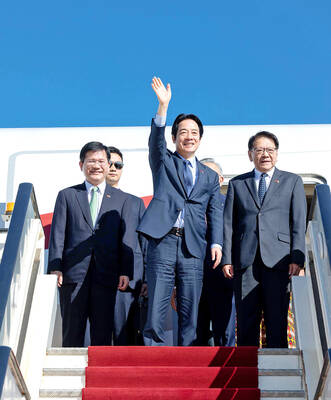
DELAYED BUT DETERMINED: The president’s visit highlights Taiwan’s right to international engagement amid regional pressure from China President Willaim Lai (賴清德) yesterday arrived in Eswatini, more than a week after his planned visit to Taiwan’s sole African ally was suspended because of revoked overflight permits. “The visit, originally scheduled for April 22, was postponed due to unforeseen external factors,” Lai wrote on social media. “After several days of careful arrangements by our diplomatic and national security teams, we successfully arrived today.” Lai said he looked forward to further deepening Taiwan-Eswatini relations through closer cooperation in the economy, agriculture, culture and education, as well as advancing the nation’s international partnerships. The president was initially scheduled to arrive in time to celebrate
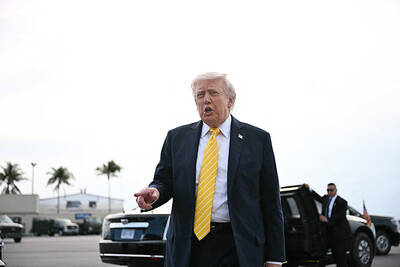
Iran’s Islamic Revolutionary Guard Corp (IRGC) yesterday said the US faced a choice between an “impossible” military operation or a “bad deal” with Tehran, after US President Donald Trump disparaged Iran’s latest peace proposal. Negotiations between the two countries have been deadlocked since a ceasefire came into effect on April 8, with only one round of direct peace talks held so far. Iran’s Tasnim and Fars news agencies reported that Tehran had submitted a 14-point proposal to mediator Pakistan, but Trump was quick to cast doubt on it. “I will soon be reviewing the plan that Iran has just sent to us, but

A group affiliated with indicted Chinese immigrant Xu Chunying (徐春鶯) is to be dissolved for monitoring Chinese immigrants in Taiwan, a source said yesterday. Xu, the secretary-general of the Cross-Strait Marriage and Family Service Alliance, was indicted on March 24 on charges of violating the Anti-Infiltration Act (反滲透法). The alliance “illegally monitored" Chinese immigrants living in Taiwan on behalf of the Chinese Communist Party (CCP) and the Ministry of the Interior is expected to dissolve the organization in the coming days under provisions of the Civil Associations Act (人民團體法), the source said. Xu, who married a Taiwanese in 1993 and became a Republic


 RSS
RSS