


The Chinese Nationalist Party (KMT) last year declared NT$18.9 billion (US$618.54 million) in total assets and remains by far the nation’s richest political party, according to the Ministry of the Interior’s 2017 Political Parties’ Assets and Finances report released yesterday.
The annual report, which is mandated by the Political Party Act (政黨法), aims to make the finances of political parties more transparent, Deputy Minister of the Interior Lin Tzu-ling (林慈玲) said yesterday.
Of the parties that declared their finances, the Democratic Progressive Party was second-richest with NT$769 million in total assets, followed by the New Power Party — founded in January 2015 — with NT$25 million, the People First Party with NT$20 million and the New Party with NT$16 million, the report said.
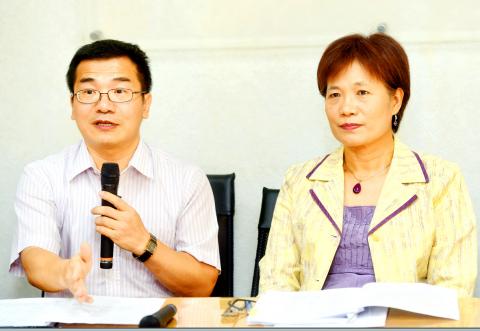
Photo: Chien Jung-feng, Taipei Times
The Executive Yuan’s Ill-gotten Party Assets Settlement Committee in 2016 designated Central Investment Co (中央投資) and its spin-off, Hsinyutai Co (欣裕台), as affiliated organizations of the KMT and froze the two companies’ assets through an administrative order, which the KMT has contested in an ongoing lawsuit.
The two firms were considered the KMT’s most valuable assets in yesterday’s report.
As of last year, Central Investment Co was worth NT$15.4 billion and Hsinyutai NT$200 million, a combined NT$400 million increase from 2015, the report said.
The KMT’s real-estate assets were estimated to be worth NT$910 million, a decrease of NT$9 million from 2015, it added.
The party’s overall expenditures last year totaled NT$2.22 billion, including personnel costs, which comprised the lion’s share of the expenses at NT$1.81 billion, the report said.
The regulations requiring political parties to disclose their finances to the government were drafted in 2006, but they did not initially include punitive measures for noncompliance and their implementation was delayed until last year, because many political parties were small and did not have proper financial records, the ministry said.
All parties were required to declare their assets by May 31, Lin said, but added that as of last month, the ministry had been unable to establish contact with 95 parties, calling on those parties to contact the ministry to safeguard their rights.
The ministry earlier this year vowed to step up efforts to communicate with political parties about the regulations and expectations of conduct under the act, he said.
As of last month, 163 of 301 registered parties had filed declarations, with 95 reports in compliance with the act, Lin said, adding that all parties should submit their final paperwork to the ministry before Jan. 15 next year.
The act stipulates that noncompliance by parties, or a refusal to file a declaration after notification has been served could result in fines of between NT$1 million and NT$5 million, the ministry said.
Parties whose reports require corrections and are not fixed within a given timeframe, or whose corrections have failed to meet ministry standards could face fines of between NT$200,000 and NT$1 million, the ministry said, adding that fines are issued per individual breach.
LEVERAGE: China did not ‘need to fire a shot’ to deny Taiwan airspace over Africa when it owns ‘half the continent’s debt,’ a US official said, calling it economic warfare The EU has raised concerns about overflight rights following the delay of President William Lai’s (賴清德) planned state visit to the Kingdom of Eswatini after three African nations denied overflight clearance for his charter at the last minute. Taiwanese allies Paraguay and Saint Kitts and Nevis, as well as several US lawmakers and the Inter-Parliamentary Alliance on China (IPAC) condemned China for allegedly pressuring the countries. Lai was scheduled to fly directly to Taiwan’s only African ally from yesterday to Sunday to celebrate the 40th anniversary of King Mswati III’s accession and his 58th birthday, but Seychelles, Mauritius and Madagascar suddenly revoked
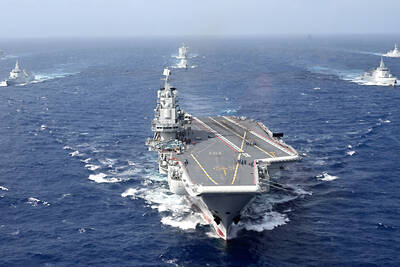
PROVOCATIVE: Chinese Deputy Ambassador to the UN Sun Lei accused Japan of sending military vessels to deliberately provoke tensions in the Taiwan Strait China denounced remarks by Japan and the EU about the South China Sea at a UN Security Council meeting on Monday, and accused Tokyo of provocative behavior in the Taiwan Strait and planning military expansion. Ayano Kunimitsu, a Japanese vice foreign minister, told the Council meeting on maritime security that Tokyo was seriously concerned about the situation in the East China and South China seas, and reiterated Japan’s opposition to any attempt to change the “status quo” by force, and obstruction of freedom of navigation and overflight. Stavros Lambrinidis, head of the EU delegation to the UN, also highlighted South China Sea
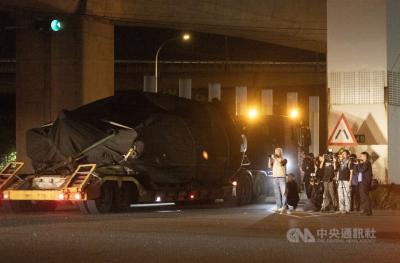
The final batch of 28 M1A2T Abrams tanks purchased from the US arrived at Taipei Port last night and were transported to the Armor Training Command in Hsinchu County’s Hukou Township (湖口), completing the military’s multi-year procurement of 108 of the tanks. Starting at 12:10am today, reporters observed more than a dozen civilian flatbed trailers departing from Taipei Port, each carrying an M1A2T tank covered with black waterproof tarps. Escorted by military vehicles, the convoy traveled via the West Coast Expressway to the Armor Training Command, with police implementing traffic control. The army operates about 1,000 tanks, including CM-11 Brave Tiger
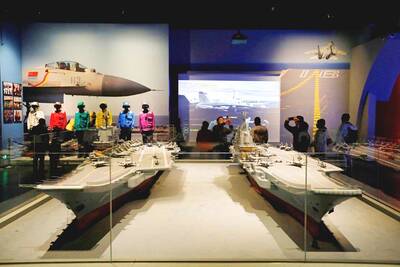
China on Wednesday teased in a video an aircraft carrier that could be its fourth, and the first using nuclear power, while making an allusion to Taiwan and vowing to further build up its islands, as it looks to boost maritime power, secure resources and bolster territorial claims. The video, issued on the eve of the 77th founding anniversary of the Chinese People’s Liberation Army Navy, featured fictional officers with names that are homophones of three commissioned aircraft carriers, the Liaoning (遼寧), Shandong (山東) and Fujian (福建). Titled Into the Deep, it showed a 19-year-old named “Hejian” (何劍) joining the group, sparking


 RSS
RSS