


The Ministry of Foreign Affairs yesterday expressed its gratitude to a British foreign affairs official who on Tuesday reiterated the British government’s long-standing policy of referring to the nation as “Taiwan.”
Asked by British lawmakers Andrea Jenkyns and Robert Blackman about China pressuring British Airways and other international airlines to list Taiwan as a part of China on their Web sites, British Minister of State for Asia and the Pacific Mark Field said that the British government’s long-standing policy on Taiwan has not changed.
“The government refers to Taiwan as simply ‘Taiwan’ and, when included in a list of places, does so under an inclusive heading, such as ‘country/territory’ or ‘world locations,’” Field said in a written response to the lawmakers.
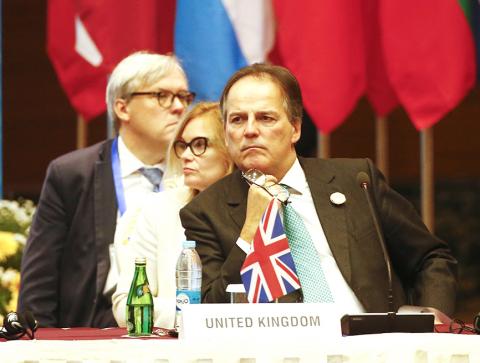
Photo: EPA
He also made clear the UK’s stance on Beijing’s move, saying that private companies and organizations should be able to decide the terminology that they use to list destinations.
“UK companies should not be placed under political pressure to make changes. Foreign and Commonwealth Office officials have registered our concern with the Chinese government on this point,” Field wrote.
Asked for comment, ministry spokesman Andrew Lee (李憲章) expressed gratitude toward Field for his remarks.
“The government refuses to accept China’s unreasonable and barbarous behavior, and the ministry will continue to lobby like-minded countries through our overseas representative offices to support Taiwan and join us in defending the universal values of democracy, freedom and the rule of law,” Lee told a regular news conference in Taipei.
He called on more like-minded nations to support Taiwan and reject China’s bullying to demonstrate the international community’s determination to defend universal values.
The British lawmakers’ question came after the Chinese Civil Aviation Administration in late April sent letters to international airlines demanding that they change references to Taiwan, Hong Kong and Macau on their Web sites and in other company materials within 30 days, or suffer repercussions for “serious discreditable conduct.”
Beijing originally set May 25 as the deadline for the changes, which it later extended to July 25, warning that failure to comply would have consequences.
The White House on May 5 denounced China’s demand as “Orwellian nonsense.”
A group of US senators in May sent a letter to two US airlines that received the demand to pledge their willingness to defend the companies’ integrity.
The ministry last month said that it is considering international litigation to safeguard the nation’s dignity and global status.
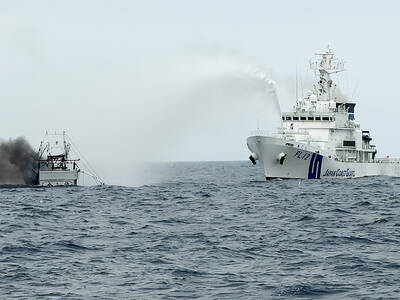
CREDIT-GRABBER: China said its coast guard rescued the crew of a fishing vessel that caught fire, who were actually rescued by a nearby Taiwanese boat and the CGA Maritime search and rescue operations do not have borders, and China should not use a shipwreck to infringe upon Taiwanese sovereignty, the Coast Guard Administration (CGA) said yesterday. The coast guard made the statement in response to the China Coast Guard (CCG) saying it saved a Taiwanese fishing boat. The Chuan Yu No. 6 (全漁6號), a fishing vessel registered in Keelung, on Thursday caught fire and sank in waters northeast of Diaoyutai Islands (釣魚台). The vessel left Keelung’s Badouzih Fishing Harbor (八斗子漁港) at 3:35pm on Sunday last week, with seven people on board — a 62-year-old Taiwanese captain surnamed Chang (張) and six
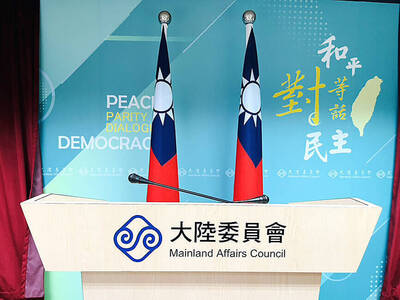
RISKY BUSINESS: The ‘incentives’ include initiatives that get suspended for no reason, creating uncertainty and resulting in considerable losses for Taiwanese, the MAC said China’s “incentives” failed to sway sentiment in Taiwan, as willingness to work in China hit a record low of 1.6 percent, a Ministry of Labor survey showed. The Directorate-General of Budget, Accounting and Statistics (DGBAS) also reported that the number of Taiwanese workers in China has nearly halved from a peak of 430,000 in 2012 to an estimated 231,000 in 2024. That marked a new low in the proportion of Taiwanese going abroad to work. The ministry’s annual survey on “Labor Life and Employment Status” includes questions respondents’ willingness to seek employment overseas. Willingness to work in China has steadily declined from

LEVERAGE: China did not ‘need to fire a shot’ to deny Taiwan airspace over Africa when it owns ‘half the continent’s debt,’ a US official said, calling it economic warfare The EU has raised concerns about overflight rights following the delay of President William Lai’s (賴清德) planned state visit to the Kingdom of Eswatini after three African nations denied overflight clearance for his charter at the last minute. Taiwanese allies Paraguay and Saint Kitts and Nevis, as well as several US lawmakers and the Inter-Parliamentary Alliance on China (IPAC) condemned China for allegedly pressuring the countries. Lai was scheduled to fly directly to Taiwan’s only African ally from yesterday to Sunday to celebrate the 40th anniversary of King Mswati III’s accession and his 58th birthday, but Seychelles, Mauritius and Madagascar suddenly revoked

The number of pet cats in Taiwan surpassed that of pet dogs for the first time last year, reaching 1,742,033, a 32.8 percent increase from 2023, the Ministry of Agriculture said yesterday, citing a survey. By contrast, the number of pet dogs declined slightly by 1.2 percent over the same period to 1,462,528, the ministry said. Despite the shift, households with dogs still slightly outnumber those with cats by 1.2 percent. However, while the number of households with multiple dogs has remained relatively stable, households keeping more than two cats have increased, contributing to the overall rise in the feline population. The trend


 RSS
RSS