


Taiwan’s top priority is to obtain an exemption from the US’ aluminum and steel tariffs, but Washington is still considering the issue, Minister Without Portfolio John Deng (鄧振中) said yesterday.
Deng made the remarks at a news conference after meeting with US officials at a SelectUSA summit held by the US Department of Commerce.
Deng led a 124-strong delegation representing 60 businesses, the nation’s largest ever, to the summit.
US Secretary of Commerce Wilbur Ross touched on Formosa Plastics Group’s (台塑集團) investments in the US, and the department held a small conference to discuss Hon Hai Precision Industry Co’s (鴻海精密) investment plans in Wisconsin, which are signs that Washington is giving Taiwanese businesses a fair share of attention, Deng said.
Deng also met with officials from other US government agencies, including those from the US Department of Energy, as well as members of the US Senate Committee on Finance and US Representative Ted Yoho, who is chairman of the US House of Representatives Foreign Affairs Subcommittee on Asia and the Pacific.
However, he did not meet with Office of the US Trade Representative officials, as he had done so last month at the Asia-Pacific Economic Cooperation summit in Papua New Guinea, Deng said.
Taiwan is a also a victim of China’s excessive production of steel, he said, adding that he explained to US officials Taipei’s measures to offset the negative effects of the Chinese excess.
US officials told him that Washington is still “considering its options” on the matter, Deng said.
The excess in Chinese steel production has upset international steel prices, while Taiwan’s steel production has remained stagnant, Deng said, adding that the government is seeking to reduce the sector’s reliance on China.
In response to the US’ call to other nations to help it counter China’s infringement of intellectual property rights, the delegation expressed its willingness to cooperate with the US on the grounds that China’s disregard for intellectual property has contravened the WHO’s Agreement on Trade-Related Aspects of Intellectual Property Rights, Deng said.
Taiwan aims to protect its intellectual property rights, he added.
Beijing’s heavy-handed approach on acquiring intellectual property rights subsidies and purchases could present opportunities for Taiwanese intellectual property owners in the short term, but it would affect local industry in the long run, Deng added.
In related news, CPC Corp, Taiwan (CPC, 台灣中油) at the summit signed heads of agreement (HOA) with Cheniere Energy Inc to purchase 2 million tonnes of liquified natural gas annually.
The deal is expected to deepen ties between Taiwan and the US, the company said.
As the government’s energy policy is focused on developing renewable energy sources, the HOAs would help diversify the nation’s energy sources and improve energy stability, Deng said.
He said he hopes his meeting with the energy department would expand business opportunities for the energy sector on both sides.
The nation last year purchased US$154 million of crude oil from the US, and has placed orders for US$2.31 billion of oil for the first eight months of this year, statistics compiled by the delegation showed.
No records on crude oil imports from the US prior to last year were available.
Additional reporting by Nadia Tsao
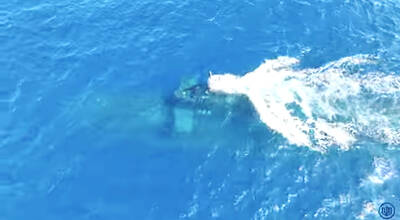
CSBC Corp, Taiwan (台灣國際造船) yesterday released the first video documenting the submerged sea trials of Taiwan’s indigenous defense submarine prototype, the Hai Kun (海鯤), or Narwhal, showing underwater navigation and the launch of countermeasures. The footage shows the vessel’s first dive, steering and control system tests, and the raising and lowering of the periscope and antenna masts. It offered a rare look at the progress in the submarine’s sea acceptance tests. The Hai Kun carried out its first shallow-water diving trial late last month and has since completed four submerged tests, CSBC said. The newly released video compiles images recorded from Jan. 29 to
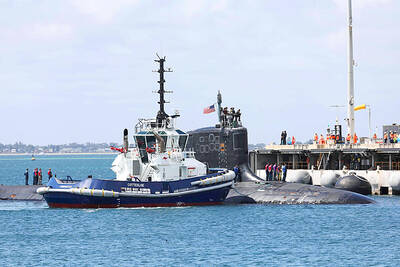
DETERRENCE EFFORTS: Washington and partners hope demonstrations of force would convince Beijing that military action against Taiwan would carry high costs The US is considering using HMAS Stirling in Western Australia as a forward base to strengthen its naval posture in a potential conflict with China, particularly over Taiwan, the Wall Street Journal reported on Saturday. As part of its Indo-Pacific strategy, Washington plans to deploy up to four nuclear-powered submarines at Stirling starting in 2027, providing a base near potential hot spots such as Taiwan and the South China Sea. The move also aims to enhance military integration with Pacific allies under the Australia-UK-US trilateral security partnership, the report said. Currently, US submarines operate from Guam, but the island could
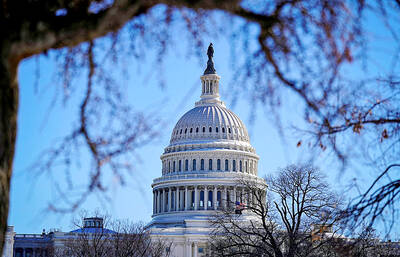
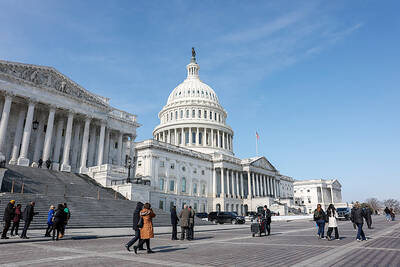
RESTRAINTS: Should China’s actions pose any threat to Taiwan’s security, economic or social systems, China would be excluded from major financial institutions, the bill says The US House of Representatives on Monday passed the PROTECT Taiwan Act, which states that Washington would exclude China from participating in major global financial organizations if its actions directly threaten Taiwan’s security. The bill, proposed by Republican Representative Frank Lucas, passed with 395 votes in favor and two against. It stipulates that if China’s actions pose any threat to Taiwan’s security, economic or social systems, the US would, “to the maximum extent practicable,” exclude Beijing from international financial institutions, including the G20, the Bank for International Settlements and the Financial Stability Board. The bill makes it clear that China must be prepared
The partisan standoff over President William Lai’s (賴清德) proposed defense budget has raised questions about the nation’s ability to adequately fund its own defense, the US Congressional Research Service (CRS) said in a report released on Tuesday. The report, titled Taiwan: Defense and Military Issues, said the government has increased its defense budget at an average annual rate of 5 percent from 2019 to 2023, with about 2.5 percent of its GDP spent on defense in 2024. Lai in November last year proposed a special budget of about US$40 billion over eight years, and said he intends to increase defense spending to


 RSS
RSS