


Taiwanese’s favorite nation is Singapore, followed by Japan and Canada, while China is their third-least favorite, a survey released yesterday by the Taiwanese Public Opinion Foundation found.
When asked about their impression of Singapore, 88.2 percent of the respondents said they have a good impression of the city-state, while 5.4 said they have a negative impression, the poll found.
The survey found that 84.6 percent of respondents have a favorable impression of Japan, while 11 percent have a negative impression of it.
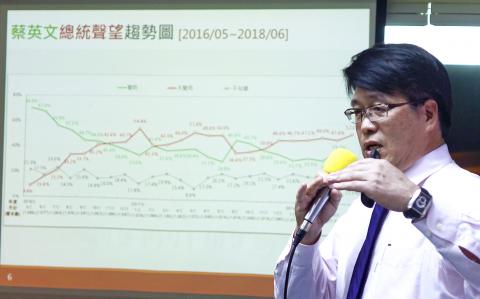
Photo: Wang Yi-sung, Taipei Times
As for Canada, 82.3 percent of respondents expressed a favorable impression, while 4.2 percent said they have a negative impression of it, the foundation said.
Respondents’ least favorite nation was North Korea, with 70.9 percent of respondents saying they have a negative impression of it, followed by the Philippines (52.9 percent) and China (43.9 percent).
However, Taiwanese’s impression of China has become more positive over the past year, the poll found.
For the first time, more Taiwanese said they have a good impression of China than those who said they have a bad impression of it, the foundation said.
Compared with a similar poll conducted last year, the percentage of respondents with a favorable impression of China rose from 44.4 to 48.8 percent, while the percentage of those with a negative impression of it fell from 47.4 to 43.9 percent, it said.
Nevertheless, 79.1 percent of respondents said China’s attempts to limit Taiwan’s international space are “unreasonable,” while 11.9 percent thought the opposite, the poll found.
When asked if they are confident that President Tsai Ing-wen’s (蔡英文) administration can defend the nation against such attempts, 32.7 percent said that they are confident, while 60.3 percent said they are not, the poll found.
The public’s views on other nations reflect their expectations for what they hope Taiwan can be, said Chen Yi-chien (陳宜倩), a professor at Shih Hsin University’s Graduate Institute for Gender Studies.
“Taiwanese like Singapore, because they have projected onto the nation their desire for a cleaner and more orderly society,” she said.
While Japan is still the most popular destination for Taiwanese tourists, the “Japan fever,” which swept the nation in the 1990s, has apparently calmed down in the past few years, said Chuang Chia-yin (莊佳穎), an associate professor at National Taiwan Normal University’s Department of Taiwan Culture, Languages and Literature.
In addition to South Korea, China is becoming an important source of culture, entertainment and consumer goods for Taiwan, as more Taiwanese are exposed to Chinese TV shows, such as the Voice of China (中國好聲音), she said, adding that this might have improved the public’s impression of that nation.
The telephone poll, conducted on Monday and Tuesday last week, collected 1,073 valid responses selected by random sampling. It has a margin of error of 2.99 percentage points and a confidence level of 95 percent.

A magnitude 7.0 earthquake struck off Yilan at 11:05pm yesterday, the Central Weather Administration (CWA) said. The epicenter was located at sea, about 32.3km east of Yilan County Hall, at a depth of 72.8km, CWA data showed There were no immediate reports of damage. The intensity of the quake, which gauges the actual effect of a seismic event, measured 4 in Yilan County area on Taiwan’s seven-tier intensity scale, the data showed. It measured 4 in other parts of eastern, northern and central Taiwan as well as Tainan, and 3 in Kaohsiung and Pingtung County, and 2 in Lienchiang and Penghu counties and 1
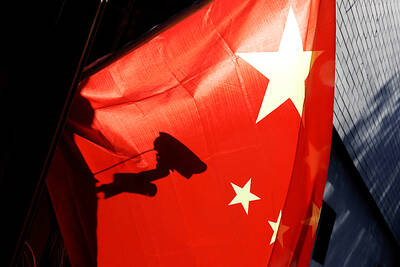
FOREIGN INTERFERENCE: Beijing would likely intensify public opinion warfare in next year’s local elections to prevent Lai from getting re-elected, the ‘Yomiuri Shimbun’ said Internal documents from a Chinese artificial intelligence (AI) company indicated that China has been using the technology to intervene in foreign elections, including propaganda targeting Taiwan’s local elections next year and presidential elections in 2028, a Japanese newspaper reported yesterday. The Institute of National Security of Vanderbilt University obtained nearly 400 pages of documents from GoLaxy, a company with ties to the Chinese government, and found evidence that it had apparently deployed sophisticated, AI-driven propaganda campaigns in Hong Kong and Taiwan to shape public opinion, the Yomiuri Shimbun reported. GoLaxy provides insights, situation analysis and public opinion-shaping technology by conducting network surveillance
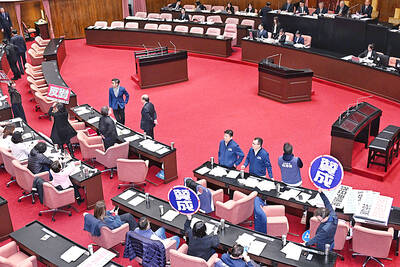
‘POLITICAL GAME’: DPP lawmakers said the motion would not meet the legislative threshold needed, and accused the KMT and the TPP of trivializing the Constitution The Legislative Yuan yesterday approved a motion to initiate impeachment proceedings against President William Lai (賴清德), saying he had undermined Taiwan’s constitutional order and democracy. The motion was approved 61-50 by lawmakers from the main opposition Chinese Nationalist Party (KMT) and the smaller Taiwan People’s Party (TPP), who together hold a legislative majority. Under the motion, a roll call vote for impeachment would be held on May 19 next year, after various hearings are held and Lai is given the chance to defend himself. The move came after Lai on Monday last week did not promulgate an amendment passed by the legislature that

Taiwan is gearing up to celebrate the New Year at events across the country, headlined by the annual countdown and Taipei 101 fireworks display at midnight. Many of the events are to be livesteamed online. See below for lineups and links: Taipei Taipei’s New Year’s Party 2026 is to begin at 7pm and run until 1am, with the theme “Sailing to the Future.” South Korean girl group KARA is headlining the concert at Taipei City Hall Plaza, with additional performances by Amber An (安心亞), Nick Chou (周湯豪), hip-hop trio Nine One One (玖壹壹), Bii (畢書盡), girl group Genblue (幻藍小熊) and more. The festivities are to


 RSS
RSS