


Olympic double gold medalist Hsu Shu-ching (許淑淨) yesterday announced she is retiring from weightlifting and would not compete in the Asian Games in August.
In a Facebook post, the 27-year-old cited long-standing knee problems and injuries sustained during last year’s World Weightlifting Championships as the reasons for her decision, which also meant she was reluctantly giving up her dreams of competing in the 2020 Tokyo Olympics, but would turn her attention to coaching a new generation of athletes.
“I am still recovering from serious injuries sustained last year and cannot undergo training in full. After discussing the matter with my coach, my doctor, the Chinese Taipei Weightlifting Association and leaders in various organizations, I have decided to withdraw from training for the Asian Games in Jakarta and end my career as an athlete,” she said.
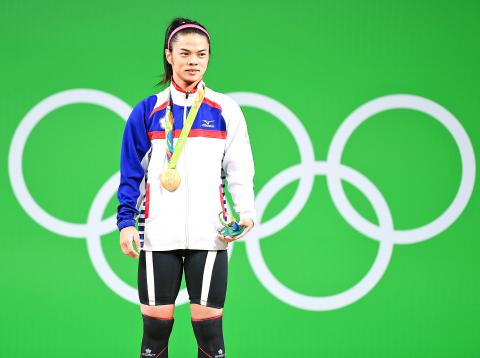
Photo: CNA
“Because of the government’s financial support, I will stay in the National Sports Training Center and assist Coach Tsai Wen-yee (蔡溫義) and other coaches in training young weightlifters. I will learn to be a good coach to help train more top athletes for the nation,” she said.
Hsu thanked her coach, the association, her sponsors and other parties for supporting her training so that she could do so well not only in the Olympics, but the 2014 Asian Games in Incheon, South Korea.
Government policy and support from others for weightlifting are crucial for athletes like her, Hsu said.
Hsu won a gold in the 53kg category at the 2012 London Games and the 2016 Rio De Janeiro Games, the first Taiwanese athlete to win two Olympic golds. She was scheduled to compete in the same category in Jakarta.
She said she hoped the public would continue to support her and cheer for the nation’s weightlifters in Jakarta.
Tsai, who won a bronze in the 60kg class in weightlifting at the 1984 Los Angeles Olympics, told the Central News Agency that Hsu’s retirement comes two years earlier than they had planned.
He and Hsu had originally planned that she would compete in the Tokyo Games, but he would respect her decision even though it was against his wishes, Tsai said.
Hsu tore two ligaments in her right arm during the world championships and underwent surgery after she returned to Taiwan.
Told rehabilitation would take a year, her recovery has not gone as she had expected, Hsu has said previously.
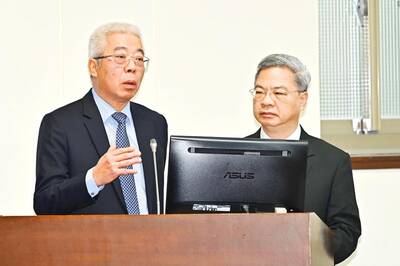
Taiwan has arranged for about 8 million barrels of crude oil, or about one-third of its monthly needs, to be shipped from the Red Sea this month to bypass the Strait of Hormuz and ease domestic supply pressures, CPC Corp, Taiwan (CPC, 台灣中油) said yesterday. The state-run oil company has worked with Middle Eastern suppliers to secure routes other than the Strait of Hormuz, through which about 20 percent of the world’s oil and liquefied natural gas typically passes, CPC chairman Fang Jeng-zen (方振仁) said at a meeting of the legislature’s Economics Committee in Taipei. Suppliers in Saudi Arabia have indicated they
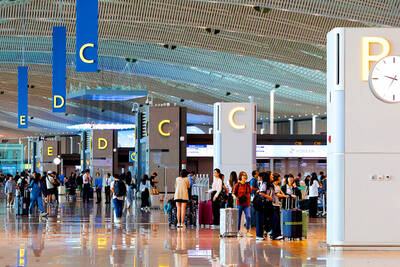
South Korea has adjusted its electronic arrival card system to no longer list Taiwan as a part of China, a move that the Ministry of Foreign Affairs said would help facilitate exchanges between the two sides. South Korea previously listed “Taiwan” as “Taiwan (China)” in the drop-down menus of its online arrival card system, where people had to fill out where they came from and their next destination. The ministry had requested South Korea make a revision and said it would change South Korea’s name on Taiwan’s online immigration system from “Republic of Korea” to “Korea (South),” should the issue not be
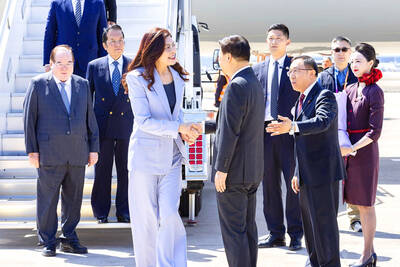
CCP ‘PAWN’? Beijing could use the KMT chairwoman’s visit to signal to the world that many people in Taiwan support the ‘one China’ principle, an academic said Chinese Nationalist Party (KMT) Chairwoman Cheng Li-wun (鄭麗文) yesterday arrived in China for a “peace” mission and potential meeting with Chinese President Xi Jinping (習近平), while a Taiwanese minister detailed the number of Chinese warships currently deployed around the nation. Cheng is visiting at a time of increased Chinese military pressure on Taiwan, as the opposition-dominated Legislative Yuan stalls a government plan for US$40 billion in extra defense spending. Speaking to reporters before going to the airport, Cheng said she was going on a “historic journey for peace,” but added that some people felt uneasy about her trip. “If you truly love Taiwan,
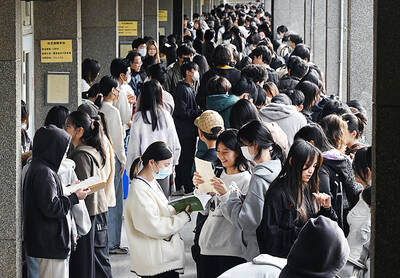
A global survey showed that 60 percent of Taiwanese had attained higher education, second only to Canada, the Ministry of the Interior said. Taiwan easily surpassed the global average of 43 percent and ranked ahead of major economies, including Japan, South Korea and the US, data from the Organisation for Economic Co-operation and Development (OECD) for 2024 showed. Taiwan has a high literacy rate, data released by the ministry showed. As of the end of last year, Taiwan had 20.617 million people aged 15 or older, accounting for 88.5 percent of the total population, with a literacy rate of 99.4 percent, the data


 RSS
RSS