


The US Department of State on Friday again expressed concern over the People’s Republic of China’s (PRC) lack of military transparency and reiterated its opposition to attempts to change the “status quo” in the Taiwan Strait, after Chinese military aircraft circled around Taiwan.
“The United States remains concerned by China’s lack of transparency about its growing military capabilities and associated strategic intentions,” a department spokesperson said in an e-mailed response to queries by Taiwanese media. “The United States opposes unilateral actions by any party aimed at altering the status quo, including any resort to force or other forms of coercion.”
The US has a deep and abiding interest in cross-strait peace and stability and encourages Taipei and Beijing to engage in constructive dialogue that pursues a peaceful resolution of differences acceptable to the people on both sides of the Strait, they added.
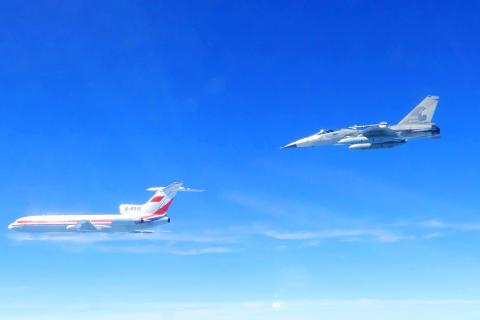
Photo: AFP / Ministry of National Defense
China has increased its military activities near Taiwan over the past year, widely seen as part of its efforts to step up pressure on the administration of President Tsai Ing-wen (蔡英文), who has refused to accept the so-called “1992 consensus.”
The “1992 consensus” — a term former Mainland Affairs Council chairman Su Chi (蘇起) admitted making up in 2000 — refers to a tacit understanding between the Chinese Nationalist Party (KMT) and the Chinese Communist Party that both sides acknowledge that there is “one China,” with each side having its own interpretation of what “China” means.
In the latest incident on Friday, the Chinese People’s Liberation Army Air Force conducted a long-range drill with aircraft circling Taiwan in opposite directions, according to information released by the Taiwanese and Chinese militaries.
Involved in the exercise were the Xian H-6K bomber, Su-35 and J-11 fighters, the Shaanxi Y-8 transport plane, the Kj-2000 early warning aircraft and Tu-154 electronic surveillance aircraft, but neither Taipei nor Beijing disclosed the number of aircraft involved.
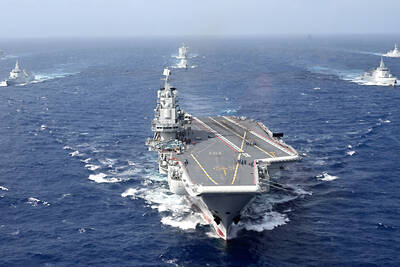
PROVOCATIVE: Chinese Deputy Ambassador to the UN Sun Lei accused Japan of sending military vessels to deliberately provoke tensions in the Taiwan Strait China denounced remarks by Japan and the EU about the South China Sea at a UN Security Council meeting on Monday, and accused Tokyo of provocative behavior in the Taiwan Strait and planning military expansion. Ayano Kunimitsu, a Japanese vice foreign minister, told the Council meeting on maritime security that Tokyo was seriously concerned about the situation in the East China and South China seas, and reiterated Japan’s opposition to any attempt to change the “status quo” by force, and obstruction of freedom of navigation and overflight. Stavros Lambrinidis, head of the EU delegation to the UN, also highlighted South China Sea
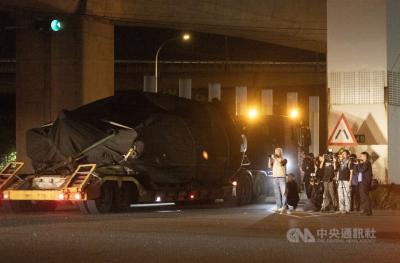
The final batch of 28 M1A2T Abrams tanks purchased from the US arrived at Taipei Port last night and were transported to the Armor Training Command in Hsinchu County’s Hukou Township (湖口), completing the military’s multi-year procurement of 108 of the tanks. Starting at 12:10am today, reporters observed more than a dozen civilian flatbed trailers departing from Taipei Port, each carrying an M1A2T tank covered with black waterproof tarps. Escorted by military vehicles, the convoy traveled via the West Coast Expressway to the Armor Training Command, with police implementing traffic control. The army operates about 1,000 tanks, including CM-11 Brave Tiger
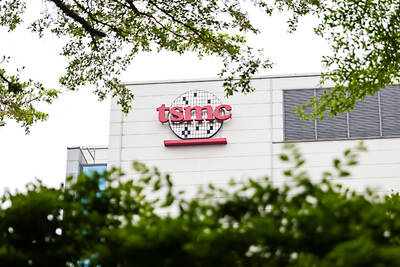
Taiwan Semiconductor Manufacturing Co (TSMC, 台積電), the world’s largest contract chipmaker, said it expects its 2-nanometer (2nm) chip capacity to grow at a compound annual rate of 70 percent from this year to 2028. The projection comes as five fabs begin volume production of 2-nanometer chips this year — two in Hsinchu and three in Kaohsiung — TSMC senior vice president and deputy cochief operating officer Cliff Hou (侯永清) said at the company’s annual technology symposium in Silicon Valley, California, last week. Output in the first year of 2-nanometer production, which began in the fourth quarter of last year, is expected to
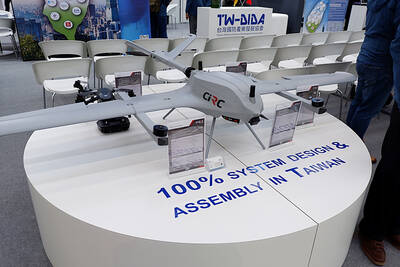
Taiwan’s drone exports surged past US$100 million in the first quarter, exceeding last year’s full-year total, with the Czech Republic emerging as the largest buyer, the Ministry of Economic Affairs said. Exports of complete drones reached US$115.85 million in the period, about 1.2 times the total recorded for all of last year, the ministry said in a report. Exports to the Czech Republic accounted for about US$100 million, far outpacing other markets. Poland, last year’s top destination, recorded about US$11.75 million in the first quarter. Taiwan’s drone exports have expanded rapidly in the past few years, with last year’s total


 RSS
RSS