


The Executive Yuan yesterday approved 43 draft amendments to the Organizational Act of the Executive Yuan (行政院組織法), which, if passed by legislators, would implement a long-awaited restructuring of government, including upgrading the Environmental Protection Administration (EPA) to a ministry of environmental resources.
According to the draft amendments, the ministry of environmental resources would take over part of the responsibilities that fall under the Council of Agriculture (COA), the Ministry of Economic Affairs and the Ministry of Transportation and Communications (MOTC).
Those include forestry and wildlife conservation, water and soil conservation, and weather forecasting.
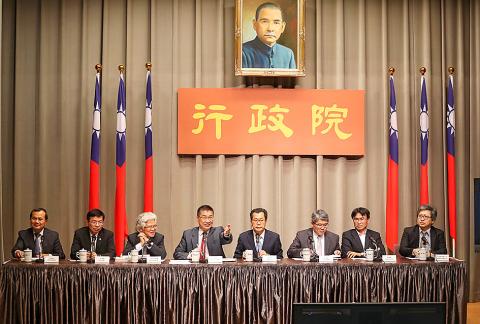
Photo: CNA
Unlike other agencies involved in the restructuring, the proposed environment ministry would be practically an entirely new agency rather than the product of an internal reorganization, Directorate-General of Personnel Administration Minister Jay Shih (施能傑) told a news conference in Taipei.
The Central Weather Bureau would become a central weather administration under the environment ministry, the draft amendments say.
EPA agencies in charge of regulating toxic substances and conducting environmental inspections are to become the toxic substances and chemicals administration and the environmental management bureau.
A new research institute of biodiversity and forest protection is also to be created under the new environment ministry, Shih said.
Water management tasks relating to economic development — including the appropriation of water for industrial use and river remediation projects — would remain within the purview of the Ministry of Economic Affairs, he said.
Responding to media queries, EPA Minister Lee Ying-yuan (李應元) denied that the proposed new ministry would be a “grand ministry,” saying its budget is likely to be far smaller than the budgets allocated to the MOTC, the Ministry of the Interior and the Ministry of National Defense.
The tasks of the new ministry — responding to climate change and cutting carbon dioxide emissions — would be highly challenging, meaningful and in line with global trends, he said, as he thanked employees at the other agencies for their willingness to become part of the new ministry.
According to the amendments, the interior ministry would continue to govern national parks, a proposal that Deputy Minister of the Interior Hua Ching-chun (花敬群) lauded, saying that it is “better equipped” to take care of the parks, especially when it comes to formulating construction management and urban renewal plans.
The draft amendments also seek to adjust the responsibilities of the Construction and Planning Agency, which is expected to be become a national land management administration.
The amendments also propose upgrading the COA to a ministry of agriculture with three new agencies.
They are the water resources agency for farming communities and irrigation, the agricultural services and financing administration, and the agricultural science parks management office.
The proposed amendments embody the “final piece of the puzzle” for restructuring the government, Shih said.
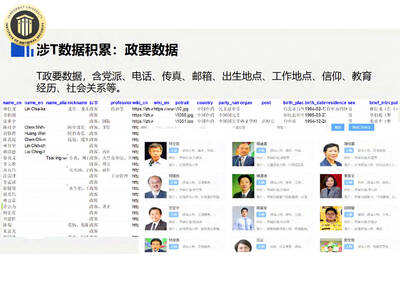
NETWORK-MAPPING PROJECT: The database contains 170 detailed files of Taiwanese politicians and about 23 million records of household registration data in Taiwan China has developed a network-mapping project targeting political figures and parties in Taiwan to monitor public opinion during elections and to craft tailored influence campaigns aimed at dividing Taiwanese society, according to documents leaked by Chinese technology firm GoLaxy (中科天璣). The documents, collected by Taipei-based Doublethink Lab, showed a database was specifically created to gather detailed information on Taiwanese political figures, including their political affiliations, job histories, birthplaces, residences, education, religion and a brief biography about them. Several notable Taiwanese politicians are in the database, including President William Lai (賴清德), former president Tsai Ing-wen (蔡英文), Minister of Foreign Affairs Lin Chia-lung (林佳龍),
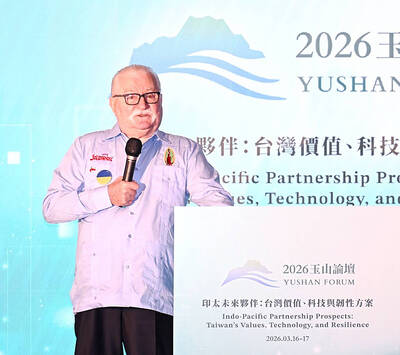
RECOGNITION: Former Fijian prime minister Mahendra Chaudhry said that Taiwan’s New Southbound Policy serves as a stabilizing force in the Indo-Pacific region Taiwan can lead the unification of the Chinese people, Nobel Peace Prize laureate and former Polish president Lech Walesa said in Taipei yesterday, adding that as the world order is changing, peaceful discussion would find good solutions, and that the use of force and coercion would always fail. Walesa made the remarks during his keynote address at a luncheon of the Yushan Forum in Taipei, titled “Indo-Pacific Partnership Prospects: Taiwan’s Values, Technology and Resilience,” organized by the Taiwan-Asia Exchange Foundation with the Ministry of Foreign Affairs. Walesa said that he had been at the forefront of a big peaceful revolution and “if
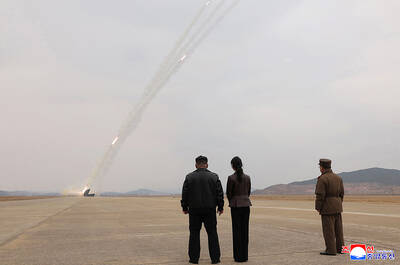
North Korea tested nuclear-capable rocket launchers, state media reported yesterday, a day after Seoul detected the launch of about 10 ballistic missiles. The test comes after South Korean and US forces launched their springtime military drills, due to run until Thursday. North Korean leader Kim Jong-un on Saturday oversaw the testing of the multiple rocket launcher system (MRLS), the Korean Central News Agency (KCNA) said. The test involved 12 600mm-caliber ultra-precision multiple rocket launchers and two artillery companies, it said. Kim said the drill gave Pyongyang’s enemies, within the 420km striking range, a sense of “uneasiness” and “a deep understanding

North Korea yesterday fired about 10 ballistic missiles to the sea toward Japan, the South Korean Joint Chiefs of Staff (JCS) said, days after Pyongyang warned of “terrible consequences” over ongoing South Korea-US military drills. Pyongyang recently dashed hopes of a diplomatic thaw with Seoul, Washington’s security ally, describing its latest peace efforts as a “clumsy, deceptive farce.” Seoul’s military detected “around 10 ballistic missiles launched from the Sunan area in North Korea toward the East Sea [Sea of Japan] at around 1:20pm,” JCS said in a statement, referring to South Korea’s name for the body of water. The missiles


 RSS
RSS