


An Air China Ltd (中國國際航空) flight bound for Beijing was yesterday diverted to central China after a passenger held a flight attendant hostage using a pen as a weapon, authorities said.
All passengers and crew on Flight 1350 made it safely off the plane after it landed in Zhengzhou, Henan Province, at 10am due to what had earlier been described by authorities as an unspecified “illegal interference.”
The flight had taken off at 8:40am from Changsha, Hunan Province, and was scheduled to land in Beijing at 11am.
The Civil Aviation Authority of China said in a statement on its Web site that the plane was diverted when a male passenger held a flight attendant hostage.
It said only that “the matter was successfully handled” by 1:17pm, but did not provide any details.
Police in Zhengzhou said in a statement that the alleged hostage-taker has a history of mental illness and experienced an unspecified “sudden” psychological disorder when he grabbed the flight attendant.
It identified the man only by his surname, Xu (徐), and said he was 41 and from Anhua County in Hunan.
Police arrested him at about 1pm, the statement said.
In a brief report on Weibo, state broadcaster China Central Television shared an image of what appeared to be paramilitary police in combat uniforms and helmets assembled outside a Zhengzhou airport hotel and another image of several ambulances.
The airline said police and aviation authorities were handling the matter and refused to provide further information.
Beijing News said on Weibo that a passenger described being awoken by a scream coming from the front of the plane and that “nobody knew what was going on.”
The Xiaoxiang Morning Herald quoted a passenger as saying that the disturbance occurred in the first or business class cabins, but that the curtains separating those sections from economy class were pulled tightly shut.
She looked out the window and saw many police cars, ambulances and fire engines parked outside the plane as it was landing in Zhengzhou, the newspaper said on Weibo.
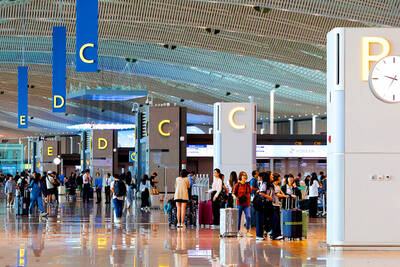
South Korea has adjusted its electronic arrival card system to no longer list Taiwan as a part of China, a move that the Ministry of Foreign Affairs said would help facilitate exchanges between the two sides. South Korea previously listed “Taiwan” as “Taiwan (China)” in the drop-down menus of its online arrival card system, where people had to fill out where they came from and their next destination. The ministry had requested South Korea make a revision and said it would change South Korea’s name on Taiwan’s online immigration system from “Republic of Korea” to “Korea (South),” should the issue not be

Tainan, Taipei and New Taipei City recorded the highest fines nationwide for illegal accommodations in the first quarter of this year, with fines issued in the three cities each exceeding NT$7 million (US$220,639), Tourism Administration data showed. Among them, Taipei had the highest number of illegal short-term rental units, with 410. There were 3,280 legally registered hotels nationwide in the first quarter, down by 14 properties, or 0.43 percent, from a year earlier, likely indicating operators exiting the market, the agency said. However, the number of unregistered properties rose to 1,174, including 314 illegal hotels and 860 illegal short-term rental
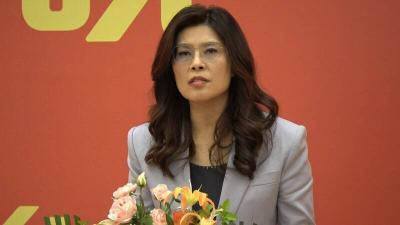
Both sides of the Taiwan Strait share a political foundation based on the “1992 consensus” and opposition to Taiwanese independence, Chinese Nationalist Party (KMT) Chairwoman Cheng Li-wun (鄭麗文) today said during her meeting with Chinese President Xi Jinping (習近平). Both sides of the Strait should plan and build institutionalized and sustainable mechanisms for dialogue and cooperation based on that foundation to make peaceful development across the Strait irreversible, she said. Peace is a shared moral value across the Strait, and both sides should move beyond political confrontation to seek institutionalized solutions to prevent war, she said. Mutually beneficial cross-strait relations are what the
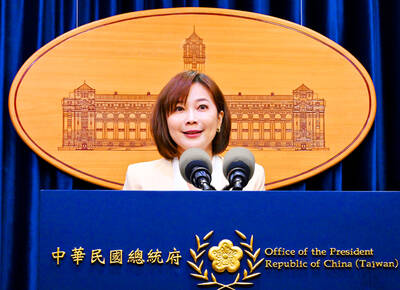
ECONOMIC COERCION: Such actions are often inconsistently applied, sometimes resumed, and sometimes just halted, the Presidential Office spokeswoman said The government backs healthy and orderly cross-strait exchanges, but such arrangements should not be made with political conditions attached and never be used as leverage for political maneuvering or partisan agendas, Presidential Office spokeswoman Karen Kuo (郭雅慧) said yesterday. Kuo made the remarks after China earlier in the day announced 10 new “incentive measures” for Taiwan, following a landmark meeting between Chinese President Xi Jinping (習近平) and Chinese Nationalist Party (KMT) Chairwoman Cheng Li-wun (鄭麗文) in Beijing on Friday. The measures, unveiled by China’s Xinhua news agency, include plans to resume individual travel by residents of Shanghai and China’s Fujian


 RSS
RSS