


President Tsai Ing-wen (蔡英文) yesterday praised a military drill she observed in waters off eastern Taiwan and denied she was trying to upstage Chinese President Xi Jinping (習近平) as China prepares to hold military exercises in the Taiwan Strait.
“The military has done a great job in the joint exercise, in which it has fully demonstrated its capabilities to conduct asymmetric warfare and gain naval supremacy [in the Taiwan Strait]. It was impressive,” Tsai said after the drill.
Tsai boarded the Kidd-class destroyer Keelung at Chungcheng Base (中正基地) in Yilan County’s Suao (蘇澳) and sailed to watch the offshore combat readiness exercise involving the three branches of the military.
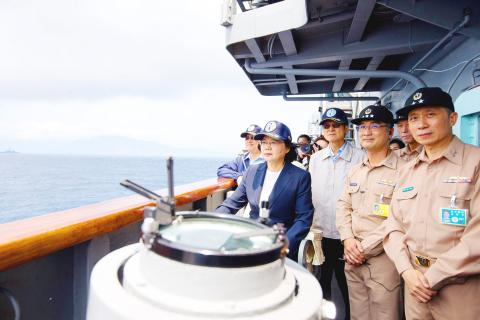
Photo: CNA, Courtesy of the Military News Agency
It was her first time on a warship since taking office in May 2016.
When asked whether the timing of her appearance was intended to outshine Xi, Tsai said: “There is no need to ‘overreact’ to the event.”
“It was just a routine military readiness exercise, marking the start of a series of drills, as the military never rests during the year,” she said.
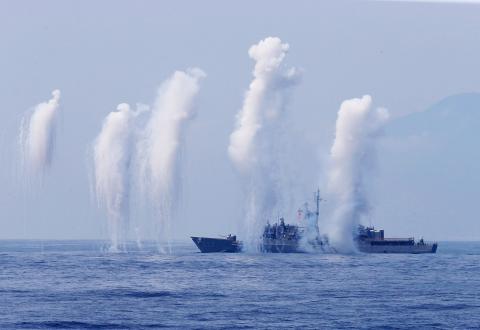
Photo: CNA, Courtesy of the Military News Agency
The Chinese People’s Liberation Army is to hold a live-fire military exercise in the Taiwan Strait on Wednesday, when Tsai is to be away from Taiwan on a visit to Swaziland, one of the nation’s two diplomatic allies in Africa.
She leaves on Tuesday and returns on Saturday next week.
“I have confidence in our military,” Tsai said. “My plan to visit Swaziland will not be affected.”
During yesterday’s drill, held to test the nation’s combat readiness and rapid response capabilities, the military simulated a response to invading forces attempting to seize Taiwan’s major sea ports through air and naval attacks.
The navy dispatched 20 vessels in coordination with eight air force F-16s and 2,500 army troops in a joint sea-and-air exercise to repel the simulated attacks.
Xi on Thursday spoke about the importance of Chinese naval power while attending a massive fleet review in the South China Sea.
China on Thursday also announced the live-fire military exercise it plans to hold in the Taiwan Strait on Wednesday.
In response to Beijing’s announcement, the US Department of State on Thursday reiterated Washington’s opposition to unilateral actions by any party aimed at altering the cross-strait “status quo,” including any use of force or other forms of coercion.
The Mainland Affairs Council has said China’s drills would not go down well with the Taiwanese public and urged China to engage in rational communication to ensure peace across the Taiwan Strait.
Additional reporting by Reuters and AP

The National Chungshan Institute of Science and Technology yesterday showcased its locally developed variants of the Vision 60 robotic patrol dog, which it plans to deploy on the nation’s outlying territories in the South China Sea. The variants were produced under the Joint Lab project — created by the institute and domestic companies — and assembled with domestically produced motors, lenses and artificial intelligence (AI) systems alongside licensed tech from the US, Missile and Rocket Systems Research Division deputy director Jen Kuo-kang (任國光) told the media event at a military base in Taipei’s Dazhi (大直) area. Taiwan has built up its strengths

RIGHT DIRECTION: Taiwan’s efforts to prevent forced labor include a proposal to ‘fully prohibit’ employers from withholding workers’ documents, an official said Taiwan is to establish a mechanism to restrict imports of goods linked to forced labor, the Executive Yuan said yesterday, after the US proposed imposing additional tariffs on Taiwanese goods over labor concerns. “The Ministry of Labor and the Ministry of Economic Affairs are to establish an interministerial review procedure,” Executive Yuan spokesperson Michelle Lee (李慧芝) said at a news briefing in Taipei. “The government is to use the Foreign Trade Act [貿易法] as the legal basis to restrict imports of goods produced with forced labor” and bring its supply chain governance more in line with international standards on human rights, resilience
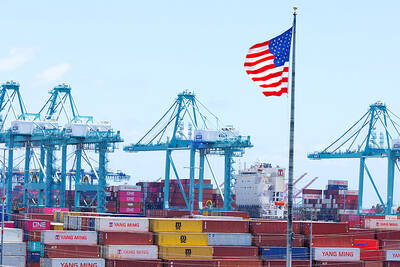
NOT IMMEDIATE: Taiwan has a chance to appeal the proposed 10 percent tariff before it starts, while other countries face a 12.5 percent tariff from the trade office Taiwan is among 60 economies determined by the US to have failed to impose or enforce a ban on the importation of goods produced with forced labor, according to a notice released on Tuesday by the Office of the US Trade Representative (USTR), which proposed imposing an additional 10 percent or more tariff on them. The USTR in a statement said that following an investigation, it had determined under Section 301 of the Trade Act of 1974 that the failure of the 60 economies to impose and effectively enforce a prohibition on the importation of goods produced with forced labor is
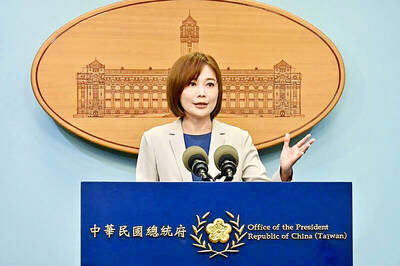
TIT-FOR-TAT: The US allegedly revoked the visa of a Chinese national working at Xinhua News Agency in the US in response to Beijing’s expulsion of Vivian Wang The Presidential Office yesterday condemned China for expelling a New York Times correspondent from Beijing following the newspaper’s interview with President William Lai (賴清德), saying the move highlighted Beijing’s suppression of press freedom and its threat to international news media. Taiwan has noted a series of recent incidents in which Beijing used similar tactics to “threaten and pressure international media outlets and journalists,” Presidential Office spokeswoman Karen Kuo (郭雅慧) said in a statement. “This concerns not only press freedom and freedom of expression, but also the safety of journalists, and Taiwan and relevant partners are paying close attention to the situation,” she


 RSS
RSS