


Premier William Lai (賴清德) yesterday reiterated his position on Taiwanese independence and called on China to respect freedom of speech, as Beijing ramped up its rhetoric.
Democracy signifies freedom to express one’s opinion on the direction that the country’s development should take and to advocate Taiwanese independence if they wish to, Lai said.
Free speech is valued all over the world and should therefore be protected in China as well, the premier added.
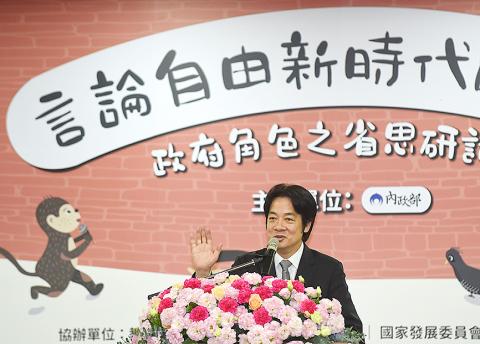
Photo: Liu Hsin-de, Taipei Times
The latest verbal sparring was prompted by Lai’s comment on Friday at the Legislative Yuan that he was a “Taiwan independence worker” and that Taiwan is a sovereign, independent country, sparking a call by the Chinese tabloid Global Times for his prosecution under China’s 2005 “Anti-Secession” Law.
“If evidence of his crimes are cast iron, then a global wanted notice can be issued for him,” the paper, published by the Chinese Communist Party’s official People’s Daily, wrote on Saturday.
China’s Taiwan Affairs Office weighed in late on Monday, saying Lai’s comments were “dangerous and presumptuous,” harming peace and stability across the Taiwan Strait, and that Taiwan would never be separated from China.
Lai yesterday stressed the importance of free speech at a forum organized by the Ministry of the Interior ahead of Freedom of Expression Day on Saturday.
“I absolutely am a ‘Taiwan independence worker,’” he said in Hoklo (commonly known as Taiwanese). “But it is out of respect for [late democracy pioneer] Deng Nan-jung (鄭南榕) that I do not say ‘I advocate Taiwanese independence.’ I am a follower, which is why I do this work.”
Lai said Chinese President Xi Jinping (習近平) took a cue from former president Chiang Kai-shek (蔣介石) in abolishing presidential term limits, and the abduction of Taiwanese democracy activist Lee Ming-che (李明哲) by Chinese authorities in March last year is evidence of the current state of Chinese society.
China now is like Taiwan during the Martial Law era when the Chinese Nationalist Party (KMT) held a monopoly on power, he said.
Separately, the Mainland Affairs Council said the Global Times’ and Chinese government’s comments were “intimidating and irrational.”
“Taiwan is a democratic, pluralistic society,” the council said, adding that Lai had consistently followed President Tsai Ing-wen’s (蔡英文) policy of maintaining peace and stability across the Taiwan Strait.
China “has repeatedly manipulated the media and so-called ‘Internet users’ to threaten and repress Taiwan’s government and people, trying to use military blows and legal threats to violate our dignity and interests,” the council said.
“This is not what a responsible party should be doing. It will only increase cross-strait antagonism and damage relations,” it added.
“Over the past two years, our government has not ‘felt animosity toward China,’” it said.
“But mainland China must face up to the reality of the separate governments on both sides of the Taiwan Strait and respect Taiwan’s democracy and the will of its people,” the council said.

A signaling system malfunction disrupted high-speed rail (HSR) services beginning at 8am today, with trains temporarily reduced to three northbound and three southbound trains per hour as authorities conduct inspections. The malfunction occurred on a section of track in Miaoli County during pre-operation checks early this morning, forcing northbound and southbound trains to use a single track, the HSR operator said. The regular schedule has been replaced with three hourly trains offering only nonreserved seating in each direction, stopping at every station, it said, adding that business class cars would still have reserved seating. Departures from terminal stations are scheduled at the top
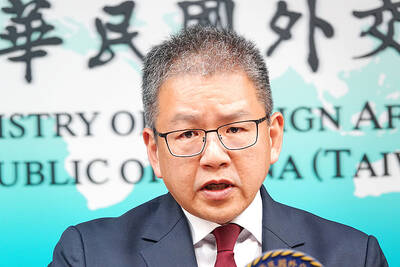
Taiwan is still in the process of assessing the possibility of recruiting workers from Eswatini, the Ministry of Foreign Affairs said yesterday, adding that its goal is to help Eswatini upgrade its vocational training centers. If there are plans to recruit workers from Eswatini, safeguarding national security, protecting public health and ensuring the employment rights of Taiwanese would be prerequisites, Department of West Asian and African Affairs Director-General Yen Chia-liang (顏嘉良) told a news conference. Key considerations would also include filling labor shortages in specific industries, and fostering bilateral professional and technical exchanges, he said. Yen was asked about the progress of labor

VERBOSE VESSELS: A CGA cutter and a China Coast Guard exchanged verbal barbs for more than a day in Taiwanese-controlled waters before the Chinese vessel left The Taiwanese and Chinese coast guards had a standoff near the strategically located Pratas Islands (Dongsha Islands, 東沙群島) in the north of the South China Sea, the Coast Guard Administration (CGA) said yesterday. The two sides engaged in intense radio exchanges over sovereignty claims during the 33-hour standoff. China Coast Guard vessel 3501 eventually left the restricted waters, 26.6 nautical miles (49.2km) west of the Pratas Islands, at 5pm yesterday, the CGA said. Lying approximately between southern Taiwan and Hong Kong, the Taiwan-controlled Pratas are seen by some security experts as vulnerable to Chinese attack due to their distance — more than

A US uncrewed surface vessel (USV) encountered multiple Chinese warships during an autonomous transit of the Taiwan Strait, US defense company Seasats said in a statement on Wednesday. Seasats announced that a Lightfish USV had completed the first autonomous transit of the Taiwan Strait. Over five days, the USV traversed the entire length of the Strait while constantly monitoring surface vessel traffic, the company said. The Lightfish encountered multiple Chinese warships, one of which was a Chinese People’s Liberation Army Navy (PLAN) Type 056 corvette, it said. The Chinese vessels were operating “well within Taiwan’s exclusive economic zone without transmitting their identity via the


 RSS
RSS