


The Civil Aeronautics Administration (CAA) yesterday said it would ask China Airlines (中華航空) to provide details of its flight attendant internship program following criticism from lawmakers and cabin crew.
The nation’s largest airline on Wednesday announced that it would recruit 24 flight attendant interns through its partnerships with four universities: National Kaohsiung University of Hospitality and Tourism, Vanung University, China University of Science and Technology and Ming Chuan University.
The internship is to last one year, with each intern required to undergo a two-month flight attendant training and pass an evaluation before they are allowed to work on flights, the airline said.
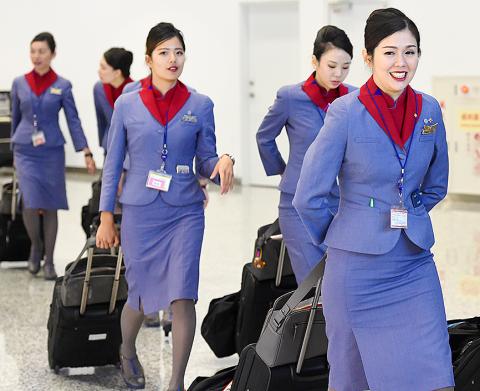
Photo: Chu Pei-hsiung, Taipei Times
Interns are to fly 60 hours per month, for which they are to receive a scholarship of NT$150,000 per semester, it added.
The program has drawn opposition from the Taoyuan Flight Attendants Union, which is comprised of mostly China Airlines flight attendants who succeeded in shutting down the carrier in 2016 through a strike.
“This is an example of how a Taiwanese company exploits workers. What interns would have to do is almost exactly the same as flight attendants officially employed by the airline. However, the interns would not receive a ‘scholarship’ commensurate to the amount of work they would do,” the union said in a statement on Facebook.
It also asked whether the Labor Standards Act (勞動基準法) would apply to the interns, and whether they would receive the same compensation as flight attendants if they are injured or killed while working.
The internship program is the only one of its kind in the world and sets the worst example, it said.
The Legislative Yuan’s Transportation Committee yesterday also scrutinized the program.
New Power Party Legislator Hung Tzu-yung (洪慈庸) asked the CAA if any other airlines worldwide also recruit flight attendant interns.
She asked the agency to strictly review the program, saying that it should not allow the carrier to offer the program without thoroughly considering consumer interests.
“We are not saying that interns are not good enough to do the job, but we have to consider if [full-time] flight attendants have the time and capacity to train interns,” Hung said.
CAA Director-General Lin Kuo-hsien (林國顯) said China Airlines has applied to offer the internship program, but the agency has asked the airline to provide more information regarding the program, including whether it fulfills Ministry of Education and aviation safety requirements.
Flight attendants must be trained and meet certain criteria before they can work on flights, he said.
If program members are considered formal employees, they would have to be hired and treated based on rules applicable to all flight attendants, Lin said, adding that if they are just interns, they should not count toward cabin crew minimum staffing requirements.
China Airlines said the program is unrelated to the normal development of flight attendants, as it aims to help interns gain an understanding of the industry and enable the company to develop talent.
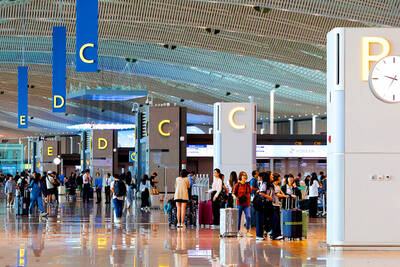
South Korea has adjusted its electronic arrival card system to no longer list Taiwan as a part of China, a move that the Ministry of Foreign Affairs said would help facilitate exchanges between the two sides. South Korea previously listed “Taiwan” as “Taiwan (China)” in the drop-down menus of its online arrival card system, where people had to fill out where they came from and their next destination. The ministry had requested South Korea make a revision and said it would change South Korea’s name on Taiwan’s online immigration system from “Republic of Korea” to “Korea (South),” should the issue not be

The Legislative Yuan’s Finance Committee yesterday approved proposed amendments to the Amusement Tax Act (娛樂稅法) that would abolish taxes on films, cultural activities and competitive sporting events, retaining the fee only for dance halls and golf courses. The proposed changes would set the maximum tax rate for dance halls and golf courses at 50 and 20 percent respectively, with local governments authorized to suspend the levies. Article 2 of the act says that “amusement tax shall be levied on tickets sold or fees charged by amusement places, facilities or activities” in six categories: “Cinema; professional singing, story-telling, dancing, circus, magic show, acrobatics

Tainan, Taipei and New Taipei City recorded the highest fines nationwide for illegal accommodations in the first quarter of this year, with fines issued in the three cities each exceeding NT$7 million (US$220,639), Tourism Administration data showed. Among them, Taipei had the highest number of illegal short-term rental units, with 410. There were 3,280 legally registered hotels nationwide in the first quarter, down by 14 properties, or 0.43 percent, from a year earlier, likely indicating operators exiting the market, the agency said. However, the number of unregistered properties rose to 1,174, including 314 illegal hotels and 860 illegal short-term rental
INFLATION UP? The IMF said CPI would increase to 1.5 percent this year, while the DGBAS projected it would rise to 1.68 percent, with GDP per capita of US$44,181 The IMF projected Taiwan’s real GDP would grow 5.2 percent this year, up from its 2.1 percent outlook in January, despite fears of global economic disruptions sparked by the US-Iran conflict. Taiwan’s consumer price index (CPI) is projected to increase to 1.5 percent, while unemployment would be 3.4 percent, roughly in line with estimates for Asia as a whole, the international body wrote in its Global Economic Outlook Report published in the US on Monday. The figures are comparatively better than the IMF outlook for the rest of the world, which pegged real GDP growth at 3.1 percent, down from 3.3 percent


 RSS
RSS