


Coast Guard Administration (CGA) officials yesterday said they have arrested 31 foreigners in a suspected human-trafficking operation that resulted in two drowning deaths.
CGA units and local police cooperated in the arrest of 15 foreigners near the coastal village of Nantian (南田) in Taitung County’s Daren Township (達仁).
“All 15 foreigners arrested yesterday [Monday] were Vietnamese, except for one woman from China. We believe they are all part of the same human-trafficking ring operated by a Taiwanese ship, which tried to land them along the Taitung coast so they could enter the country illegally,” said Li chih-hao (李智豪), a section chief at the agency’s Eastern Coastal Patrol Office.
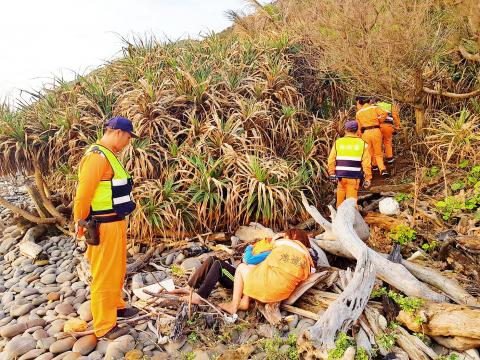
Photo: copied by Chen Hsien-i, Taipei Times
The agency said it picked up a speedboat heading toward Taitung on radar at about 2am on Monday, and a patrol team was dispatched to investigate.
The speedboat headed to a spot about 2 nautical miles (3.7km) from the shore of Nantian Village, where a Taiwanese man told the foreigners to get into a rubber dinghy and to row the rest of the way to the shore, the agency said.
The dinghy capsized in high waves and six occupants fell into the water. The CGA patrol tried to rescue two of those who fell into the water — a Vietnamese man and woman — and rushed them to hospital, but the two were later pronounced dead.
The other four — two Vietnamese women, a Vietnamese man and a Taiwanese man — made it to land, where they were arrested by coast guard agents.
The Taiwanese man is likely a crew member of the Kaohsiung-registered Jin Chun Cai (金春財), which is suspected of being engaged in human trafficking, the agency said.
The agency said it boarded the vessel, where they found 16 Vietnamese nationals and six Taiwanese crew members.
It said that all the foreign nationals and Taiwanese crew have been detained for questioning, while public prosecutors in Taitung and Kaohsiung conduct an investigation.
CGA units in Kaohsiung yesterday confirmed they had arrested the captain of the Jin Chun Cai, a 64-year-old man surnamed Wang (王), and five crew — three Taiwanese and two foreign workers.
When questioned, Wang said he had nothing to do with the two drowning deaths.
However, agency officials said Wang has a reputation as a “snakehead” among local fishermen and has allegedly colluded with Chinese to smuggle foreigners into Taiwan in the past.
Dawu Police Precinct spokesman Tsai Ching-liang (蔡清良) said the Vietnamese intended to work in Taiwan illegally, because they wanted to avoid paying high labor broker fees.
Many foreign recruitment companies make high profits by charging additional fees on top of the government-sanctioned fees.
Migrant workers have complained of having to pay as much as their entire year’s salary to labor brokers.
In August last year, the Ministry of Labor raised the minimum monthly wage for migrant workers from NT$21,009 to NT$22,000, or NT$264,000 a year.

National Taiwan University (NTU) yesterday said it disqualified a person from an entrance examination for using AI smart glasses to cheat, along with two others for making untruthful statements in their curriculum vitae. The three applicants were given null scores, Taiwan’s highest-ranked university said, calling on prospective students to be honest in the admissions process. NTU registrar Lee Hung-sen (李宏森) said that the cheating applicant wore a hat and thick-rimmed glasses to the second written exam for medical school, claiming that they felt cold. Suspicions were aroused when the applicant stared oddly at the test for long stretches while steadily bringing the paper
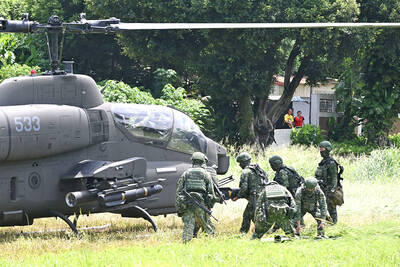
MILITARY ISSUES: A partisan divide between the Cabinet and the legislature ‘raised questions about Taiwan’s ability to adequately fund its defense,’ the report said Taiwan’s defense budget, military personnel numbers and resilience are challenges to its ability to meet national defense goals, the US Naval Institute said in a report published on Tuesday. In response to the perception of a growing military threat posed by China, Taiwan has embarked on an effort to enhance the capabilities needed to deter an attempt by Beijing to annex the nation by force, the institute said in the US Congressional Research Service report, titled Taiwan: Defense and Military Issues, which was filed on Thursday last week. Taiwan’s defense budget increased by about 7.5 percent from 2024 to last year, it

66 FIGHTER JETS: The aircraft is likely undergoing preparations for its transfer to Taiwan — a significant step forward in the nation’s modernization program, a lawmaker said The first of Taiwan’s order of F-16V Block 70 aircraft has been sighted in Texas ahead of delivery, Democratic Progressive Party (DPP) Legislator Wang Ting-yu (王定宇) said. Taiwan’s first F-16V Block 70 two-seat aircraft, tail number 6831, was seen flying from Lockheed Martin’s production facility in Greenville, South Carolina, to Naval Air Station Joint Reserve Base Fort Worth in Texas, Wang wrote on Facebook yesterday. The plane is likely undergoing preparations for its transfer to Taiwan, marking a significant step forward in the Republic of China Air Force’s modernization program, Wang said, citing military analysts. The F-16V Block 70 is a new-build version

NOT JUST NUMBERS: What matters to intelligence work is crucial, reliable information, so even a few credible leads can be highly valuable to national security, a legislator said The National Security Bureau (NSB) yesterday said it has finished the establishment of an information-reporting channel for Chinese nationals, the aim of which is to broaden intelligence gathering on China’s political, military, economic and social developments. Chinese nationals can submit information on the Web page, https://report.nsb.gov.tw, the NSB said in a statement. The move aims to expand the bureau’s diverse intelligence sources and is pursuant to the National Intelligence Services Act (國家情報工作法), it said, adding that it referenced practices adopted by intelligence agencies in the US, the UK and Israel. An increasing number of people are approaching Taiwanese agencies to provide information, as


 RSS
RSS