


A program to comprehensively examine the earthquake resistance of old buildings, with the examination of all six-story buildings or higher built before 2000 to be completed in three years, and compulsory reinforcement or reconstruction of problem buildings, was announced by the Cabinet yesterday.
The announcement came a little more than two weeks after the Cabinet said it was mulling a compulsory “health checkup” of older buildings and the establishment of a third-party construction supervision system to improve building safety in the wake of the Feb. 6 earthquake that killed 17 people in Hualien.
The Cabinet is allocating a four-year, NT$6.07 billion (US$207.63 million) budget to cover “fast screening,” resistance analysis, reconstruction, reinforcement and financial aid for buildings built before 2000, Premier William Lai (賴清德) told a news conference.
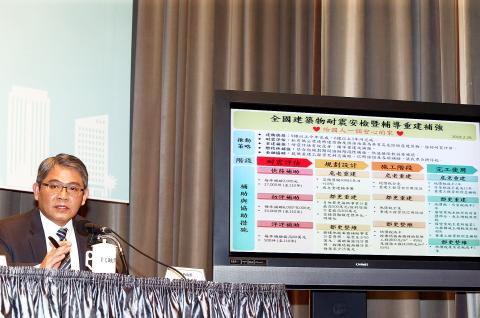
Photo: CNA
The program is aimed at buildings constructed before Dec. 31, 1999, when a more stringent construction code was introduced following the 921 Earthquake.
There are about 36,300 such buildings, and 9,300 have been put through the “fast screening” process in which government agencies examine a building’s blueprints and other plans to determine if it is safe or needs reinforcement or reconstruction.
For the rest, the government plans to complete the “fast screening” of those buildings that are at least nine stories this year, and those that are between six and nine stories in three years.
The program will include large residential and commercial complexes such as Weiguan Jinlong (維冠金龍) in Tainan that collapsed in an earthquake on Feb. 6, 2016, and the Yun Men Tsui Ti (雲門翠堤) building that collapsed in the Hualien quake, Lai said.
A “fast screening” of Yun Men Tsui Ti conducted by the Hualien County Government found there were structural weaknesses with the building, but the quake occurred before any further structural assessment and reinforcement could be conducted, Deputy Minister of the Interior Hua Ching-chun (花敬群) said.
Tax benefits and “floor space rewards” will be offered to homeowners to reconstruct their homes.
For owners whose buildings are determined to be “aging and dangerous,” the government would offer a reward of 30 percent extra floor space, land tax exemption and credit guarantees for bank loans to cover owners’ reconstruction costs, officials said.
For buildings that do not fit the “aging and dangerous” criteria, but are structurally compromised, a maximum NT$5 million subsidy, land tax exemption and loan guarantees would be offered for each reconstruction project, they said.
For homeowners who want to reinforce their buildings, a subsidy of at least NT$250,000 would be offered for each project.
The Cabinet also plans to revise the Building Act (建築法) to allow the government to order the compulsory reconstruction or reinforcement of dangerous buildings, Yeh said.
“It was very difficult to enforce [the examination program], because [homeowners feared] a potential drop in properties prices. Now we are offering a variety of incentives to homeowners to reconstruct buildings. If homeowners still refuse to comply, the government will be able to order compulsory reconstruction,” Lai said.
“We cannot let [more buildings] collapse,” he added.
Additional reporting by staff writer
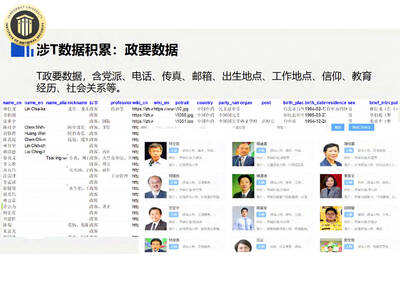
NETWORK-MAPPING PROJECT: The database contains 170 detailed files of Taiwanese politicians and about 23 million records of household registration data in Taiwan China has developed a network-mapping project targeting political figures and parties in Taiwan to monitor public opinion during elections and to craft tailored influence campaigns aimed at dividing Taiwanese society, according to documents leaked by Chinese technology firm GoLaxy (中科天璣). The documents, collected by Taipei-based Doublethink Lab, showed a database was specifically created to gather detailed information on Taiwanese political figures, including their political affiliations, job histories, birthplaces, residences, education, religion and a brief biography about them. Several notable Taiwanese politicians are in the database, including President William Lai (賴清德), former president Tsai Ing-wen (蔡英文), Minister of Foreign Affairs Lin Chia-lung (林佳龍),
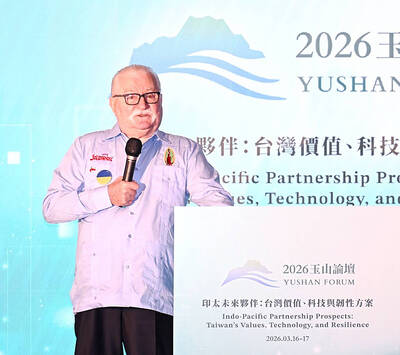
RECOGNITION: Former Fijian prime minister Mahendra Chaudhry said that Taiwan’s New Southbound Policy serves as a stabilizing force in the Indo-Pacific region Taiwan can lead the unification of the Chinese people, Nobel Peace Prize laureate and former Polish president Lech Walesa said in Taipei yesterday, adding that as the world order is changing, peaceful discussion would find good solutions, and that the use of force and coercion would always fail. Walesa made the remarks during his keynote address at a luncheon of the Yushan Forum in Taipei, titled “Indo-Pacific Partnership Prospects: Taiwan’s Values, Technology and Resilience,” organized by the Taiwan-Asia Exchange Foundation with the Ministry of Foreign Affairs. Walesa said that he had been at the forefront of a big peaceful revolution and “if
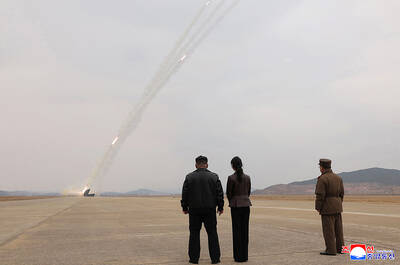
North Korea tested nuclear-capable rocket launchers, state media reported yesterday, a day after Seoul detected the launch of about 10 ballistic missiles. The test comes after South Korean and US forces launched their springtime military drills, due to run until Thursday. North Korean leader Kim Jong-un on Saturday oversaw the testing of the multiple rocket launcher system (MRLS), the Korean Central News Agency (KCNA) said. The test involved 12 600mm-caliber ultra-precision multiple rocket launchers and two artillery companies, it said. Kim said the drill gave Pyongyang’s enemies, within the 420km striking range, a sense of “uneasiness” and “a deep understanding

North Korea yesterday fired about 10 ballistic missiles to the sea toward Japan, the South Korean Joint Chiefs of Staff (JCS) said, days after Pyongyang warned of “terrible consequences” over ongoing South Korea-US military drills. Pyongyang recently dashed hopes of a diplomatic thaw with Seoul, Washington’s security ally, describing its latest peace efforts as a “clumsy, deceptive farce.” Seoul’s military detected “around 10 ballistic missiles launched from the Sunan area in North Korea toward the East Sea [Sea of Japan] at around 1:20pm,” JCS said in a statement, referring to South Korea’s name for the body of water. The missiles


 RSS
RSS