


Five Democratic Progressive Party (DPP) lawmakers are seeking an audience with Pope Francis as concerns grow over Taipei’s diplomatic relations with the Vatican.
The Holy See is one of only 20 countries that recognize Taipei instead of Beijing, but Francis has sought to improve ties with China since he took office in 2013.
The five lawmakers, who are members of the Legislative Yuan’s Foreign and National Defense Committee and Internal Administration Committee, are scheduled to leave tomorrow for an eight-day trip to Italy and Greece.
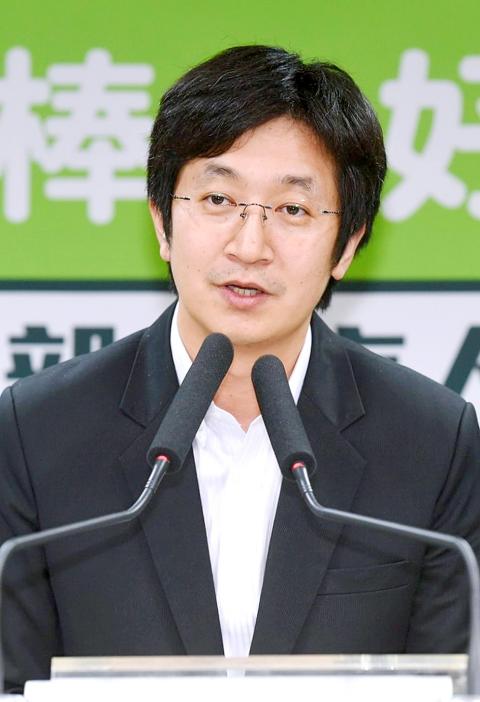
Photo: Chu Pei-hsiung, Taipei Times
DPP Legislator Tsai Shih-ying (蔡適應) said he and his colleagues “hope to have an audience with the pope,” but such a meeting has yet to be confirmed.
“We will express our stance and communicate on issues ... relating to Taiwan-Vatican ties,” he said.
Tsai’s office said the other lawmakers are Wu Kun-yuh (吳焜裕), Chuang Jui-hsiung (莊瑞雄), Chang Hung-lu (張宏陸) and Chou Chun-mi (周春米).
The announcement of their trip comes after the Vatican chastised retired Hong Kong cardinal Joseph Zen (陳日君), who accused it of “selling out” to Beijing after it promoted bishops loyal to China’s state-backed Chinese Patriotic Catholic Association instead of the pontiff.
Zen confirmed an AsiaNews missionary news agency report that a Vatican diplomat had asked two Chinese bishops recognized by the Vatican to resign in favor of state-sanctioned prelates.
The Vatican has not maintained diplomatic relations with Beijing since 1951, two years after the founding of the People’s Republic of China.
Although they have improved relations over the past few years as China’s Catholic population has grown, they remain at odds over which side has the authority to ordain bishops.
Previous attempts to restore ties have floundered over Beijing’s insistence that the Vatican must give up its recognition of Taiwan and promise not to interfere in religious issues in China.
In related news, Department of European Affairs Director-General Anna Kao (高安) yesterday said the Ministry of Foreign Affairs is aware of the dialogue between the Vatican and Beijing, and would continue to closely monitor developments.
Kao would not comment when asked if the two sides have made a breakthrough, saying only that even if there was a breakthrough on the appointments issue, huge differences remain concerning religious freedom.
Taiwan has democracy and freedom, with a vibrant Catholic community, she added.
Taiwan maintains close exchanges and communications with its only diplomatic ally in Europe and bilateral ties remain strong and stable, she said.
Cordial relations have been exemplified by frequent two-way visits by high-ranking officials over the years, while Taiwan and the Holy See also work closely together on cultural exchanges and humanitarian assistance projects, she said.

‘NO SECURITY RISK’: The Railway Bureau reassured the public that the technicians’ activities were limited to technical guidance and did not involve sensitive systems The Railway Bureau yesterday said it had invited eight Chinese technicians to assist with an airport MRT construction project. The bureau issued the confirmation after an Internet user said Chinese nationals had entered the construction zone of Taiwan Taoyuan International Airport’s Terminal 3 project. They asked why “individuals from an enemy state” were allowed access to such a major national infrastructure project, which raised serious concerns over Taiwan’s industrial safety, sensitive systems and information security. The bureau’s Northern Region Engineering Branch Office said subcontractor Taiwan Handle Industrial Co (台灣手把工業) of the Taoyuan airport MRT’s “Contract No. CU05 Project A14 Station Civil, MEP &

A US uncrewed surface vessel (USV) encountered multiple Chinese warships during an autonomous transit of the Taiwan Strait, US defense company Seasats said in a statement on Wednesday. Seasats announced that a Lightfish USV had completed the first autonomous transit of the Taiwan Strait. Over five days, the USV traversed the entire length of the Strait while constantly monitoring surface vessel traffic, the company said. The Lightfish encountered multiple Chinese warships, one of which was a Chinese People’s Liberation Army Navy (PLAN) Type 056 corvette, it said. The Chinese vessels were operating “well within Taiwan’s exclusive economic zone without transmitting their identity via the
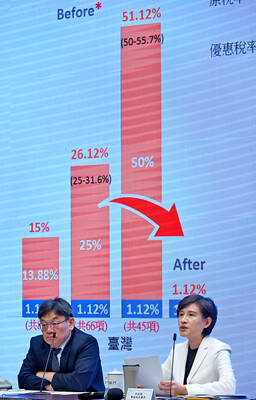
GREATER REACH? Auto parts and wood products would face tariffs of up to 15%, matching those targeting the EU, Japan and South Korea, Vice Premier said The US has announced that preferential tariff treatment for Taiwan’s non-semiconductor Section 232 goods would take effect retroactively from May 1, the Executive Yuan said yesterday. The US government yesterday posted a notice on the Federal Register’s public inspection Web site previewing tariff concessions for Taiwan under a memorandum of understanding (MOU) on Taiwan-US investment after two months of negotiations. The MOU signed on Jan. 15 stipulated three major preferential tariff arrangements: a 15 percent “reciprocal” tariff rate for Taiwan without stacking most-favored nation (MFN) rates; preferential Section 232 treatment for semiconductors and related products; and preferential Section 232 treatment for non-semiconductor

The National Chungshan Institute of Science and Technology yesterday showcased its locally developed variants of the Vision 60 robotic patrol dog, which it plans to deploy on the nation’s outlying territories in the South China Sea. The variants were produced under the Joint Lab project — created by the institute and domestic companies — and assembled with domestically produced motors, lenses and artificial intelligence (AI) systems alongside licensed tech from the US, Missile and Rocket Systems Research Division deputy director Jen Kuo-kang (任國光) told the media event at a military base in Taipei’s Dazhi (大直) area. Taiwan has built up its strengths


 RSS
RSS