


China and Japan plan to open a military hotline to ease tensions over disputed East China Sea islands, Beijing said yesterday, after their top diplomats held rare talks aimed at warming chilly ties.
Japanese Minister of Foreign Affairs Taro Kono yesterday met his Chinese counterpart Wang Yi (王毅) in Beijing in an attempt to improve relations held back by longstanding and seemingly intractable disputes over maritime territory and Japan’s wartime legacy.
Kono’s visit to China is the first by a serving Japanese foreign minister in nearly two years.
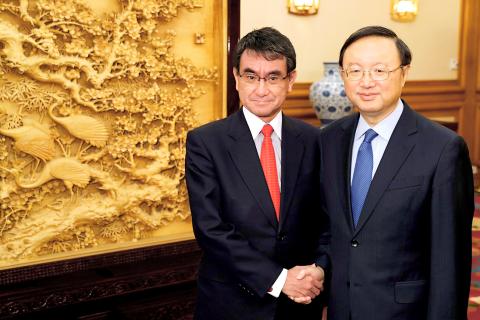
Photo: Reuters
The Chinese Ministry of Foreign Affairs said in a statement that the two nations had pledged to sign an agreement “as soon as possible” to establish a military hotline to help prevent incidents in the East China Sea.
“China and Japan should work together to build the East China Sea into the sea of peace, cooperation and friendship,” it said.
In remarks before the talks Kono praised the progress toward improving ties, while calling on China to do more to curb North Korea’s nuclear weapons program.
“It is important not only to discuss issues related to our two countries, but for Japan and China to stand side by side to deal with global issues,” he said. “In particular, the North Korea issue is now an urgent issue for the whole of international society.”
Tokyo has been wooing China with official visits and business delegations, but an exchange of state visits has remained a hard sell.
Japan is hoping that might change this year as the two nations prepare to celebrate the 40th anniversary of the signing of a Japan-China friendship treaty.
Wang kept his cards close to his chest before the meeting.
Relations between the two were at a “crucial stage,” he said. “There is positive progress, but many disturbances and obstacles remain.”
Japan is also pushing to host a trilateral summit with leaders from China and South Korea to discuss a range of regional issues, including North Korea’s nuclear program.
The two sides agreed the meeting should be held “as soon as possible,” the Chinese ministry said without mentioning the venue.
Meanwhile, US President Donald Trump’s administration has joined European governments in urging Beijing to release a Swedish citizen who sold gossipy books about Chinese leaders.
A US Department of State spokeswoman called on China to disclose Gui Minhai’s (桂民海) whereabouts and allow him to leave China if he wishes.
“We call on Chinese authorities to explain the reasons and legal basis for Mr Gui’s arrest and detention, disclose his whereabouts, and allow him freedom of movement and the freedom to leave China,” spokeswoman Heather Nauert said in a statement.
The US “will continue to coordinate with our partners, allies and regional organizations on promoting greater respect for human rights in China,” Nauert said.
About 10 Chinese police officers surrounded Gui and Swedish diplomats on Jan. 20 as they traveled by train to Beijing. Gui, a naturalized Swedish citizen, was seized and his whereabouts remain unknown.
His latest detention has particularly rattled Western governments after it unfolded in the presence of diplomats.
Additional reporting by AP

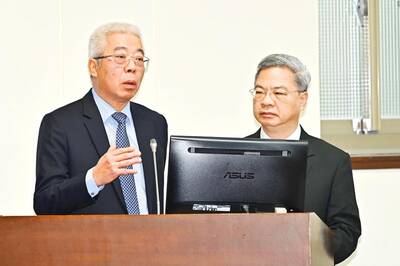
Taiwan has arranged for about 8 million barrels of crude oil, or about one-third of its monthly needs, to be shipped from the Red Sea this month to bypass the Strait of Hormuz and ease domestic supply pressures, CPC Corp, Taiwan (CPC, 台灣中油) said yesterday. The state-run oil company has worked with Middle Eastern suppliers to secure routes other than the Strait of Hormuz, through which about 20 percent of the world’s oil and liquefied natural gas typically passes, CPC chairman Fang Jeng-zen (方振仁) said at a meeting of the legislature’s Economics Committee in Taipei. Suppliers in Saudi Arabia have indicated they
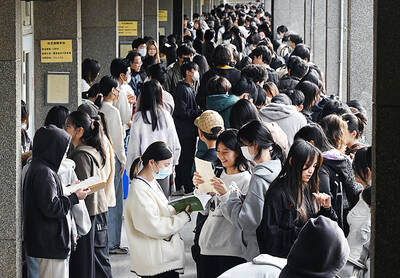
A global survey showed that 60 percent of Taiwanese had attained higher education, second only to Canada, the Ministry of the Interior said. Taiwan easily surpassed the global average of 43 percent and ranked ahead of major economies, including Japan, South Korea and the US, data from the Organisation for Economic Co-operation and Development (OECD) for 2024 showed. Taiwan has a high literacy rate, data released by the ministry showed. As of the end of last year, Taiwan had 20.617 million people aged 15 or older, accounting for 88.5 percent of the total population, with a literacy rate of 99.4 percent, the data
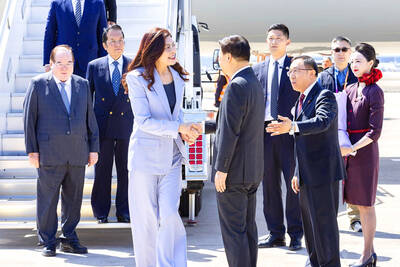
CCP ‘PAWN’? Beijing could use the KMT chairwoman’s visit to signal to the world that many people in Taiwan support the ‘one China’ principle, an academic said Chinese Nationalist Party (KMT) Chairwoman Cheng Li-wun (鄭麗文) yesterday arrived in China for a “peace” mission and potential meeting with Chinese President Xi Jinping (習近平), while a Taiwanese minister detailed the number of Chinese warships currently deployed around the nation. Cheng is visiting at a time of increased Chinese military pressure on Taiwan, as the opposition-dominated Legislative Yuan stalls a government plan for US$40 billion in extra defense spending. Speaking to reporters before going to the airport, Cheng said she was going on a “historic journey for peace,” but added that some people felt uneasy about her trip. “If you truly love Taiwan,

NEW LOW: The council in 2024 based predictions on a pessimistic estimate for the nation’s total fertility rate of 0.84, but last year that rate was 0.69, 17 percent lower An expected National Development Council (NDC) report expects the nation’s population to drop below 12 million by 2065, with the old-age dependency ratio to top 100 percent sooner than 2070, sources said yesterday. The council is slated to release its latest population projections in August, using an ultra-low fertility model, the sources said. The previous report projected that Taiwan’s population would fall to 14.37 million by 2070, but based on a new estimate of the total fertility rate (TFR) — the average number of children born to a woman over her lifetime — the population is expected to reach 12 million by


 RSS
RSS