


Taipei Mayor Ko Wen-je (柯文哲) yesterday said he would like to know what President Tsai Ing-wen (蔡英文) meant by “Taiwanese values,” after she said that he should reaffirm his commitment to such values to gain the support of Democratic Progressive Party (DPP) members.
Tsai made the remark in an interview with political talk show host Cheng Hung-yi (鄭弘儀) on Monday when she was asked whether the DPP still views Ko as an ally, as the party had supported him in the 2014 Taipei mayoral election.
Ko made some remarks and did some things that made DPP supporters uncomfortable, Tsai said, adding that the mayor is a smart person, so if he wants the support of DPP voters, he should know what they expect of him.

Photo: Fang Pin-chao, Taipei Times
He should reaffirm his commitment to “Taiwanese values” so that DPP supporters “can feel that he is someone with whom we can fight together,” Tsai said.
“I would like to know what Taiwanese values mean,” Ko said when asked what he thought Tsai meant.
“Within the Chinese community in east Asia, what makes Taiwan special is its democracy, freedom, diversity and openness. While there is room for improvement in its rule of law, human rights and environmental protection, the realization of these universal values should be Taiwan’s values,” he said.
“I think politics should be realized in the people’s daily lives, so making idealistic and unpractical remarks is useless,” he said, adding that as an example, people want affordable, good quality apartments to rent.
“I know the levels of thinking of the president and the mayor are not the same — the president has to deal with national defense, diplomacy and ideological issues, but the mayor does not,” Ko said. “The mayor only has to care about economic development and try to let people live happy lives.”
“Society is not very accepting of criticism and I was only speaking the truth,” Ko said, when asked why he made DPP supporters uncomfortable.
Even though he could speak less, he cannot keep things to himself, Ko said.
Former DPP legislator Lin Cho-shui (林濁水), a senior party member, yesterday wrote on Facebook that while the president mentioned that there are many definitions of “Taiwanese values,” she should share her point of view and the nation’s perspective, so that everyone can use them to evaluate Ko.
DPP legislators Pasuya Yao (姚文智) and Tuan Yi-kang (段宜康) have criticized Ko’s perception of Taiwanese values as being overly China-friendly and authoritarian.
Yao, who has announced his candidacy for the Taipei mayoral seat, said Ko’s descriptions of cross-strait relations as “one family” and a “quarreling couple” during a visit to Shanghai in July last year “deviated from Taiwanese values” and made DPP supporters “feel uneasy.”
Ko’s values differ dramatically from those of the DPP, and one might question whether he would hold the Nazis and Adolf Hitler in high regard with his authoritarian mindset, Tuan said.
Taiwan and China are not a family, and close cross-strait ties can be developed, but not forced, Tuan said.
“Efficiency in building an authoritarian rule cannot be used to gloss over the victimization of the people,” Tuan said, referring to Ko’s seeming admiration for former president Chiang Ching-kuo (蔣經國).
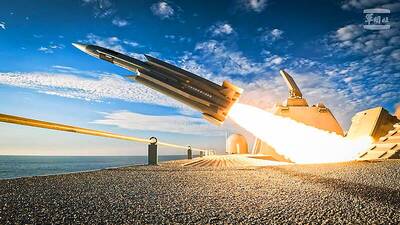
DETERRENCE: With 1,000 indigenous Hsiung Feng II and III missiles and 400 Harpoon missiles, the nation would boast the highest anti-ship missile density in the world With Taiwan wrapping up mass production of Hsiung Feng II and III missiles by December and an influx of Harpoon missiles from the US, Taiwan would have the highest density of anti-ship missiles in the world, a source said yesterday. Taiwan is to wrap up mass production of the indigenous anti-ship missiles by the end of year, as the Chungshan Institute of Science and Technology has been meeting production targets ahead of schedule, a defense official with knowledge of the matter said. Combined with the 400 Harpoon anti-ship missiles Taiwan expects to receive from the US by 2028, the nation would have

North Korea yesterday fired about 10 ballistic missiles to the sea toward Japan, the South Korean Joint Chiefs of Staff (JCS) said, days after Pyongyang warned of “terrible consequences” over ongoing South Korea-US military drills. Pyongyang recently dashed hopes of a diplomatic thaw with Seoul, Washington’s security ally, describing its latest peace efforts as a “clumsy, deceptive farce.” Seoul’s military detected “around 10 ballistic missiles launched from the Sunan area in North Korea toward the East Sea [Sea of Japan] at around 1:20pm,” JCS said in a statement, referring to South Korea’s name for the body of water. The missiles

‘UNWAVERING FRIENDSHIP’: A representative of a Japanese group that co-organized a memorial, said he hopes Japanese never forget Taiwan’s kindness President William Lai (賴清德) yesterday marked the 15th anniversary of the Tohoku earthquake and tsunami, urging continued cooperation between Taiwan and Japan on disaster prevention and humanitarian assistance. Lai wrote on social media that Taiwan and Japan have always helped each other in the aftermath of major disasters. The magnitude 9 earthquake struck northeastern Japan on March 11, 2011, triggering a massive tsunami that claimed more than 19,000 lives, according to data from Japanese authorities. Following the disaster, Taiwan donated more than US$240 million in aid, making it one of the largest contributors of financial assistance to Japan. In addition to cash donations and
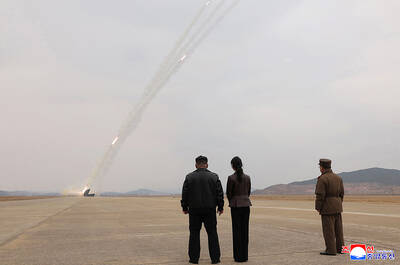
North Korea tested nuclear-capable rocket launchers, state media reported yesterday, a day after Seoul detected the launch of about 10 ballistic missiles. The test comes after South Korean and US forces launched their springtime military drills, due to run until Thursday. North Korean leader Kim Jong-un on Saturday oversaw the testing of the multiple rocket launcher system (MRLS), the Korean Central News Agency (KCNA) said. The test involved 12 600mm-caliber ultra-precision multiple rocket launchers and two artillery companies, it said. Kim said the drill gave Pyongyang’s enemies, within the 420km striking range, a sense of “uneasiness” and “a deep understanding


 RSS
RSS