


China-based Taiwanese businesspeople “understood” the rationale behind possible cancelations of additional flights during the Lunar New Year holiday in response to Beijing’s unilateral activation of four aviation routes over the Taiwan Strait, the semi-official Straits Exchange Foundation (SEF) said yesterday.
The foundation said in a statement that it on Thursday contacted associations of China-based Taiwanese businesspeople in eight points of departure, including Shanghai, Nanjing and Fuzhou, who could be affected by the policy to gauge their needs and possible concerns.
The foundation told the associations’ leaders that the approval of additional flights has been stalled due to concerns over aviation safety caused by Beijing on Jan. 4 disregarding a 2015 cross-strait agreement and activating the northbound M503 route and extending routes W121, W122 and W123.
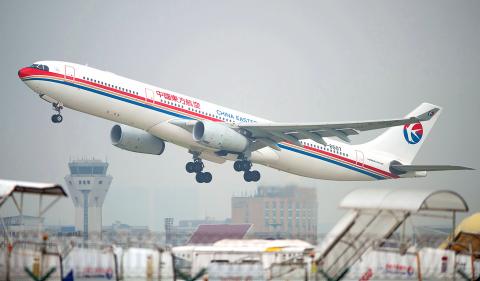
Photo: AFP
“During our communications, the foundation repeatedly stressed the significance of ‘safety first.’ We emphasized that while the utmost effort will be made to satisfy people’s needs and expectations to come home for the holiday, our more important consideration is to ensure their safe return,” the foundation said.
The association directors all expressed understanding of the government’s stance, it said.
“They also suggested that technical negotiations should be conducted over aviation safety as soon as possible by governments of both sides to fundamentally resolve the issue,” it added.
The foundation’s statement came days after the Civil Aeronautics Administration (CAA) on Thursday announced that it would hold off on giving the green light to applications for 106 additional flights by China Eastern Airlines Corp (中國東方航空) and 70 by XiamenAir (廈門航空) during the holiday. It is in response to Beijing’s disregard for Taipei’s calls to return to the negotiating table following the launch of the routes.
It is expected to affect 50,000 people seeking to return home for the holiday traditionally celebrated with family.
There have been reports of complaints from Taiwanese businesspeople in China.
Meanwhile, the Mainland Affairs Council (MAC) yesterday said in a statement that it has encouraged other Chinese airlines to apply for additional flights for the holiday.
“China Eastern Airlines and Xiamen Air have turned a deaf ear to the CAA’s advice and insisted on using the unsafe aviation routes... That is why we need to cautiously evaluate their application for additional flights,” the council said.
It said that the northbound M503 route is too close to the Taipei flight information region, while the W123 and W122 routes are close to air routes W6 and W8, which are used by Taiwanese flights to carry an estimated 2.6 million passengers each year to Kinmen and Matsu.
“We urge Beijing to refrain from shunning aviation safety issues, setting up political hurdles to cross-strait technical negotiations, blaming us for its unreasonable and unilateral actions and holding Taiwanese businesspeople hostage,” the council said.
It is the shared responsibility of the governments on both sides to ensure the safe return of China-based Taiwanese businesspeople, it added.

Japan has deployed long-range missiles in a southwestern region near China, the Japanese defense minister said yesterday, at a time when ties with Beijing are at their lowest in recent years. The missiles were installed in Kumamoto in the southern region of Kyushu, as Japan is attempting to shore up its military capacity as China steps up naval activity in the East China Sea. “Standoff defense capabilities enable us to counter the threat of enemy forces attempting to invade our country ... while ensuring the safety of our personnel,” Japanese Minister of Defense Shinjiro Koizumi said. “This is an extremely important initiative for

MORE POPULAR: Taiwan Pass sales increased by 59 percent during the first quarter compared with the same period last year, the Tourism Administration said The Tourism Administration yesterday said that it has streamlined the Taiwan Pass, with two versions available for purchase beginning today. The tourism agency has made the pass available to international tourists since 2024, allowing them to access the high-speed rail, Taiwan Railway Corp services, four MRT systems and four Taiwan Tourist Shuttles. Previously, five types of Taiwan Pass were available, but some tourists have said that the offerings were too complicated. The agency said only two types of Taiwan Pass would be available, starting from a three-day pass with the high-speed rail and a three-day pass with Taiwan Railway Corp. The former costs NT$2,800

COUNTERING HOSTILITY: The draft bill would require the US to increase diplomatic pressure on China and would impose sanctions on those who sabotage undersea cable networks US lawmakers on Thursday introduced a bipartisan bill to bolster the resilience of Taiwan’s submarine cables to counter China’s hostile activities. The proposal, titled the critical undersea infrastructure resilience initiative act, was cosponsored by Republican representatives Mike Lawler and Greg Stanton, and Democratic Representative Dave Min. US Senators John Curtis and Jacky Rosen also introduced a companion bill in the US Senate, which has passed markup at the chamber’s Committee on Foreign Relations. The House’s version of the bill would prioritize the deployment of sensors to detect disruptions or potential sabotage in real-time and enhance early warning capabilities through global intelligence sharing frameworks,

NEW LOW: The council in 2024 based predictions on a pessimistic estimate for the nation’s total fertility rate of 0.84, but last year that rate was 0.69, 17 percent lower An expected National Development Council (NDC) report expects the nation’s population to drop below 12 million by 2065, with the old-age dependency ratio to top 100 percent sooner than 2070, sources said yesterday. The council is slated to release its latest population projections in August, using an ultra-low fertility model, the sources said. The previous report projected that Taiwan’s population would fall to 14.37 million by 2070, but based on a new estimate of the total fertility rate (TFR) — the average number of children born to a woman over her lifetime — the population is expected to reach 12 million by


 RSS
RSS