


The European Parliament on Thursday passed a resolution calling for the Chinese government to drop the charges against several human rights activists, including Taiwanese Lee Ming-che (李明哲), and for them to be released.
It was the second time that it has called for Lee’s release. The first was in July last year after he had been detained in China for more than three months for alleged “subversion of state power.”
Since then, Lee has been convicted and sentenced to five years in prison and the deprivation of his political rights for two years.
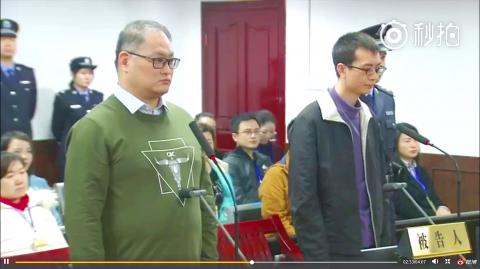
Screengrab from the Yueyang City Intermediate People’s Court’s microblog
In Thursday’s resolution, the European Parliament also addressed the cases of Chinese activists Wu Gan (吳淦) and Xie Yang (謝陽), as well as Tibetan activist Tashi Wangchuk and Gedhun Choekyi Nyima, who the Dalai Lama has named as the 11th Panchen Lama.
The resolution stated the parliament’s concern over the Chinese government’s approach to human rights activists and lawyers, and called for the release of Wu, Lee and Wangchuk.
Pending the release of the detainees, the Chinese government should give them access to adequate medical care and allow regular, unrestricted visits by their relatives and lawyers, the resolution said.
Furthermore, the detainees should not be subjected to torture or any other form of ill-treatment, the European Parliament said, calling on China to guarantee that defenders of human rights could carry out their work in the country without fear of reprisals.
It also urged China to ratify the International Covenant on Civil and Political Rights, and to sign and ratify the International Convention for the Protection of All Persons from Enforced Disappearance.
In Taipei yesterday, the Ministry of Foreign Affairs thanked the European Parliament on behalf of the Taiwanese government for passing the resolution.
Ministry spokesman Andrew Lee (李憲章) said that it would continue to cooperate with relevant government agencies to support Lee’s family and the “Lee Ming-che rescue team,” an alliance formed by non-governmental organizations in Taiwan.

CHAOS: Iranians took to the streets playing celebratory music after reports of Khamenei’s death on Saturday, while mourners also gathered in Tehran yesterday Iranian Supreme Leader Ayatollah Ali Khamenei was killed in a major attack on Iran launched by Israel and the US, throwing the future of the Islamic republic into doubt and raising the risk of regional instability. Iranian state television and the state-run IRNA news agency announced the 86-year-old’s death early yesterday. US President Donald Trump said it gave Iranians their “greatest chance” to “take back” their country. The announcements came after a joint US and Israeli aerial bombardment that targeted Iranian military and governmental sites. Trump said the “heavy and pinpoint bombing” would continue through the week or as long
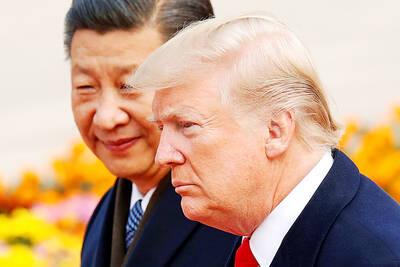
TRUST: The KMT said it respected the US’ timing and considerations, and hoped it would continue to honor its commitments to helping Taiwan bolster its defenses and deterrence US President Donald Trump is delaying a multibillion-dollar arms sale to Taiwan to ensure his visit to Beijing is successful, a New York Times report said. The weapons sales package has stalled in the US Department of State, the report said, citing US officials it did not identify. The White House has told agencies not to push forward ahead of Trump’s meeting with Chinese President Xi Jinping (習近平), it said. The two last month held a phone call to discuss trade and geopolitical flashpoints ahead of the summit. Xi raised the Taiwan issue and urged the US to handle arms sales to

State-run CPC Corp, Taiwan (CPC, 台灣中油) yesterday said that it had confirmed on Saturday night with its liquefied natural gas (LNG) and crude oil suppliers that shipments are proceeding as scheduled and that domestic supplies remain unaffected. The CPC yesterday announced the gasoline and diesel prices will rise by NT$0.2 and NT$0.4 per liter, respectively, starting Monday, citing Middle East tensions and blizzards in the eastern United States. CPC also iterated it has been reducing the proportion of crude oil imports from the Middle East and diversifying its supply sources in the past few years in response to geopolitical risks, expanding
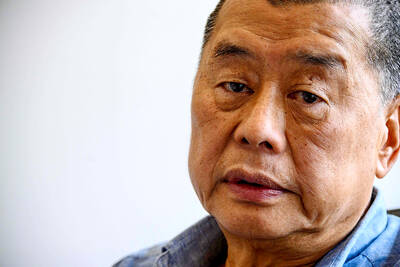
Pro-democracy media tycoon Jimmy Lai’s (黎智英) fraud conviction and prison sentence were yesterday overturned by a Hong Kong court, in a surprise legal decision that comes soon after Lai was jailed for 20 years on a separate national security charge. Judges Jeremy Poon (潘兆初), Anthea Pang (彭寶琴) and Derek Pang (彭偉昌) said in the judgement that they allowed the appeal from Lai, and another defendant in the case, to proceed, as a lower court judge had “erred.” “The Court of Appeal gave them leave to appeal against their conviction, allowed their appeals, quashed the convictions and set aside the sentences,” the judges


 RSS
RSS