


As of press time last night, Chinese Nationalist Party (KMT) lawmakers were filibustering the Democratic Progressive Party’s (DPP) proposed amendments to the Organic Regulations for Irrigation and Water Conservancy Associations (農田水利會組織通則). However, it was expected that the amendments would pass last night.
According to the draft amendments, the Council of Agriculture would appoint association presidents and officials, while elections of association heads and officials are to be abolished.
Association officials would be governed by the Civil Service Administrative Neutrality Act (公務人員行政中立法), the proposals said.
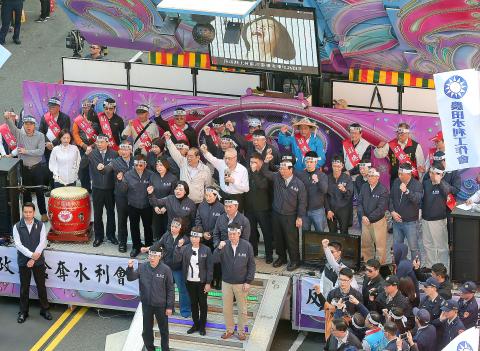
Photo: Huang Yao-cheng, Taipei Times
The draft amendments also proposed that the term of all association presidents be extended from May 31 to Sept. 30, 2020, in line with the Taipei-based Chi-Sing Irrigation Association and Liugong Irrigation Association.
Establishing a unified water management agency would mean that it facilitates water distribution in times of extreme weather, Council of Agriculture Minister Lin Tsung-hsien (林聰賢) said.
It would add 360,000 hectares to the irrigation zones nationwide formerly covered by the 17 associations, allowing the agency to serve more farmers, he said.
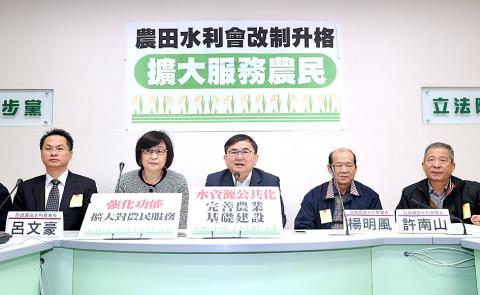
Photo: Liao Chen-huei, Taipei Times
As yesterday’s was the first of a two-stage legislation, the concerns expressed by people opposed to the amendments — including the disposition of association assets and job placement plans for association employees — would be addressed in the next phase, Liu said, adding that association workers’ rights would not be affected.
The amendments would ensure fairer distribution of water resources and help to stabilize the nation’s water supplies, he said.
Lin rejected criticism that the government is planning to prioritize the water needs of the industrial sector over that of agriculture, saying that the water needed for farming has always been prioritized by law.
Touting the amendments as “progressive legislation,” DPP Legislator Liu Shih-fang (劉世芳) said that the amendments would include farmland that had been excluded from the associations’ areas of irrigation, while ensuring farmers not affiliated with the associations fair access to water.
Speaking to reporters on the sidelines of a cross-caucus negotiation, DPP caucus whip Ker Chien-ming (柯建銘) rejected the KMT’s allegation that the amendments were aimed at helping the DPP gain an advantage in elections.
The draft amendments propose extending the term of 15 association presidents to Sept. 30, 2020, by which time both the local elections in November, and presidential and legislative elections in 2020 would all have ended, he said.
Then-president Lee Teng-hui’s (李登輝) administration in 1993 proposed changing the associations into government agencies, but the bill was defeated by the KMT, which wanted the government to have the right to appoint association heads.
By the time former president Chen Shui-bian (陳水扁) of the DPP took office, then-KMT lawmakers again changed the regulations, allowing association members to elect their presidents, Ker said, adding that this was meant to prevent Chen from making appointments.
“The irrigation associations have long been the KMT’s army. The DPP, which has the legislative majority, should shoulder the responsibility of carrying through a historic reform,” Ker said.
KMT caucus secretary-general Lin Wei-chou (林為洲) questioned the amendments’ ability to ensure fair distribution of water and prevent waterway contamination.
He also questioned why after the DPP said the associations needed reform, it had proposed extending the term of 15 current association heads until 2020.
As for vote-buying in association elections, Lin said that this problem could be solved by adding a special chapter to the regulations that would bring candidates distributing bribes under the jurisdiction of the Civil Servants Election and Recall Act (公職人員選舉罷免法).
The proposed amendments were sent to a plenary session to be further discussed and voted on after the cross-party negotiations broke down.

PROVOCATIVE: Chinese Deputy Ambassador to the UN Sun Lei accused Japan of sending military vessels to deliberately provoke tensions in the Taiwan Strait China denounced remarks by Japan and the EU about the South China Sea at a UN Security Council meeting on Monday, and accused Tokyo of provocative behavior in the Taiwan Strait and planning military expansion. Ayano Kunimitsu, a Japanese vice foreign minister, told the Council meeting on maritime security that Tokyo was seriously concerned about the situation in the East China and South China seas, and reiterated Japan’s opposition to any attempt to change the “status quo” by force, and obstruction of freedom of navigation and overflight. Stavros Lambrinidis, head of the EU delegation to the UN, also highlighted South China Sea

The final batch of 28 M1A2T Abrams tanks purchased from the US arrived at Taipei Port last night and were transported to the Armor Training Command in Hsinchu County’s Hukou Township (湖口), completing the military’s multi-year procurement of 108 of the tanks. Starting at 12:10am today, reporters observed more than a dozen civilian flatbed trailers departing from Taipei Port, each carrying an M1A2T tank covered with black waterproof tarps. Escorted by military vehicles, the convoy traveled via the West Coast Expressway to the Armor Training Command, with police implementing traffic control. The army operates about 1,000 tanks, including CM-11 Brave Tiger
Taiwan Semiconductor Manufacturing Co (TSMC, 台積電), the world’s largest contract chipmaker, said it expects its 2-nanometer (2nm) chip capacity to grow at a compound annual rate of 70 percent from this year to 2028. The projection comes as five fabs begin volume production of 2-nanometer chips this year — two in Hsinchu and three in Kaohsiung — TSMC senior vice president and deputy cochief operating officer Cliff Hou (侯永清) said at the company’s annual technology symposium in Silicon Valley, California, last week. Output in the first year of 2-nanometer production, which began in the fourth quarter of last year, is expected to

Taiwan’s drone exports surged past US$100 million in the first quarter, exceeding last year’s full-year total, with the Czech Republic emerging as the largest buyer, the Ministry of Economic Affairs said. Exports of complete drones reached US$115.85 million in the period, about 1.2 times the total recorded for all of last year, the ministry said in a report. Exports to the Czech Republic accounted for about US$100 million, far outpacing other markets. Poland, last year’s top destination, recorded about US$11.75 million in the first quarter. Taiwan’s drone exports have expanded rapidly in the past few years, with last year’s total


 RSS
RSS