


The Taipei City Government is to deploy more than 1,000 police officers to maintain public safety at the Taipei New Year’s Eve Countdown Party, while balloons and aerial drones will also be prohibited from the area.
The Taipei Police Department’s Xinyi Precinct (信義) yesterday said that it has formed a counterterrorism task force with the Wei-an Police Special Services Commando Unit to guard against the possibility of a terrorist attack during the celebration, which is to start at 7pm today at the Taipei City Hall Square.
About 1,100 officers would be assigned to keep order at the party venue and at nearby intersections, Xinyi Precinct Deputy Chief Chen Shao-hsu (陳少旭) said, adding that counterterrorism police and sniffer dogs would also patrol the area, looking for suspicious people or hidden explosives.
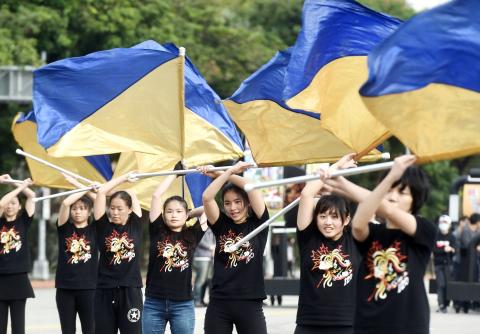
Photo: Chien Jung-fong, Taipei Times
To prevent a vehicle-ramming attack, large vehicles would be barred around the venue from 6pm, the precinct said, adding that barriers would also be placed at major intersections.
“Aerial drones have become more popular in recent years, so we have prepared drone defender rifles to make sure unauthorized aerial photography drones do not fly into the controlled zone, to ensure public safety,” Chen said.
Balloons, including light-up types, would be prohibited in the venue and the surrounding controlled area, and police would stop people who carry them or stalls that sell them in the area, he added.
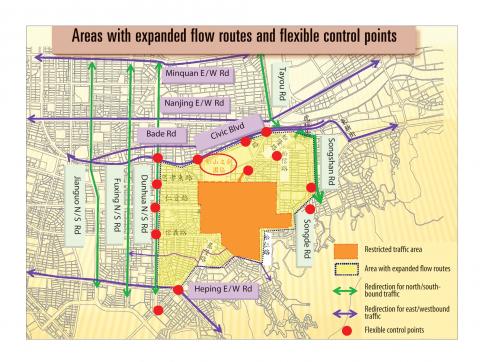
Photo: Taipei Times
Separately, the Railway Police Bureau’s Taipei Precinct said that it received a report from the Taipei Police Department yesterday morning about someone who posted a message on Facebook saying that he would “place a bomb at Taipei Railway Station on New Year’s Eve.”
Police tracked the suspect’s Internet protocol address and identified him as a man surnamed Hsu (徐) living in Keelung.
Hsu was taken to a police station for questioning and was charged with public intimidation.
Police urged people not to post such online threats, as they contravene the Social Order Maintenance Act (社會秩序維護法) and are punishable as an offense of public intimidation based on the Criminal Code.

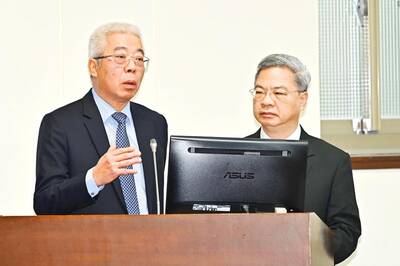
Taiwan has arranged for about 8 million barrels of crude oil, or about one-third of its monthly needs, to be shipped from the Red Sea this month to bypass the Strait of Hormuz and ease domestic supply pressures, CPC Corp, Taiwan (CPC, 台灣中油) said yesterday. The state-run oil company has worked with Middle Eastern suppliers to secure routes other than the Strait of Hormuz, through which about 20 percent of the world’s oil and liquefied natural gas typically passes, CPC chairman Fang Jeng-zen (方振仁) said at a meeting of the legislature’s Economics Committee in Taipei. Suppliers in Saudi Arabia have indicated they
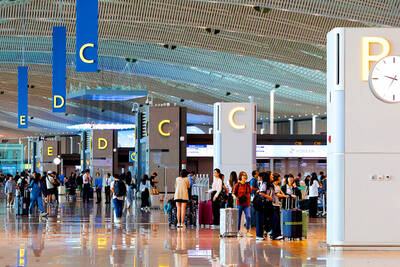
South Korea has adjusted its electronic arrival card system to no longer list Taiwan as a part of China, a move that the Ministry of Foreign Affairs said would help facilitate exchanges between the two sides. South Korea previously listed “Taiwan” as “Taiwan (China)” in the drop-down menus of its online arrival card system, where people had to fill out where they came from and their next destination. The ministry had requested South Korea make a revision and said it would change South Korea’s name on Taiwan’s online immigration system from “Republic of Korea” to “Korea (South),” should the issue not be

Tainan, Taipei and New Taipei City recorded the highest fines nationwide for illegal accommodations in the first quarter of this year, with fines issued in the three cities each exceeding NT$7 million (US$220,639), Tourism Administration data showed. Among them, Taipei had the highest number of illegal short-term rental units, with 410. There were 3,280 legally registered hotels nationwide in the first quarter, down by 14 properties, or 0.43 percent, from a year earlier, likely indicating operators exiting the market, the agency said. However, the number of unregistered properties rose to 1,174, including 314 illegal hotels and 860 illegal short-term rental

AIR ALERT: China’s reservation of airspace over the Yellow Sea and East China Sea could be an attempt to test the US’ response ahead of a Trump-Xi meeting, the NSB head said China’s attempts to infiltrate Taiwan are systematic, planned and targeted, with activity shifting from recruiting mid-level military officers to rank-and-file enlisted personnel, National Security Bureau (NSB) Director-General Tsai Ming-yen (蔡明彥) said yesterday. The Chinese Communist Party’s (CCP) integrates national security, intelligence operations and “united front” efforts into a dense network to conduct intelligence gathering and espionage in Taiwan, Tsai said at a meeting of the legislature’s Foreign Affairs and National Defense Committee. It uses specific networks to screen targets through exchange activities and recruiting local collaborators to establish intelligence-gathering organizations, he said. China is also shifting who it targets to lower-ranking military personnel,


 RSS
RSS