


New Party spokesman Wang Ping-chung (王炳忠) yesterday maintained that he has never received any funds from organizations affiliated with the Chinese Communist Party (CCP), as his party vowed to initiate a referendum to ensure witnesses’ right to an attorney following his and three other party members’ arrests on Tuesday in connection with an espionage investigation.
Wang made the remarks at a news conference at the New Party headquarters in Taipei yesterday morning, one day after he, his father and fellow party members Hou Han-ting (侯漢廷), Lin Ming-cheng (林明正) and Chen Ssu-chun (陳斯俊) were taken to the Investigation Bureau and the Taipei District Prosecutors’ Office for questioning.
They were questioned as part of a probe into suspected leaks of classified information in connection with an investigation into convicted Chinese spy Zhou Hongxu (周泓旭).
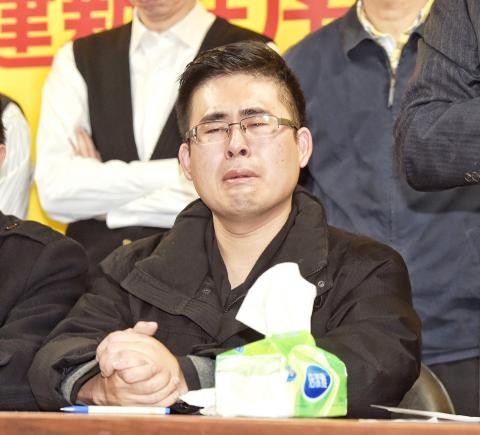
Photo: Huang Yao-cheng, Taipei Times
“They [prosecutors and investigators] acted worse than gangsters,” Wang said, alleging that they refused to let his attorney be present when they raided his residence in Taipei, held his throat in a tight grip and shoved him into a car.
Wang rejected allegations that he had financial dealings with the CCP, after investigators found an account book written in simplified Chinese and an undisclosed amount of yuan at his house.
“I have never accepted financial support from CCP-affiliated organizations. That is a fact,” Wang said.
He said the money came from legitimate business activities, including royalties from a book he published in China.
Wang added that he and his friends were mulling starting a business venture in China.
Regarding his decision to livestream the early part of the raid, which might be in violation of the law, Wang said it was made out of fear that his voice would no longer be heard and that he immediately stopped streaming after investigators entered his house.
“I only livestreamed what was happening to protect my rights,” he added.
The other three party members also lambasted prosecutors’ actions as brutal and akin to political persecution, but Hou said he remained unfettered and would not abandon his pro-unification and anti-Taiwanese independence stance.
Hou also announced his decision to run for Taipei city councilor next year to continue to safeguard the public’s welfare.
New Party Deputy Chairman Lee Sheng-feng (李勝峰) said as referendum thresholds have been lowered following the approval of amendments to the Referendum Act (公民投票法) on Tuesday last week, he planned to initiate a plebiscite to remedy legal loopholes that do not guarantee a witness’ right to an attorney.

CREDIT-GRABBER: China said its coast guard rescued the crew of a fishing vessel that caught fire, who were actually rescued by a nearby Taiwanese boat and the CGA Maritime search and rescue operations do not have borders, and China should not use a shipwreck to infringe upon Taiwanese sovereignty, the Coast Guard Administration (CGA) said yesterday. The coast guard made the statement in response to the China Coast Guard (CCG) saying it saved a Taiwanese fishing boat. The Chuan Yu No. 6 (全漁6號), a fishing vessel registered in Keelung, on Thursday caught fire and sank in waters northeast of Diaoyutai Islands (釣魚台). The vessel left Keelung’s Badouzih Fishing Harbor (八斗子漁港) at 3:35pm on Sunday last week, with seven people on board — a 62-year-old Taiwanese captain surnamed Chang (張) and six
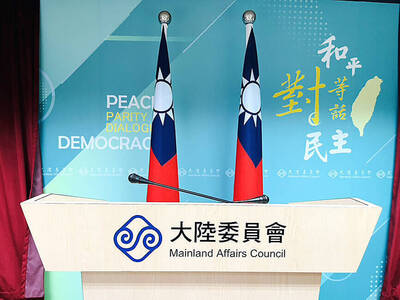
RISKY BUSINESS: The ‘incentives’ include initiatives that get suspended for no reason, creating uncertainty and resulting in considerable losses for Taiwanese, the MAC said China’s “incentives” failed to sway sentiment in Taiwan, as willingness to work in China hit a record low of 1.6 percent, a Ministry of Labor survey showed. The Directorate-General of Budget, Accounting and Statistics (DGBAS) also reported that the number of Taiwanese workers in China has nearly halved from a peak of 430,000 in 2012 to an estimated 231,000 in 2024. That marked a new low in the proportion of Taiwanese going abroad to work. The ministry’s annual survey on “Labor Life and Employment Status” includes questions respondents’ willingness to seek employment overseas. Willingness to work in China has steadily declined from

The Legislative Yuan’s Finance Committee yesterday approved proposed amendments to the Amusement Tax Act (娛樂稅法) that would abolish taxes on films, cultural activities and competitive sporting events, retaining the fee only for dance halls and golf courses. The proposed changes would set the maximum tax rate for dance halls and golf courses at 50 and 20 percent respectively, with local governments authorized to suspend the levies. Article 2 of the act says that “amusement tax shall be levied on tickets sold or fees charged by amusement places, facilities or activities” in six categories: “Cinema; professional singing, story-telling, dancing, circus, magic show, acrobatics
INFLATION UP? The IMF said CPI would increase to 1.5 percent this year, while the DGBAS projected it would rise to 1.68 percent, with GDP per capita of US$44,181 The IMF projected Taiwan’s real GDP would grow 5.2 percent this year, up from its 2.1 percent outlook in January, despite fears of global economic disruptions sparked by the US-Iran conflict. Taiwan’s consumer price index (CPI) is projected to increase to 1.5 percent, while unemployment would be 3.4 percent, roughly in line with estimates for Asia as a whole, the international body wrote in its Global Economic Outlook Report published in the US on Monday. The figures are comparatively better than the IMF outlook for the rest of the world, which pegged real GDP growth at 3.1 percent, down from 3.3 percent


 RSS
RSS