


Prominent news personality Wang Ping-chung (王炳忠) and three other New Party youth wing leaders were detained for questioning yesterday, as part of a probe into suspected leaks of classified information in connection with an espionage investigation against Chinese student Zhou Hongxu (周泓旭).
In coordinated actions yesterday morning, Ministry of Justice Investigation Bureau (MJIB) officials, backed up by police officers, served summonses and conducted searches at Wang’s home in Taipei and at the residences of other New Party youth wing executives Ho Han-ting (侯漢廷), Lin Ming-cheng (林明正) and Chen Ssu-chun (陳斯俊).
The officials had search warrants, summons notifications and arrest warrants for Wang and his New Party colleagues, and the operation was carried out in accordance with legal procedures, they said.

Photo: Peter Lo, Taipei Times
Wang, the New Party spokesman and head of its youth member committee, is known for his outspoken pro-China views and has made frequent trips to China, often appearing as a political commentator on Chinese state media.
Officials dispatched to search Wang’s home said they had to call a locksmith to gain entry after Wang stalled them for about an hour by refusing to open the door.
Wang tried to call his lawyer, as he began filming what was taking place for an online live broadcast.
After gaining entry, officials served summonses and warrants for Wang and his father, and they were taken for questioning at the MJIB headquarters in New Taipei City.
The same was done with Wang’s colleagues.
Taipei prosecutor Lin Chun-ting (林俊廷) headed yesterday’s investigation, as he is also in charge of the investigation of Zhou, who was convicted in September for trying to obtain classified information and recruit people for a spy network.
The Taipei District Prosecutors’ Office later released a statement saying that Wang and other people of interest were being investigated on suspicion of violating the National Security Act (國家安全法) in relation to Zhou’s case.
Except for Chen Ssu-chun, the other three had just returned from China on Saturday, as they had accompanied New Party Chairman Yok Mu-ming (郁慕明) and Taipei City Councilor Chen Yen-po (陳彥伯) on an official visit to China.
Chen Yen-po yesterday confirmed that the New Party delegation held a number of meetings with executives at China’s Taiwan Affairs Office, and that they had visited Beijing, Shanghai, Nanjing and other Chinese cities.
Regarding Zhou’s case, the investigation had earlier revealed that Wang had become friends with Zhou when the Chinese student was active in universities and social circles in getting to know more people and government officials prior to his arrest and conviction.
The two had been seen attending the same events.
It was alleged that Wang had played a key role by introducing Zhou to Taiwanese government officials and acting as an intermediary for Zhou’s activities.
Chen Ssu-chun and Lin Ming-cheng were listed as witnesses, and transferred to the Taipei District Prosecutors’ Office for further questioning at about 7pm yesterday, while Wang and Ho were still being questioned at MJIB as of press time last night.
Zhou, who is under detention, was also summoned by prosecutors last night, as officials said they might arrange for Zhou and Wang to testify and be cross-examined as part of the investigation into the case.
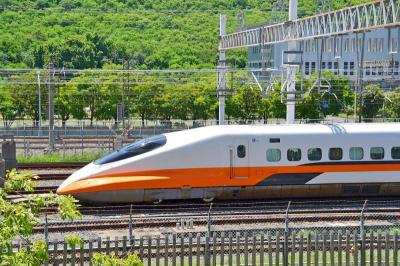
A signaling system malfunction disrupted high-speed rail (HSR) services beginning at 8am today, with trains temporarily reduced to three northbound and three southbound trains per hour as authorities conduct inspections. The malfunction occurred on a section of track in Miaoli County during pre-operation checks early this morning, forcing northbound and southbound trains to use a single track, the HSR operator said. The regular schedule has been replaced with three hourly trains offering only nonreserved seating in each direction, stopping at every station, it said, adding that business class cars would still have reserved seating. Departures from terminal stations are scheduled at the top
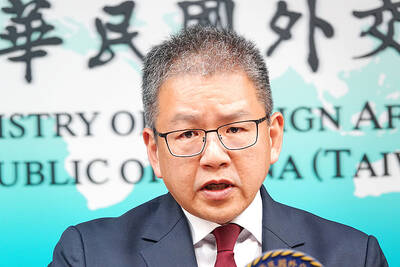
Taiwan is still in the process of assessing the possibility of recruiting workers from Eswatini, the Ministry of Foreign Affairs said yesterday, adding that its goal is to help Eswatini upgrade its vocational training centers. If there are plans to recruit workers from Eswatini, safeguarding national security, protecting public health and ensuring the employment rights of Taiwanese would be prerequisites, Department of West Asian and African Affairs Director-General Yen Chia-liang (顏嘉良) told a news conference. Key considerations would also include filling labor shortages in specific industries, and fostering bilateral professional and technical exchanges, he said. Yen was asked about the progress of labor
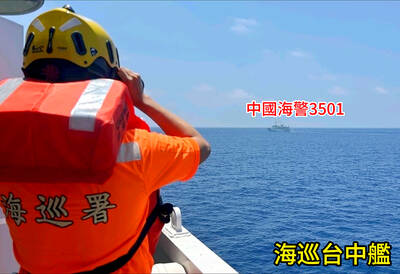
VERBOSE VESSELS: A CGA cutter and a China Coast Guard exchanged verbal barbs for more than a day in Taiwanese-controlled waters before the Chinese vessel left The Taiwanese and Chinese coast guards had a standoff near the strategically located Pratas Islands (Dongsha Islands, 東沙群島) in the north of the South China Sea, the Coast Guard Administration (CGA) said yesterday. The two sides engaged in intense radio exchanges over sovereignty claims during the 33-hour standoff. China Coast Guard vessel 3501 eventually left the restricted waters, 26.6 nautical miles (49.2km) west of the Pratas Islands, at 5pm yesterday, the CGA said. Lying approximately between southern Taiwan and Hong Kong, the Taiwan-controlled Pratas are seen by some security experts as vulnerable to Chinese attack due to their distance — more than

A US uncrewed surface vessel (USV) encountered multiple Chinese warships during an autonomous transit of the Taiwan Strait, US defense company Seasats said in a statement on Wednesday. Seasats announced that a Lightfish USV had completed the first autonomous transit of the Taiwan Strait. Over five days, the USV traversed the entire length of the Strait while constantly monitoring surface vessel traffic, the company said. The Lightfish encountered multiple Chinese warships, one of which was a Chinese People’s Liberation Army Navy (PLAN) Type 056 corvette, it said. The Chinese vessels were operating “well within Taiwan’s exclusive economic zone without transmitting their identity via the


 RSS
RSS