


The military’s Cyberwarfare Group has been renamed the Cyberwarfare Wing after an expansion and reorganization to meet rising Chinese cyberthreats, a defense official said on Sunday.
A unit of the Information and Electronic Warfare Command, the wing saw an increase in personnel from less than 600 to between 800 and 1,200, the official said, speaking on condition of anonymity.
The wing is the only military formation outside of the air force that is organized as a wing, a basic deployable unit of maneuver roughly equivalent to an army or marine brigade or a naval fleet, the official said.
Wing Commander Colonel Chen Yung-shun (陳永順) has been combing the nation’s higher education institutions to find recruits with the appropriate skill sets for the Reserve Officers’ Training Corps, the official said.
The unit’s efforts have yielded encouraging results in recruiting active-service volunteers and reserve officers, the official said.
The Ministry of National Defense ordered the cyberunit’s organizational upgrade following the Electronic and Information Warfare Command’s establishment on June 29, the official said.
The ministry’s willingness to reorganize the unit suggests that the nation’s cyberwarfare-qualified troops have multiplied since the initiative began, the official said.
The wing’s reorganization reflects the unit’s dedication to the missions that President Tsai Ing-wen (蔡英文) highlighted at the Electronic and Information Warfare Command’s founding, the official said.
The command is tasked with “Internet-based defensive and offensive operations, protecting the integrity of communications and pursuing electromagnetic capabilities,” Tsai said at her dedication speech, without clarifying what that meant.
However, the military’s decision to organize hack-tool users and developers into separate “first echelon” and “second echelon” units has resulted in poor communication between the units, which has plagued the improvement of hacking tools, an expert on cyberwarfare said on condition of anonymity.
The most significant shortfall is that developers have little to no feedback on the tools’ frequency of utilization or cyberattack success rates, the source said.
The military should consider employing properly vetted civilian contractors for cyberdefense and offense to strengthen its capabilities, another expert said.
In response, the ministry on Sunday said that the military imposes the same qualification standards for all cyberwarfare troops, without making any distinctions between the so-called “first or second echelon units.”
Cyberoperations have unique requirements and any proposed utilization of contractors must meet security and legal requirements, the ministry said.
The military is studying the US military’s cyberwarfare organization’s model and the only cyberwarfare activities carried out by non-governmental groups are the educational training provided by higher-education institutions, the ministry said.
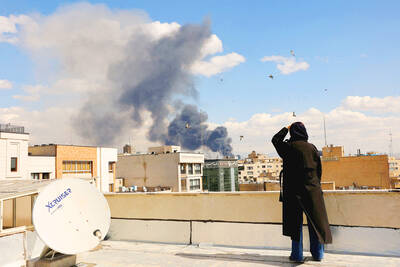
CHAOS: Iranians took to the streets playing celebratory music after reports of Khamenei’s death on Saturday, while mourners also gathered in Tehran yesterday Iranian Supreme Leader Ayatollah Ali Khamenei was killed in a major attack on Iran launched by Israel and the US, throwing the future of the Islamic republic into doubt and raising the risk of regional instability. Iranian state television and the state-run IRNA news agency announced the 86-year-old’s death early yesterday. US President Donald Trump said it gave Iranians their “greatest chance” to “take back” their country. The announcements came after a joint US and Israeli aerial bombardment that targeted Iranian military and governmental sites. Trump said the “heavy and pinpoint bombing” would continue through the week or as long
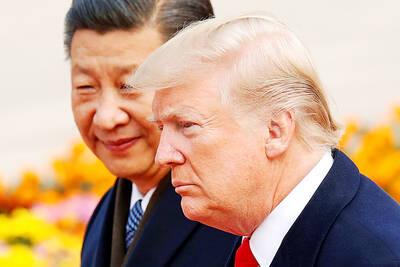
TRUST: The KMT said it respected the US’ timing and considerations, and hoped it would continue to honor its commitments to helping Taiwan bolster its defenses and deterrence US President Donald Trump is delaying a multibillion-dollar arms sale to Taiwan to ensure his visit to Beijing is successful, a New York Times report said. The weapons sales package has stalled in the US Department of State, the report said, citing US officials it did not identify. The White House has told agencies not to push forward ahead of Trump’s meeting with Chinese President Xi Jinping (習近平), it said. The two last month held a phone call to discuss trade and geopolitical flashpoints ahead of the summit. Xi raised the Taiwan issue and urged the US to handle arms sales to

State-run CPC Corp, Taiwan (CPC, 台灣中油) yesterday said that it had confirmed on Saturday night with its liquefied natural gas (LNG) and crude oil suppliers that shipments are proceeding as scheduled and that domestic supplies remain unaffected. The CPC yesterday announced the gasoline and diesel prices will rise by NT$0.2 and NT$0.4 per liter, respectively, starting Monday, citing Middle East tensions and blizzards in the eastern United States. CPC also iterated it has been reducing the proportion of crude oil imports from the Middle East and diversifying its supply sources in the past few years in response to geopolitical risks, expanding
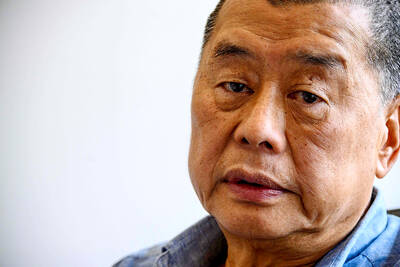
Pro-democracy media tycoon Jimmy Lai’s (黎智英) fraud conviction and prison sentence were yesterday overturned by a Hong Kong court, in a surprise legal decision that comes soon after Lai was jailed for 20 years on a separate national security charge. Judges Jeremy Poon (潘兆初), Anthea Pang (彭寶琴) and Derek Pang (彭偉昌) said in the judgement that they allowed the appeal from Lai, and another defendant in the case, to proceed, as a lower court judge had “erred.” “The Court of Appeal gave them leave to appeal against their conviction, allowed their appeals, quashed the convictions and set aside the sentences,” the judges


 RSS
RSS