


Lawmakers yesterday passed an amendment to the Organized Crime Prevention Act (組織犯罪防制條例) which broadens the definition of criminal organizations, making it applicable when charging members of political parties that are controlled by criminal gangs or known to threaten public safety.
The act formerly defined criminal organizations as standing and for-profit organizations that engage in violence, coercion, fraud, extortion or any other actions punishable by a maximum prison term of five years or longer.
The amendment substitutes “and” with “or,” which effectively widened the definition of criminal groups, which no longer have to be “for-profit” to warrant indictment.
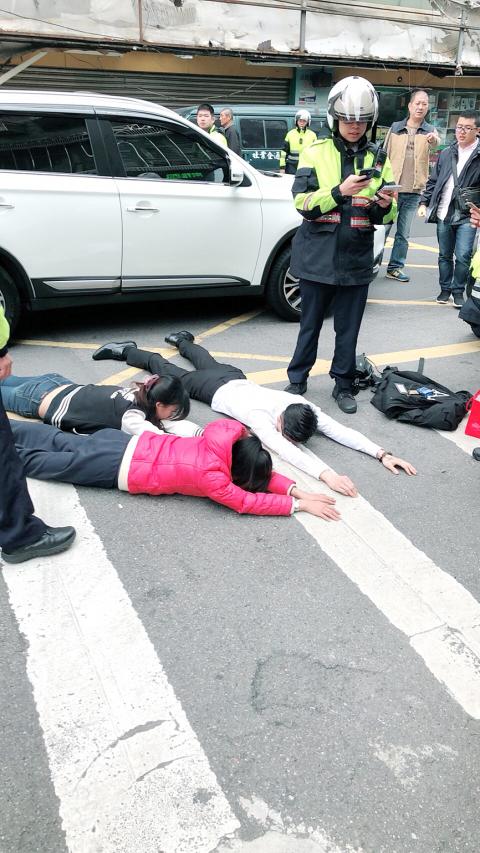
Photo provided by police
Democratic Progressive Party (DPP) Legislator Wang Ding-yu (王定宇), who proposed the amendment, said the Chinese Communist Party (CCP) has been covertly commanding Taiwanese criminal gangs to infiltrate demonstrations and protests, as well as cause social disorder.
The situation has worsened to the extent that it threatens national security, and he hopes that the legislation would solve those problems, he said.
The amendment includes a new stipulation against name-dropping: People who imply or claim that they are affiliated with criminal gangs or their members — through actions, words or any other means — to pressure others into selling their assets or shares, relinquishing proprietary rights, cooperating with urban renewal projects, purchasing goods or services, repaying a debt or agreeing to terms laid down during debt settlement negotiations face a maximum jail term of three years and a maximum fine of NT$3 million (US$100,027).
Those who contravene this stipulation are also to be punished even if the criminal gangs or gangsters they cited no longer exist.
To offer victims or witnesses of organized crime better protection, they can question or confront suspects via audio or video calls, the amendment stipulates, adding that victims or witnesses who are overseas can do so by seeking help at the nation’s representative offices.
In other developments, new changes were made to the Child and Youth Sexual Exploitation Prevention Act (兒童及少年性剝削防制條例) to enhance the safety of minors at amusement arcades and Internet cafes, as well as to prevent them becoming the subject of sexual exploitation.
Under the amendment, employees at amusement arcades and Internet cafes are now on a list of businesses whose occupants should proactively inform local police or prosecutors upon learning that a minor is under threat of sexual exploitation, including having nude photographs taken, being allowed to engage in prostitution or bar-hosting, being solicited or shown sexually explicit material.
The act now includes penalties for people who entice, trick, force or accommodate minors as a way to have them perform bar-hosting duties, such as at erotic karaoke bars or as escorts.
Offenders face a maximum jail term of one year and a maximum fine of NT$300,000.
Those who have minors perform bar-hosting through the use of violence, coercion, drugs or subterfuge face a jail term of between three and five years and a maximum fine of NT$1.5 million.
DPP Legislator Lee Li-feng (李麗芬), who initiated the amendment, said the renaming of the act from the Child and Youth Sexual Transaction Prevention Act (兒童及少年性交易防制條例) to the Child and Youth Sexual Exploitation Prevention Act in 2015 was momentous, but it was not enough to avoid potential pitfalls facing minors.
The passage of the amendment was the fruit of collaboration between lawmakers, interest groups and academics, she said.

South Korea has adjusted its electronic arrival card system to no longer list Taiwan as a part of China, a move that the Ministry of Foreign Affairs said would help facilitate exchanges between the two sides. South Korea previously listed “Taiwan” as “Taiwan (China)” in the drop-down menus of its online arrival card system, where people had to fill out where they came from and their next destination. The ministry had requested South Korea make a revision and said it would change South Korea’s name on Taiwan’s online immigration system from “Republic of Korea” to “Korea (South),” should the issue not be

Tainan, Taipei and New Taipei City recorded the highest fines nationwide for illegal accommodations in the first quarter of this year, with fines issued in the three cities each exceeding NT$7 million (US$220,639), Tourism Administration data showed. Among them, Taipei had the highest number of illegal short-term rental units, with 410. There were 3,280 legally registered hotels nationwide in the first quarter, down by 14 properties, or 0.43 percent, from a year earlier, likely indicating operators exiting the market, the agency said. However, the number of unregistered properties rose to 1,174, including 314 illegal hotels and 860 illegal short-term rental

Both sides of the Taiwan Strait share a political foundation based on the “1992 consensus” and opposition to Taiwanese independence, Chinese Nationalist Party (KMT) Chairwoman Cheng Li-wun (鄭麗文) today said during her meeting with Chinese President Xi Jinping (習近平). Both sides of the Strait should plan and build institutionalized and sustainable mechanisms for dialogue and cooperation based on that foundation to make peaceful development across the Strait irreversible, she said. Peace is a shared moral value across the Strait, and both sides should move beyond political confrontation to seek institutionalized solutions to prevent war, she said. Mutually beneficial cross-strait relations are what the

ECONOMIC COERCION: Such actions are often inconsistently applied, sometimes resumed, and sometimes just halted, the Presidential Office spokeswoman said The government backs healthy and orderly cross-strait exchanges, but such arrangements should not be made with political conditions attached and never be used as leverage for political maneuvering or partisan agendas, Presidential Office spokeswoman Karen Kuo (郭雅慧) said yesterday. Kuo made the remarks after China earlier in the day announced 10 new “incentive measures” for Taiwan, following a landmark meeting between Chinese President Xi Jinping (習近平) and Chinese Nationalist Party (KMT) Chairwoman Cheng Li-wun (鄭麗文) in Beijing on Friday. The measures, unveiled by China’s Xinhua news agency, include plans to resume individual travel by residents of Shanghai and China’s Fujian


 RSS
RSS