


Former president Ma Ying-jeou (馬英九) yesterday filed a lawsuit against Taipei prosecutors for allegedly leaking details from a case under investigation, after media reports that prosecutors have a recording allegedly implicating Ma in financial irregularities arising from the sale of party assets more than a decade ago.
With his security escorts in tow, Ma filed his complaint naming Chief Prosecutor Shing Tai-chao (邢泰釗) and head prosecutor Wang Hsin-chien (王鑫健) as those allegedly responsible for the leaks at the Taipei District Prosecutors’ Office.
He then went to the Taiwan High Prosecutors’ Office to apply for a transfer of the case under investigation to another jurisdiction.
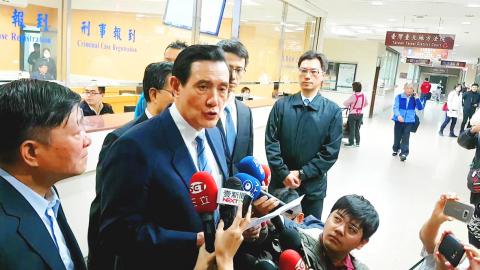
Photo: Hsieh Chun-lin, Taipei Times
The latest development came after the Chinese-language Mirror Media magazine reported that Taipei prosecutors had a recording of Ma giving undue financial benefits to the buyer of China Television Co (CTV, 中視) in 2005, as the Chinese Nationalist Party (KMT) made plans to sell party-owned media companies.
The digital recording was purportedly made in December 2005 during a meeting of top party officials and executives of KMT-controlled Central Investment Co (CIC, 中央投資公司) to discuss the sale of CTV to China Times Group (中時集團).
China Times Group was then owned by the Yu family, which is headed by Yu Chien-hsin (余建新).
Yu had negotiated a deal to buy CTV for NT$892 million (US$29.71 million at the current exchange rate), but it fell short of CIC executives’ expectations by NT$480 million.
The two sides were deadlocked over the price difference, but when then-KMT chairman Ma joined the meeting, he allegedly said: “Then let’s make a concession (回饋) for them.”
If the recording could be verified, it would be a breakthrough in the case, showing Ma was instrumental in concluding the sale and that he gave instructions for financial kickbacks to Yu, which resulted in the NT$480 million loss, legal experts said.
Ma’s alleged remark was found among hundreds of digital recordings transferred to CDs, which were gathered in raids of CIC’s headquarters.
Ma had been listed as a possible defendant in the probe into financial irregularities regarding the KMT’s sale of party-owned media companies and other valuable assets in the 2000s.
Based on the recording, it could be inferred that Ma was the main decisionmaker in the process and if found guilty, he could face breach of trust and violations of the Securities and Exchange Act (證券交易法) charges because it would indicate that Ma, as party chairman, knew about the sale of KMT-owned companies below their market value and gave undue financial benefit to buyers, experts said.
Media reports also said that prosecutors found a photograph showing a gift box containing NT$5 million in cash, allegedly given by Yu to former CIC chairman Chang Che-chen (張哲琛), purportedly to win approval for Yu’s purchase of CTV below market price.
Ma said the Taipei prosecutors had not adhered to the principle of confidentiality in a case under investigation.
The Taipei District Prosecutors’ Office yesterday said in a statement that the allegations reported in the media had not been verified and had nothing to do with any of the prosecutors, adding that people should not engage in speculation.
Prosecutors had been focusing on suspected financial irregularities regarding the KMT’s sale of CTV, along with Central Motion Picture Corp (中影) and Broadcasting Corp of China (中廣), as the KMT had to dispose of the three companies after a 2003 amendment to the Broadcasting and Television Act (廣播電視法), which barred political parties, the military and politicians from owning media outlets.
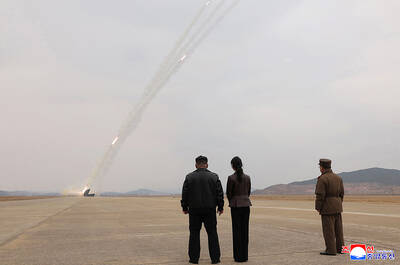
North Korea tested nuclear-capable rocket launchers, state media reported yesterday, a day after Seoul detected the launch of about 10 ballistic missiles. The test comes after South Korean and US forces launched their springtime military drills, due to run until Thursday. North Korean leader Kim Jong-un on Saturday oversaw the testing of the multiple rocket launcher system (MRLS), the Korean Central News Agency (KCNA) said. The test involved 12 600mm-caliber ultra-precision multiple rocket launchers and two artillery companies, it said. Kim said the drill gave Pyongyang’s enemies, within the 420km striking range, a sense of “uneasiness” and “a deep understanding
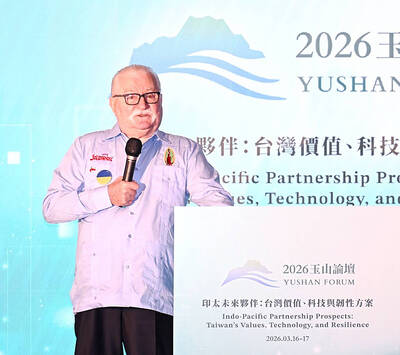
RECOGNITION: Former Fijian prime minister Mahendra Chaudhry said that Taiwan’s New Southbound Policy serves as a stabilizing force in the Indo-Pacific region Taiwan can lead the unification of the Chinese people, Nobel Peace Prize laureate and former Polish president Lech Walesa said in Taipei yesterday, adding that as the world order is changing, peaceful discussion would find good solutions, and that the use of force and coercion would always fail. Walesa made the remarks during his keynote address at a luncheon of the Yushan Forum in Taipei, titled “Indo-Pacific Partnership Prospects: Taiwan’s Values, Technology and Resilience,” organized by the Taiwan-Asia Exchange Foundation with the Ministry of Foreign Affairs. Walesa said that he had been at the forefront of a big peaceful revolution and “if
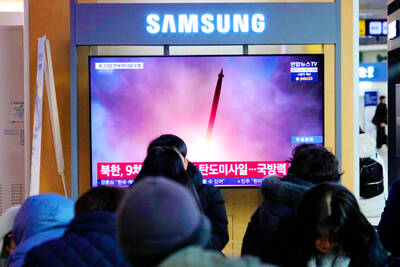
North Korea yesterday fired about 10 ballistic missiles to the sea toward Japan, the South Korean Joint Chiefs of Staff (JCS) said, days after Pyongyang warned of “terrible consequences” over ongoing South Korea-US military drills. Pyongyang recently dashed hopes of a diplomatic thaw with Seoul, Washington’s security ally, describing its latest peace efforts as a “clumsy, deceptive farce.” Seoul’s military detected “around 10 ballistic missiles launched from the Sunan area in North Korea toward the East Sea [Sea of Japan] at around 1:20pm,” JCS said in a statement, referring to South Korea’s name for the body of water. The missiles

‘UNWAVERING FRIENDSHIP’: A representative of a Japanese group that co-organized a memorial, said he hopes Japanese never forget Taiwan’s kindness President William Lai (賴清德) yesterday marked the 15th anniversary of the Tohoku earthquake and tsunami, urging continued cooperation between Taiwan and Japan on disaster prevention and humanitarian assistance. Lai wrote on social media that Taiwan and Japan have always helped each other in the aftermath of major disasters. The magnitude 9 earthquake struck northeastern Japan on March 11, 2011, triggering a massive tsunami that claimed more than 19,000 lives, according to data from Japanese authorities. Following the disaster, Taiwan donated more than US$240 million in aid, making it one of the largest contributors of financial assistance to Japan. In addition to cash donations and


 RSS
RSS