


The Ministry of National Defense (MND) yesterday censured a number of top navy officers, including Vice Minister of National Defense Admiral Pu Tze-chun (蒲澤春) and Chief of General Staff Admiral Lee Hsi-ming (李喜明), in connection with a minesweeper procurement scandal.
Disciplinary action was doled out for misconduct in contracting Ching Fu Shipbuilding Co (慶富造船) to build the vessels and a report on the minesweeper program presented by defense officials in the legislature last year, the ministry told a news conference.
A total of 24 officers were disciplined, it said.
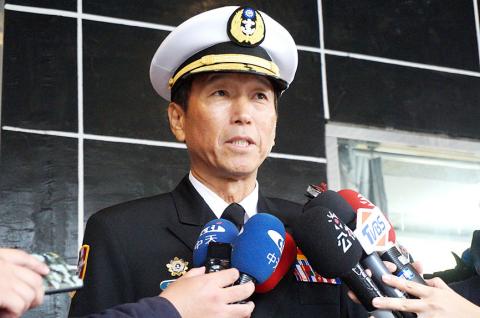
Photo: Tu Chu-min, Taipei Times
A ministerial task force was called on Nov. 2 after an Executive Yuan investigative report found fault with the military’s handling of the contract with Ching Fu to build six minesweepers, the ministry said.
The probe found flaws in the military’s pre-bidding preparations, the contract, the process for awarding the bid and supervision of the contractor’s compliance with its obligations, it said.
Eighteen admirals and captains were disciplined for their role in the procurement, including Pu, who received a demerit.
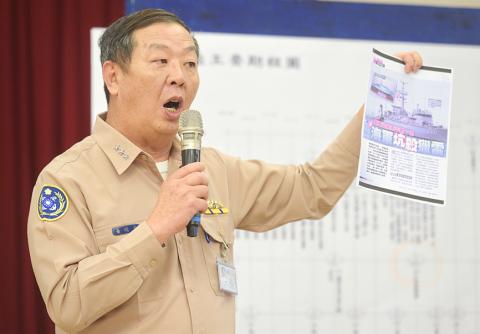
Photo: Chang Chia-ming, Taipei Times
Lee and Navy Commander Rear Admiral Huang Shu-kuang (黃曙光), and former deputy minister of national defense Admiral Chen Yung-kang (陳永康) each received two warnings.
Vice Admiral Huang Hsi-ju (黃希儒), procurement division chief of the ministry’s Armaments Bureau, received a demerit.
Nine navy admirals and captains were censured for misinforming lawmakers on the progress that Ching Fu was making on the minesweeper program during a budget report on Nov. 17 last year, the ministry said.
The officers presented a report that was inaccurate, the ministry said, adding that the incident reflected organizational failures on multiple levels of the ministry.
Four of the nine censured for making inaccurate reports to the legislature were also involved in the minesweepers’ procurement.
Armaments Bureau Director-General Vice Admiral Mei Chia-shu (梅家樹) received one demerit and three warnings for his conduct in the procurement process and the budget report.
The officers the ministry censured are currently serving or had served at influential ministerial posts, as well as Navy Command Headquarters and the navy’s Planning Division.
The ministry’s internal investigation is ongoing and it has informed prosecutors of its findings, which might result in criminal proceedings, it said.
President Tsai Ing-wen (蔡英文) vowed to thoroughly investigate the minesweeper scandal, address the government’s shortcomings and forge ahead with the domestic warship program.
“We will find out the truth and uphold the highest standards of accountability. This program that was initiated by previous administration is clearly flawed. The program must be subjected to strict scrutiny, from decisionmaking to bidding, syndicated loans and contract supervision,” she said in a statement.
“Each and every relevant agency must fully cooperate with the investigation... Any individual who is guilty of corruption will receive no leniency, regardless of who they are or what rank they hold,” she said.
The government will keep its focus on problem-solving and correct errors regardless of when they first occurred, she said, adding that the nation needs a more effective procurement system that excludes unsuitable contractors.
Her administration will continue its policy to develop a domestic shipbuilding program, Tsai said.
“It is my hope that this error and failure will be a lesson for our armed forces to find the right path forward,” she said.
“The government’s resolve to be self-sufficient in national defense is unshakable. We will not allow an isolated incident to affect our determination to have navy ships built domestically,” she said.
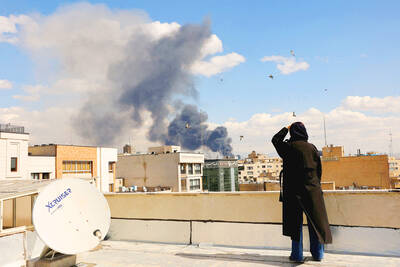
CHAOS: Iranians took to the streets playing celebratory music after reports of Khamenei’s death on Saturday, while mourners also gathered in Tehran yesterday Iranian Supreme Leader Ayatollah Ali Khamenei was killed in a major attack on Iran launched by Israel and the US, throwing the future of the Islamic republic into doubt and raising the risk of regional instability. Iranian state television and the state-run IRNA news agency announced the 86-year-old’s death early yesterday. US President Donald Trump said it gave Iranians their “greatest chance” to “take back” their country. The announcements came after a joint US and Israeli aerial bombardment that targeted Iranian military and governmental sites. Trump said the “heavy and pinpoint bombing” would continue through the week or as long
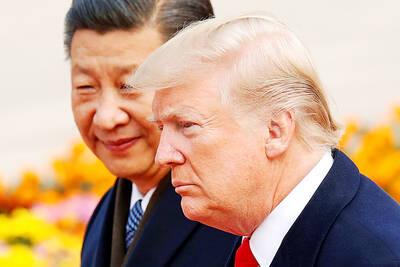
TRUST: The KMT said it respected the US’ timing and considerations, and hoped it would continue to honor its commitments to helping Taiwan bolster its defenses and deterrence US President Donald Trump is delaying a multibillion-dollar arms sale to Taiwan to ensure his visit to Beijing is successful, a New York Times report said. The weapons sales package has stalled in the US Department of State, the report said, citing US officials it did not identify. The White House has told agencies not to push forward ahead of Trump’s meeting with Chinese President Xi Jinping (習近平), it said. The two last month held a phone call to discuss trade and geopolitical flashpoints ahead of the summit. Xi raised the Taiwan issue and urged the US to handle arms sales to

An Emirates flight from Dubai arrived at Taiwan Taoyuan International Airport yesterday afternoon, the first service of the airline since the US and Israel launched strikes against Iran on Saturday. Flight EK366 took off from the United Arab Emirates (UAE) at 3:51am yesterday and landed at 4:02pm before taxiing to the airport’s D6 gate at Terminal 2 at 4:08pm, data from the airport and FlightAware, a global flight tracking site, showed. Of the 501 passengers on the flight, 275 were Taiwanese, including 96 group tour travelers, the data showed. Tourism Administration Deputy Director-General Huang He-ting (黃荷婷) greeted Taiwanese passengers at the airport and
State-run CPC Corp, Taiwan (CPC, 台灣中油) yesterday said that it had confirmed on Saturday night with its liquefied natural gas (LNG) and crude oil suppliers that shipments are proceeding as scheduled and that domestic supplies remain unaffected. The CPC yesterday announced the gasoline and diesel prices will rise by NT$0.2 and NT$0.4 per liter, respectively, starting Monday, citing Middle East tensions and blizzards in the eastern United States. CPC also iterated it has been reducing the proportion of crude oil imports from the Middle East and diversifying its supply sources in the past few years in response to geopolitical risks, expanding


 RSS
RSS