


Japanese Prime Minister Shinzo Abe yesterday met Taiwan’s special APEC envoy James Soong (宋楚瑜) for 30 minutes on the sidelines of the two-day meeting the APEC leaders summit in Da Nang, Vietnam.
Abe told Soong that Japan and Taiwan share common values, close economic ties and people-to-people interactions, and that he looked forward to further strengthening their unofficial ties, according to a news release from Japan’s Ministry of Foreign Affairs.
Abe also said Japan would work to deepen the cooperation and exchanges with Taiwan on the basis of informal, but substantive relations, according to the news release.
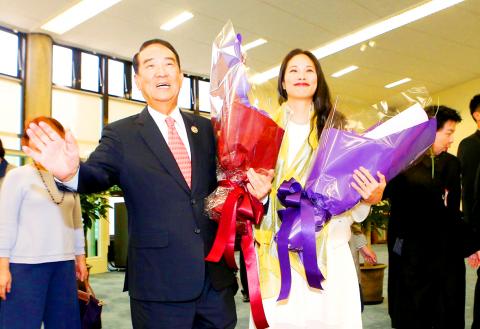
Photo: CNA
It said Abe and Soong agreed that the two nations must continue to deepen their substantial links in a wide range of areas.
When Soong raised the issue of the latest developments in relations between Taiwan and China, Abe suggested that such matters be addressed peacefully through direct dialogue, the ministry said.
Abe also said he was committed to helping to maintain regional peace and stability, the ministry said.
Earlier in the day Singaporean Prime Minister Lee Hsien Loong (李顯龍) posted a photograph on Facebook of him and his wife, Ho Ching (何晶), having tea with Soong and Soong’s daughter, Soong Cheng-mai (宋鎮邁).
Lee posted that he was happy to meet James Soong.
The People First Party chairman, speaking to the media on Saturday, said he had the opportunity to have “very good interactions” with US President Donald Trump and US Secretary of State Rex Tillerson, among others, during informal moments between summit events.
He said he would report to the government in Taipei before speaking more about the contents of those conversations, but said they had been held in an atmosphere of “great consideration.”
His meeting with Chinese President Xi Jinping (習近平) was “natural and friendly,” he said, but “this is not the occasion for cross-strait political talks.”
At a news conference on Saturday after the conclusion of the summit, he said his mission as Taiwan’s envoy was not to seek any diplomatic breakthrough, but to build trade and economic links.
He said he had taken part in an informal discussion among APEC and ASEAN leaders, which was held for the first time as part of the annual APEC summit, and the discussions helped to significantly advance the goals of Taiwan’s New Southbound Policy.
He said his discussions with ASEAN leaders also focused on economic and trade issues, and that he told them there was no need to take sides between Taiwan and China.
The discussions also extended to the leaders of Laos and Myanmar, he said.
In talks with Laotian President Bounnhang Vorachit, he said he stressed that Taiwan was aiming to deepen cooperation in agriculture and infrastructure construction, while in meeting with Burmese State Councilor and Foreign Minister Aung San Suu Kyi, he said Taiwan would like to boost economic and trade relations with Myanmar.
He said he also spoke with South Korean President Moon Jae-in and expressed Taiwan’s support for the UN Security Council’s resolutions to impose new sanctions on North Korea.
The Taiwanese delegation made a great effort at the APEC summit, James Soong said.
His delegation flew home yesterday and was greeted at Taiwan Taoyuan International Airport by Minister of Foreign Affairs David Lee (李大維) and Presidential Office Secretary-General Joseph Wu (吳釗燮).
Additional reporting by Reuters
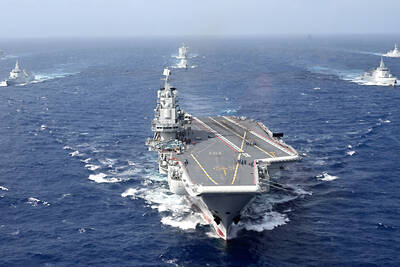
PROVOCATIVE: Chinese Deputy Ambassador to the UN Sun Lei accused Japan of sending military vessels to deliberately provoke tensions in the Taiwan Strait China denounced remarks by Japan and the EU about the South China Sea at a UN Security Council meeting on Monday, and accused Tokyo of provocative behavior in the Taiwan Strait and planning military expansion. Ayano Kunimitsu, a Japanese vice foreign minister, told the Council meeting on maritime security that Tokyo was seriously concerned about the situation in the East China and South China seas, and reiterated Japan’s opposition to any attempt to change the “status quo” by force, and obstruction of freedom of navigation and overflight. Stavros Lambrinidis, head of the EU delegation to the UN, also highlighted South China Sea
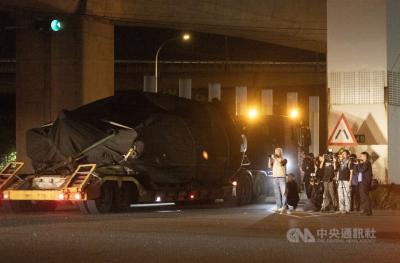
The final batch of 28 M1A2T Abrams tanks purchased from the US arrived at Taipei Port last night and were transported to the Armor Training Command in Hsinchu County’s Hukou Township (湖口), completing the military’s multi-year procurement of 108 of the tanks. Starting at 12:10am today, reporters observed more than a dozen civilian flatbed trailers departing from Taipei Port, each carrying an M1A2T tank covered with black waterproof tarps. Escorted by military vehicles, the convoy traveled via the West Coast Expressway to the Armor Training Command, with police implementing traffic control. The army operates about 1,000 tanks, including CM-11 Brave Tiger
Taiwan Semiconductor Manufacturing Co (TSMC, 台積電), the world’s largest contract chipmaker, said it expects its 2-nanometer (2nm) chip capacity to grow at a compound annual rate of 70 percent from this year to 2028. The projection comes as five fabs begin volume production of 2-nanometer chips this year — two in Hsinchu and three in Kaohsiung — TSMC senior vice president and deputy cochief operating officer Cliff Hou (侯永清) said at the company’s annual technology symposium in Silicon Valley, California, last week. Output in the first year of 2-nanometer production, which began in the fourth quarter of last year, is expected to
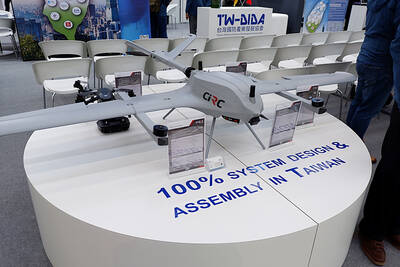
Taiwan’s drone exports surged past US$100 million in the first quarter, exceeding last year’s full-year total, with the Czech Republic emerging as the largest buyer, the Ministry of Economic Affairs said. Exports of complete drones reached US$115.85 million in the period, about 1.2 times the total recorded for all of last year, the ministry said in a report. Exports to the Czech Republic accounted for about US$100 million, far outpacing other markets. Poland, last year’s top destination, recorded about US$11.75 million in the first quarter. Taiwan’s drone exports have expanded rapidly in the past few years, with last year’s total


 RSS
RSS