


A draft amendment to the Organic Regulations for Irrigation and Water Conservancy Associations (農田水利會組織通則) would see the heads of the associations appointed by the government and abolish elections should it be ratified by the legislature, the Executive Yuan said on Thursday.
Premier William Lai (賴清德) pledged that returning associations to government control would result in better services for farmers.
Lai instructed all responsible agencies to discuss the issue with caucuses of all the parties in the legislature.
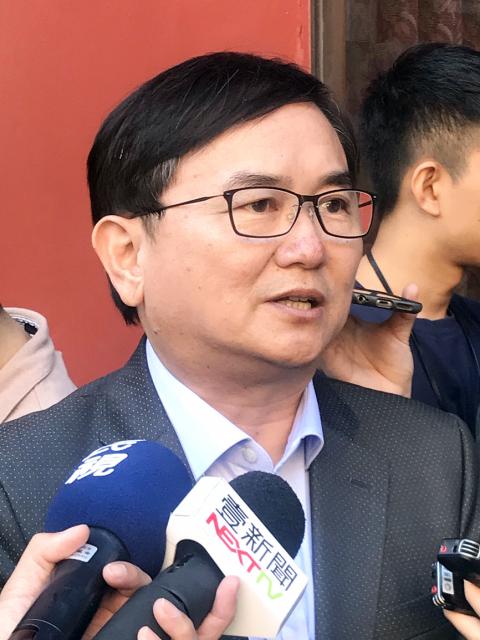
Photo: Su Fang-ho, Taipei Times
“The importance of the amendment should be communicated to the public to win support for the government’s agricultural reforms,” he said.
“To ensure the smooth passage of the new policy, the Council of Agriculture must effectively communicate it to all its staff,” Lai added.
The terms of the heads of the 15 associations in Taipei and Keelung would be extended to Sept. 30, 2020, while the heads of the Taipei Qixing Irrigation Association and Taipei Liugong Irrigation Association would continue to serve until the end of their terms on Sept. 30, 2020.
The government would appoint the heads of the associations after that date, while any vacancies on association committees between now and Sept. 30, 2020, would not be filled by holding an election, he said.
All the associations would need to observe the Civil Service Administrative Neutrality Act (公務人員行政中立法), the Executive Yuan said.
Democratic Progressive Party (DPP) lawmakers expressed support for the policy, while the Chinese Nationalist Party (KMT) questioned the decision and said it would make the associations a tool for political manipulation.
KMT Legislator Wang Hui-mei (王惠美) yesterday said the reform was politically motivated and is a scare tactic to coerce farmers to vote for the DPP, with no consideration of the welfare of farmers.
It remains unclear whether the local government or the Council of Agriculture would be in charge should problems arise, while farmers in non-irrigated areas would also be at a loss as to who they should approach to liaise with the local government, Wang said.
DPP Legislator Liu Chao-hao (劉櫂豪) said such comments were erroneous and that the KMT had also attempted to turn the associations into government agencies.
DPP Legislator Hung Tsung-yi (洪宗熠) said that water, as a public resource, should be handled by the government and not a profit-driven organization.
The policy would encourage administrative neutrality, removing the chance of local factions using the position to gain political influence.
The Taiwan Water Resources Conservation Union said the associations receive annual subsidies of NT$6 billion (US$198.9 million) from the Council of Agriculture, but their accounts remain unsupervised.
Some associations sell water rights illegally, diverting what should have been water for agricultural use to the Southern Taiwan Science Park, the union said.
Union member Nien Li-yu (粘麗玉) called for swift implementation of the new policy.
Additional reporting by Wu Hsin-tien, Yang Mien-chieh and Su Fang-ho

A signaling system malfunction disrupted high-speed rail (HSR) services beginning at 8am today, with trains temporarily reduced to three northbound and three southbound trains per hour as authorities conduct inspections. The malfunction occurred on a section of track in Miaoli County during pre-operation checks early this morning, forcing northbound and southbound trains to use a single track, the HSR operator said. The regular schedule has been replaced with three hourly trains offering only nonreserved seating in each direction, stopping at every station, it said, adding that business class cars would still have reserved seating. Departures from terminal stations are scheduled at the top

Taiwan is still in the process of assessing the possibility of recruiting workers from Eswatini, the Ministry of Foreign Affairs said yesterday, adding that its goal is to help Eswatini upgrade its vocational training centers. If there are plans to recruit workers from Eswatini, safeguarding national security, protecting public health and ensuring the employment rights of Taiwanese would be prerequisites, Department of West Asian and African Affairs Director-General Yen Chia-liang (顏嘉良) told a news conference. Key considerations would also include filling labor shortages in specific industries, and fostering bilateral professional and technical exchanges, he said. Yen was asked about the progress of labor

A US uncrewed surface vessel (USV) encountered multiple Chinese warships during an autonomous transit of the Taiwan Strait, US defense company Seasats said in a statement on Wednesday. Seasats announced that a Lightfish USV had completed the first autonomous transit of the Taiwan Strait. Over five days, the USV traversed the entire length of the Strait while constantly monitoring surface vessel traffic, the company said. The Lightfish encountered multiple Chinese warships, one of which was a Chinese People’s Liberation Army Navy (PLAN) Type 056 corvette, it said. The Chinese vessels were operating “well within Taiwan’s exclusive economic zone without transmitting their identity via the

VERBOSE VESSELS: A CGA cutter and a China Coast Guard exchanged verbal barbs for more than a day in Taiwanese-controlled waters before the Chinese vessel left The Taiwanese and Chinese coast guards had a standoff near the strategically located Pratas Islands (Dongsha Islands, 東沙群島) in the north of the South China Sea, the Coast Guard Administration (CGA) said yesterday. The two sides engaged in intense radio exchanges over sovereignty claims during the 33-hour standoff. China Coast Guard vessel 3501 eventually left the restricted waters, 26.6 nautical miles (49.2km) west of the Pratas Islands, at 5pm yesterday, the CGA said. Lying approximately between southern Taiwan and Hong Kong, the Taiwan-controlled Pratas are seen by some security experts as vulnerable to Chinese attack due to their distance — more than


 RSS
RSS