


With a round of golf, a custom cap and a hamburger of US beef, US President Donald Trump’s first trip to Asia began with a taste of home.
Japanese Prime Minister Shinzo Abe yesterday welcomed Trump with an effusive display of friendship that, in the days ahead, is to give way to high-stakes diplomacy.
The two leaders, who have struck up an unlikely but easy rapport, shared a casual lunch and played nine holes at the Kasumigaseki Country Club, joined by professional golfer Hideki Matsuyama.
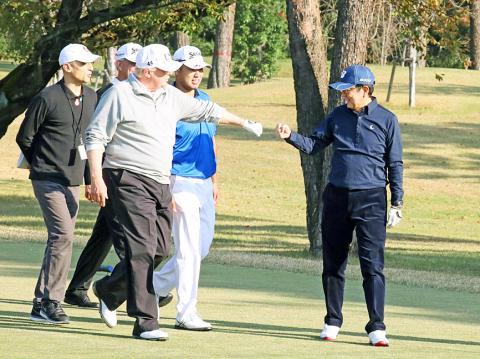
Photo: Reuters / Japan’s Cabinet Public Relations Office / Kyodo
The low-key agenda was a prelude to today’s formal talks and state dinner in Tokyo.
Eager to forge a bond with Tokyo’s crucial ally, Abe was one of the first world leaders to court then-president-elect Trump.
He was the first to call Trump after the last year’s US presidential election, and rushed to New York days later to meet him and present him with a gold Honma golf driver. The two men met on the sidelines of the G7 summit in Italy this spring and Trump hosted Abe in Florida.
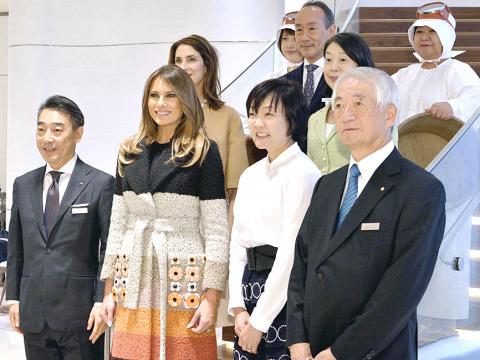
Photo: AFP
White House officials said Trump has spoken with Abe by telephone more than any world leader, aside from British Prime Minister Theresa May.
That bond was clear yesterday.
“The relationship is really extraordinary. We like each other and our countries like each other,” Trump said last night before dinner with Abe, who for this meal did show Trump traditional cuisine with a teppanyaki dinner. “And I don’t think we’ve ever been closer to Japan than we are right now.”
Photo: Bloomberg
Trump and Abe also exchanged glowing tweets about their golf.
Trump dubbed Abe and Matsuyama “wonderful people,” while Abe called it a “round of golf with a marvelous friend.”
Abe told reporters after the golf session that the two could talk frankly in a relaxed atmosphere while out on the course, adding that they were able to “carry out in depth discussion, at times touching on various difficult issues.”

Photo: AFP
A senior White House official, briefing reporters on condition of anonymity, said the pair had discussed trade and North Korea — but did not keep score.
Before the game, Trump delivered a speech at Yokota Air Base near Tokyo in which he hailed Japan as a “crucial ally” and warned adversaries not to test the US’ resolve.
“Japan is a treasured partner and crucial ally of the United States and today we thank them for welcoming us and for decades of wonderful friendship between our two nations,” he told US and Japanese service members.
Although Trump did not mention North Korea by name during the speech, he warned of the consequences of crossing what he called the “most fearsome fighting force in the history of our world.”
“Together with our allies, America’s warriors are prepared to defend our nation using the full range of our unmatched capabilities. No one — no dictator, no regime and no nation — should underestimate, ever, American resolve,” he said.
The newspaper of North Korea’s ruling party, Rodong Sinmun, yesterday warned Trump against making “reckless remarks.”
“If the US misjudges the DPRK’s [Democratic People’s Republic of Korea] toughest will and dares to act recklessly, the latter will be compelled to deal a resolute and merciless punishment upon the former with the mobilization of all forces,” it added.
Additional reporting by AFP

SILENCING CRITICS: In addition to blocking Taiwan, China aimed to prevent rights activists from speaking out against authoritarian states, a Cabinet department said The Ministry of Foreign Affairs (MOFA) yesterday condemned transnational repression by Beijing after RightsCon, a major digital human rights conference scheduled to be held in Zambia this week, was abruptly canceled due to Chinese pressure over Taiwanese participation. This year’s RightsCon, the world’s largest conference discussing issues “at the intersection of human rights and technology,” was scheduled to take place from tomorrow to Friday in Lusaka, and expected to draw 2,600 in-person attendees from 150 countries, along with 1,100 online participants. However, organizers were forced to cancel the event due to behind-the-scenes pressure from China, the ministry said, expressing its “strongest condemnation”
Taiwan’s economy grew far faster than expected in the first quarter, as booming demand for artificial intelligence (AI) applications drove a surge in exports, spilling over into investment and consumption, the Directorate-General of Budget, Accounting and Statistics (DGBAS) said yesterday. GDP growth was 13.69 percent year-on-year during the January-to-March period, beating the DGBAS’ February forecast by 2.23 percentage points and marking the most robust growth in nearly four decades, DGBAS senior official Chiang Hsin-yi (江心怡) told a news conference in Taipei. The result was powered by exports, which remain the backbone of Taiwan’s economy, Chiang said. Outbound shipments jumped 51.12 percent year-on-year to
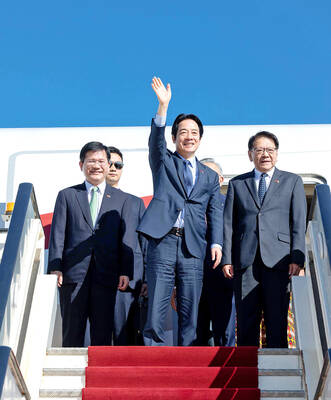
DELAYED BUT DETERMINED: The president’s visit highlights Taiwan’s right to international engagement amid regional pressure from China President Willaim Lai (賴清德) yesterday arrived in Eswatini, more than a week after his planned visit to Taiwan’s sole African ally was suspended because of revoked overflight permits. “The visit, originally scheduled for April 22, was postponed due to unforeseen external factors,” Lai wrote on social media. “After several days of careful arrangements by our diplomatic and national security teams, we successfully arrived today.” Lai said he looked forward to further deepening Taiwan-Eswatini relations through closer cooperation in the economy, agriculture, culture and education, as well as advancing the nation’s international partnerships. The president was initially scheduled to arrive in time to celebrate
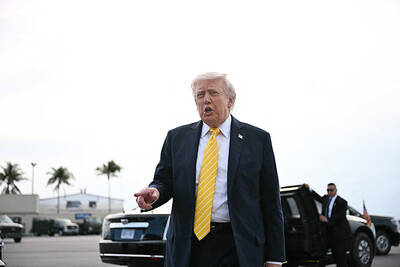
Iran’s Islamic Revolutionary Guard Corp (IRGC) yesterday said the US faced a choice between an “impossible” military operation or a “bad deal” with Tehran, after US President Donald Trump disparaged Iran’s latest peace proposal. Negotiations between the two countries have been deadlocked since a ceasefire came into effect on April 8, with only one round of direct peace talks held so far. Iran’s Tasnim and Fars news agencies reported that Tehran had submitted a 14-point proposal to mediator Pakistan, but Trump was quick to cast doubt on it. “I will soon be reviewing the plan that Iran has just sent to us, but


 RSS
RSS