


The Cabinet and Democratic Progressive Party (DPP) legislators yesterday finalized a draft bill that would allow the government to auction vacant private land in industrial parks in a bid to solve an industrial land shortage.
Land is one of five industrial shortages along with electricity, water, workforce and skilled workers.
The Cabinet on Saturday last week proposed a draft amendment to the Statute for Industrial Innovation (產業創新條例) that stipulates compulsory auction of vacant private land in industrial areas to free more space for factories and businesses.
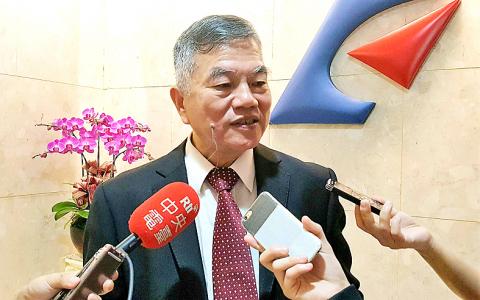
Photo: CNA
Following days of controversy over the constitutionality of the proposal, it was finalized at a meeting between the Cabinet and the DPP caucus without any substantial changes.
According to the proposal, a vacant property is defined as any land on which no structure is built within three years of its acquisition, Executive Yuan spokesman Hsu Kuo-yung (徐國勇) said.
Owners of vacant plots of land would be charged a maintenance fee that is five times the average industrial park maintenance fee and given a two-year grace period to properly utilize the land, Hsu said.
If they fail to comply, they would be given a fine of up to 10 percent of the land’s market value and would have to put forward a plan for the land within a month.
If they still fail to comply, or if negotiations fail, the government could auction the property at a reduced price to the market value, Hsu said.
The two-year grace period cannot be renewed even if a vacant plot is sold before the period expires, meaning that the new owner of the vacant plot would have to utilize the land within the original grace period, he said.
“It is constitutional to limit property rights if they hinder the economy and national development,” Hsu said.
“Property rights come with social responsibility, it is not that property rights cannot be restrained. For example, you cannot build whatever you want on private land, you have to comply with construction and land-use laws,” he said.
Chinese Nationalist Party (KMT) and People First Party lawmakers have criticized the proposal as “authoritarian” and “detrimental to democracy.”
The amendment is to be sent to the legislature for review.
According to the Cabinet, 580 hectares is needed for industrial purposes and the government is working to make 604 hectares available in two years.
Meanwhile, Minister of Economic Affairs Shen Jong-chin (沈榮津) yesterday said the ministry would order the Industrial Development Bureau to speed up the drafting of policy on how to handle idle land, and to propose a grace period between fines and forcible auction.
The bureau also needs to draft a countermeasure to prevent land owners building nonoperational plants on land to deceive the government, Shen said.
“We have to hurry as the Executive Yuan wants us to draft the policy with more details and implement it as soon as possible to alleviate the shortage of land,” Shen told reporters before the ministry’s weekly meeting.
Additional reporting by Lauly Li
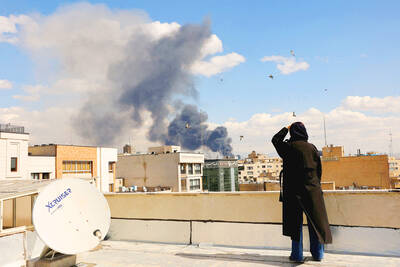
CHAOS: Iranians took to the streets playing celebratory music after reports of Khamenei’s death on Saturday, while mourners also gathered in Tehran yesterday Iranian Supreme Leader Ayatollah Ali Khamenei was killed in a major attack on Iran launched by Israel and the US, throwing the future of the Islamic republic into doubt and raising the risk of regional instability. Iranian state television and the state-run IRNA news agency announced the 86-year-old’s death early yesterday. US President Donald Trump said it gave Iranians their “greatest chance” to “take back” their country. The announcements came after a joint US and Israeli aerial bombardment that targeted Iranian military and governmental sites. Trump said the “heavy and pinpoint bombing” would continue through the week or as long
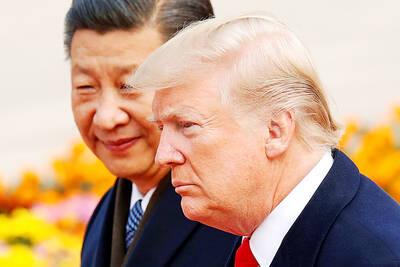
TRUST: The KMT said it respected the US’ timing and considerations, and hoped it would continue to honor its commitments to helping Taiwan bolster its defenses and deterrence US President Donald Trump is delaying a multibillion-dollar arms sale to Taiwan to ensure his visit to Beijing is successful, a New York Times report said. The weapons sales package has stalled in the US Department of State, the report said, citing US officials it did not identify. The White House has told agencies not to push forward ahead of Trump’s meeting with Chinese President Xi Jinping (習近平), it said. The two last month held a phone call to discuss trade and geopolitical flashpoints ahead of the summit. Xi raised the Taiwan issue and urged the US to handle arms sales to

State-run CPC Corp, Taiwan (CPC, 台灣中油) yesterday said that it had confirmed on Saturday night with its liquefied natural gas (LNG) and crude oil suppliers that shipments are proceeding as scheduled and that domestic supplies remain unaffected. The CPC yesterday announced the gasoline and diesel prices will rise by NT$0.2 and NT$0.4 per liter, respectively, starting Monday, citing Middle East tensions and blizzards in the eastern United States. CPC also iterated it has been reducing the proportion of crude oil imports from the Middle East and diversifying its supply sources in the past few years in response to geopolitical risks, expanding
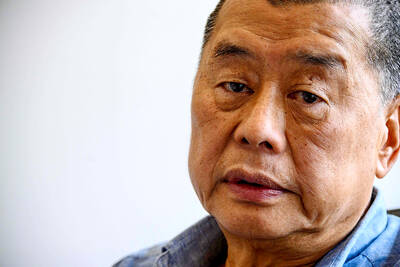
Pro-democracy media tycoon Jimmy Lai’s (黎智英) fraud conviction and prison sentence were yesterday overturned by a Hong Kong court, in a surprise legal decision that comes soon after Lai was jailed for 20 years on a separate national security charge. Judges Jeremy Poon (潘兆初), Anthea Pang (彭寶琴) and Derek Pang (彭偉昌) said in the judgement that they allowed the appeal from Lai, and another defendant in the case, to proceed, as a lower court judge had “erred.” “The Court of Appeal gave them leave to appeal against their conviction, allowed their appeals, quashed the convictions and set aside the sentences,” the judges


 RSS
RSS