


The yolks of duck eggs from two poultry farms in Yunlin County’s Yuanchang Township (元長) that were used in mooncakes were found to contain Sudan IV, a toxic chemical dye, use of which in food is banned, the Council of Agriculture (COA) said yesterday, adding that about 7,000 ducks are to be culled.
Demand for mooncakes rises at this time of the year due to the Mid-Autumn Festival, which is celebrated on the 15th day of the eighth month on the lunar calendar and this year falls on Wednesday next week.
The Food and Drug Administration (FDA) yesterday published the results of tests conducted on 203 mooncakes, which found that mooncakes sold at Tsai Tang Yao (采棠肴) in Taichung contained 1.34 milligrams per kilogram of Sudan IV, a reddish-brown chemical dye.
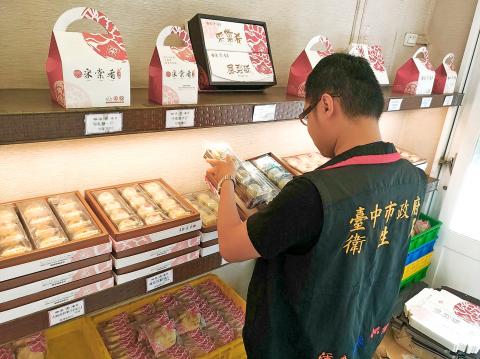
Photo: Tsai Shu-yuan, Taipei Times
According to the Environmental Protection Administration (EPA), Sudan IV is classified as a Category 3 carcinogen by the International Agency for Research on Cancer.
COA Department of Animal Industry Deputy Director Wang Chung-shu (王忠恕) said the tainted egg yolks came from the Yung Hsin (永信) and Chang Yin (張營) poultry farms, which produce and process duck eggs.
Duck eggs from the two farms were found to contain between 12 and 26 parts per billion of Sudan IV, while ducks had between 196 and 308 parts per billion of Sudan IV, COA data showed.
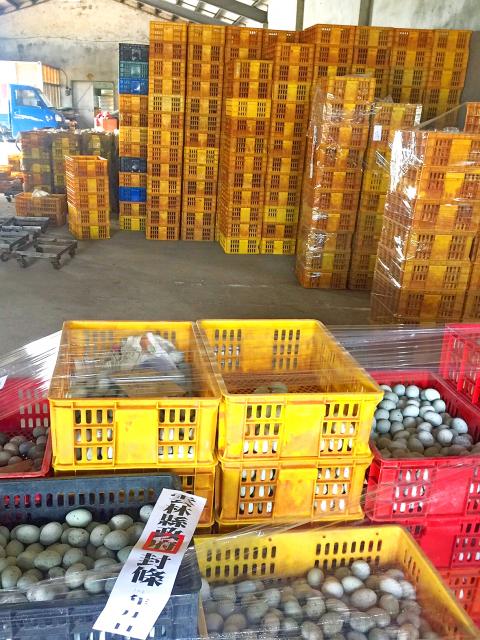
Photo: Liao Shu-ling, Taipei Times
COA, FDA, EPA and Yunlin County Government officials inspected the two farms on Wednesday and Thursday, and prohibited the removal of any ducks or eggs.
A total of about 7,000 ducks at the two farms are to be culled, because Sudan IV lingers in animal bodies for quite a long time, Wang said, adding that as no residue of the chemical was found on feeding equipment, the farmers might have manually added it into the ducks’ feed.
He emphasized that it was an isolated case, as the FDA has not reported similar incidents in the past three years.
Asked about an uptick in tainted egg scares this year, Wang said some farmers who lack professional training might randomly introduce chemicals to feed based on recommendations from neighbors.
Officials are to issue a recall of the two farms’ eggs and products, but Wang admitted that estimating the actual total would be difficult.
He said the farmers said they produce about 17 boxes, or 3,400 eggs, per day, but did not specify when they started mixing the chemical dye into the feed.
The Yunlin District Prosecutors’ Office has launched an investigation, he added.

The National Chungshan Institute of Science and Technology yesterday showcased its locally developed variants of the Vision 60 robotic patrol dog, which it plans to deploy on the nation’s outlying territories in the South China Sea. The variants were produced under the Joint Lab project — created by the institute and domestic companies — and assembled with domestically produced motors, lenses and artificial intelligence (AI) systems alongside licensed tech from the US, Missile and Rocket Systems Research Division deputy director Jen Kuo-kang (任國光) told the media event at a military base in Taipei’s Dazhi (大直) area. Taiwan has built up its strengths

RIGHT DIRECTION: Taiwan’s efforts to prevent forced labor include a proposal to ‘fully prohibit’ employers from withholding workers’ documents, an official said Taiwan is to establish a mechanism to restrict imports of goods linked to forced labor, the Executive Yuan said yesterday, after the US proposed imposing additional tariffs on Taiwanese goods over labor concerns. “The Ministry of Labor and the Ministry of Economic Affairs are to establish an interministerial review procedure,” Executive Yuan spokesperson Michelle Lee (李慧芝) said at a news briefing in Taipei. “The government is to use the Foreign Trade Act [貿易法] as the legal basis to restrict imports of goods produced with forced labor” and bring its supply chain governance more in line with international standards on human rights, resilience

NOT IMMEDIATE: Taiwan has a chance to appeal the proposed 10 percent tariff before it starts, while other countries face a 12.5 percent tariff from the trade office Taiwan is among 60 economies determined by the US to have failed to impose or enforce a ban on the importation of goods produced with forced labor, according to a notice released on Tuesday by the Office of the US Trade Representative (USTR), which proposed imposing an additional 10 percent or more tariff on them. The USTR in a statement said that following an investigation, it had determined under Section 301 of the Trade Act of 1974 that the failure of the 60 economies to impose and effectively enforce a prohibition on the importation of goods produced with forced labor is

TIT-FOR-TAT: The US allegedly revoked the visa of a Chinese national working at Xinhua News Agency in the US in response to Beijing’s expulsion of Vivian Wang The Presidential Office yesterday condemned China for expelling a New York Times correspondent from Beijing following the newspaper’s interview with President William Lai (賴清德), saying the move highlighted Beijing’s suppression of press freedom and its threat to international news media. Taiwan has noted a series of recent incidents in which Beijing used similar tactics to “threaten and pressure international media outlets and journalists,” Presidential Office spokeswoman Karen Kuo (郭雅慧) said in a statement. “This concerns not only press freedom and freedom of expression, but also the safety of journalists, and Taiwan and relevant partners are paying close attention to the situation,” she


 RSS
RSS