


The Cabinet has tabled 72 priority bills for the new legislative session, including a draft amendment to the national workweek scheme.
While its top five priorities are the annual government budgets for this year and next, the budget for a two-year river management plan, an amendment to the workweek scheme and a tax reform proposal, the proposal that is attracting the most attention is one to amend the Labor Standards Act (勞動基準法) to establish what the Executive Yuan has called a“safe and flexible work scheme.”
The bill will be the first proposal from the Cabinet on the workweek policy, as changes to the act that were promulgated in December last year were drafted by the Democratic Progressive Party (DPP) caucus, Executive Yuan spokesman Hsu Kuo-yung (徐國勇) said yesterday following a coordination meeting between the Executive Yuan and DPP caucus.
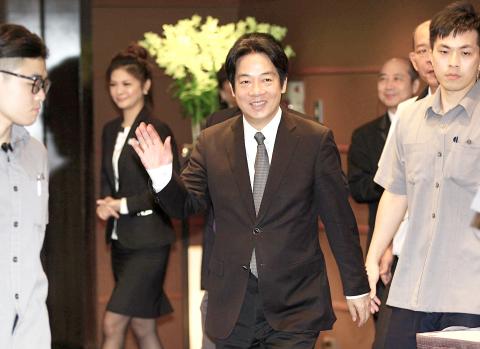
Photo: CNA
DPP lawmakers had suggested that the Cabinet propose its own draft, and Premier William Lai (賴清德) agreed, Hsu said.
“The Executive Yuan must have its own position on such a major bill as the workweek policy. The minutes [of the draft bill] are to be made public after we make a final decision after being questioned by lawmakers during the legislative session,” Lai said earlier in the day on the sideline of a forum on dengue fever prevention.
Lawmakers have already proposed three amendments to modify the workweek regulations by modifying overtime pay rates, annual leave schemes and working hour flexibility, Hsu said.
The Cabinet is not predisposed to any one legislative direction, he said.
The Cabinet has divided the 72 priority bills into eight categories: 14 bills covering economic development, six on “smart country” policies, four on “green” energy policy, five on cultural policies, 23 covering social welfare and transitional justice, 10 on food and drug safety, six on government efficiency and four covering cross-strait relations.
Key draft bills include a proposed amendment to the Referendum Act (公民投票法) to lower the threshold for launching a referendum; draft pension reform bills for the private sector and military personnel; a proposal to relax the Assembly and Parade Act (集會遊行法); one on the Mining Act (礦業法) to tighten mining requirements; a transitional justice promotional act; and an amendment to the Statute for Industrial Innovation (產業創新條例) to resolve shortages of water, power, land, workforce and skilled workers.
A draft cross-strait oversight bill has also been listed as a priority, although it had been a priority bill for the past three legislative sessions, but failed to progress.
There are only 28 plenary sessions during the new session, and the agenda is already crowded with the review of general government budgets, state-run business budgets and other important bills, which will make it a challenge to review the workweek proposals, DPP caucus whip Ker Chien-ming (柯建銘) said.
The new session opens on Friday.
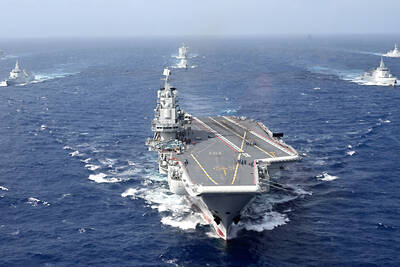
PROVOCATIVE: Chinese Deputy Ambassador to the UN Sun Lei accused Japan of sending military vessels to deliberately provoke tensions in the Taiwan Strait China denounced remarks by Japan and the EU about the South China Sea at a UN Security Council meeting on Monday, and accused Tokyo of provocative behavior in the Taiwan Strait and planning military expansion. Ayano Kunimitsu, a Japanese vice foreign minister, told the Council meeting on maritime security that Tokyo was seriously concerned about the situation in the East China and South China seas, and reiterated Japan’s opposition to any attempt to change the “status quo” by force, and obstruction of freedom of navigation and overflight. Stavros Lambrinidis, head of the EU delegation to the UN, also highlighted South China Sea
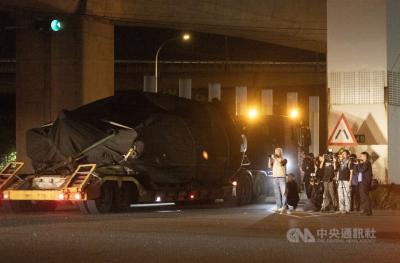
The final batch of 28 M1A2T Abrams tanks purchased from the US arrived at Taipei Port last night and were transported to the Armor Training Command in Hsinchu County’s Hukou Township (湖口), completing the military’s multi-year procurement of 108 of the tanks. Starting at 12:10am today, reporters observed more than a dozen civilian flatbed trailers departing from Taipei Port, each carrying an M1A2T tank covered with black waterproof tarps. Escorted by military vehicles, the convoy traveled via the West Coast Expressway to the Armor Training Command, with police implementing traffic control. The army operates about 1,000 tanks, including CM-11 Brave Tiger
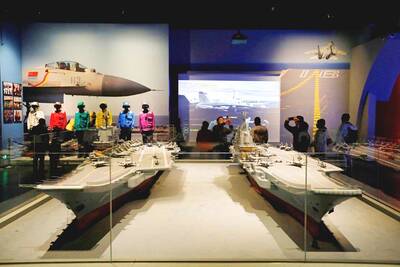
China on Wednesday teased in a video an aircraft carrier that could be its fourth, and the first using nuclear power, while making an allusion to Taiwan and vowing to further build up its islands, as it looks to boost maritime power, secure resources and bolster territorial claims. The video, issued on the eve of the 77th founding anniversary of the Chinese People’s Liberation Army Navy, featured fictional officers with names that are homophones of three commissioned aircraft carriers, the Liaoning (遼寧), Shandong (山東) and Fujian (福建). Titled Into the Deep, it showed a 19-year-old named “Hejian” (何劍) joining the group, sparking
BIG YEAR: The company said it would also release its A12 chip the same year to keep a ‘reliable stream of new silicon technologies’ flowing to its customers Taiwan Semiconductor Manufacturing Co (TSMC, 台積電) yesterday said its newest A13 chip is to enter volume production in 2029 as the chipmaker seeks to hold onto its tech leadership and demand for next-generation chips used in artificial intelligence (AI), high-performance-computing (HPC) and mobile applications. TSMC, the world’s biggest contract chipmaker, also unveiled its A12 chip at its annual technology symposium in Santa Clara, California. The A12 chip, which features TSMC’s super-power-rail technology to provide backside power delivery for AI and HPC applications, is also to enter volume production in 2029, a year after the scheduled release of the A14 chip. The technology moves


 RSS
RSS