


The Taipei Universiade Organizing Committee said it respects each delegation’s decision to attend the Games after a tweet indicated that Uganda might not attend because its government conforms to Beijing’s “one China” policy.
Norman Katende, who was director of media communications at the IAAF World Cross Country Championships Kampala, said in a tweet that the Ugandan team had been ordered not to attend because of their country’s adherence to the “one China” policy.
Katende included an image that he said was a photograph of a directive from the Ugandan Ministry of Foreign Affairs to the Ugandan Ministry of Education advising the national team not to attend the Universiade.
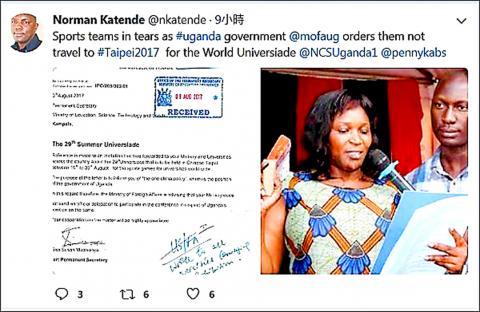
Screenshot from Norman Katende’s Twitter account
The Universiade organizing committee had received a submission from Uganda, which was planning to send 48 athletes to compete in five different events.
The committee has reached out to understand the situation and the Uganda team is still deliberating, Taipei Universiade Organizing Committee spokesman Yang Ching-tang (楊景棠) said yesterday.
“The committee will make good preparations and respect all qualified delegations’ decision on joining the Games,” he said.
Ministry of Foreign Affairs spokeswoman Eleanor Wang (王珮玲) said at a news briefing yesterday that Ugandan athletes are still discussing with their government whether to take part as scheduled.
At 3:50pm yesterday, Katende replied to his post, saying: “We will have Team Uganda at the Games,” and tagged Makerere University Sports and Recreation Department head Peninah Kabenge, saying that she has confirmed the decision.
Kabenge retweeted Katende’s post and added: “Finally sorted out. Overreaction and misunderstanding cleared up.”
Meanwhile, responding to a media report claiming that about 10 teams might not attend the Games, Yang yesterday said that the registration for the Games includes several stages, so delegations that said “yes” in the participation intention survey are not necessarily qualified.
“The committee received 152 participation intention responses, but they must be further qualified to attend the Games,” he said. “For example, the athletes’ scores must reach a given standard and they must be within their age limit.
The actual number of teams and athletes would be announced with the finalized match schedule, he added.
Additional reporting by CNA
SECURITY: Taipei presses the US for arms supplies, saying the arms sales are not only a reflection of the US security commitment to Taiwan but also serve as a mutual deterrent against regional threats Taiwan is committed to preserving the cross-strait “status quo” and contributing to regional peace and stability, the Presidential Office said yesterday. “It is an undeniable fact that the Republic of China is a sovereign and independent democratic nation,” Presidential Office spokeswoman Karen Kuo (郭雅慧) reiterated, adding that Beijing has no right to claim sovereignty over Taiwan. The statements came after US President Donald Trump warned against Taiwanese independence. Trump wrapped up a state visit to Beijing on Friday, during which Chinese President Xi Jinping (習近平) had pressed him not to support Taiwan. Taiwan depends heavily on US security backing to deter China from carrying

The subsidiary of Taiwan Semiconductor Manufacturing Co (TSMC, 台積電) in Kumamoto, Japan, turned a profit in the first quarter of this year, marking the first time the first fab of the unit has become profitable since mass production started at the end of 2024. According to the contract chipmaker’s financial statement released on Friday, Japan Advanced Semiconductor Manufacturing Inc (JASM), a joint venture running the fab in Kumamoto, posted NT$951 million (US$30.19 million) in profit in the January-to-March period, compared with a loss of NT$1.39 billion in the previous quarter, and a loss of NT$3.25 billion in the first quarter of
RESOLUTE BACKING: Two Republican senators are planning to introduce legislation that would impose immediate sanctions on China if it attempts to invade Taiwan US House of Representatives Speaker Mike Johnson on Sunday reaffirmed US congressional support for Taiwan, saying the US and “all freedom-loving people” have a stake in preventing China from seizing Taiwan by force. Johnson made the remarks in an interview with Fox News Sunday on US President Donald Trump’s summit with Chinese President Xi Jinping (習近平) last week. In an interview that aired on Friday on Fox News, just as Trump wrapped up a high-stakes visit to China, he said he has yet to green-light a new US$14 billion arms package to Taiwan and that it “depends on China.” “It’s a very good
US President Donald Trump yesterday said he would speak to President William Lai (賴清德) as his administration considers whether to move ahead with a US$14 billion weapons sale to Taiwan — a potential arms deal that has drawn criticism from China. “Well, I’ll speak to him. I speak to everybody,” Trump told reporters yesterday when asked if he had any plans to call his counterpart, although he did not offer a time frame for when such a conversation could take place. Trump previously said he would speak to the person “that’s running Taiwan,” without specifying who he meant. “We have that situation very


 RSS
RSS