


A South Korean man wanted in connection with the theft of property from the Democratic Progressive Party’s (DPP) headquarters on Tuesday, who briefly managed to flee the country, was apprehended yesterday in Wulai District (烏來), New Taipei City police said.
After receiving tip-offs from members of the public, police tracked down Cho Jun-ki, 34, and his South Korean girlfriend to the Pause Landis Resort (樸石麗緻溫泉會館), but Cho fled the hotel.
A police search located Cho in a roadside hut about noon and he was taken to the Criminal Investigation Bureau (CIB) for questioning.
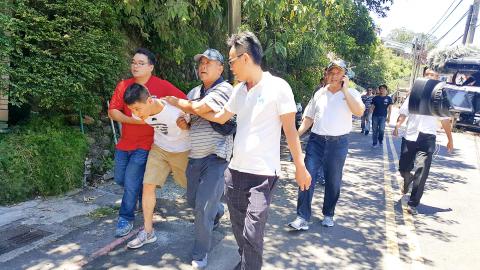
Photo: Yao Yue-hung, Taipei Times
As he was escorted by police, Cho said: “Taiwan sorry.”
“The suspect is a wanted criminal; Interpol issued a red alert for him. He has been involved in more than 20 theft cases in South Korea and is a suspect of several thefts in Thailand, Macau and the Philippines,” Deputy CIB Chief Huang Ming-chao (黃明昭) said.
“It has been a successful operation. The tip-offs we received from the public and assistance from media outlets enabled us to narrow the search down to a small area,” he said.
A CIB team coordinated with local police to close off roads and hiking trails into the mountains around Wulai after receiving reports that a man fitting Cho’s description had been seen in the area, he said.
The bureau said Cho entered Taiwan on Monday last week on a tourist visa, arriving on a flight from Thailand, and took a room at the W Hotel in Taipei.
He allegedly entered the DPP’s headquarters early on Tuesday and took NT$90,000 and possibly other items.
As of press time last night, Cho was still being questioned by investigators, who want to know if he had any Taiwanese accomplices, if he carried out other thefts while in Taiwan, if he took any classified materials from the DPP office and whether he was acting on instructions from people or groups in Taiwan or another nation.
While the DPP issued a statement on Tuesday that said only money had been taken in the robbery, and that no files or equipment were touched, there are concerns that national security might have been compromised, as President Tsai Ing-wen (蔡英文), as DPP chair, often holds meetings and consultations at the DPP’s offices.
Investigators said Cho had told them that he acted alone and the theft was not politically motivated.
“I just chose a big commercial building. It was a spur of the moment thing. I did not know it was the headquarters of Taiwan’s ruling party,” investigators quoted him as saying.
Questions have also been raised about National Immigration Agency procedures and security at Taiwan Taoyuan International Airport because Cho on Tuesday left Taiwan on a Tigerair flight to Japan, but Japanese authorities refused him entry because he did not have a valid South Korean passport and he was put on a return fligh to Taiwan.
Despite the lack of a valid South Korean passport and being on Interpol’s red alert list, he was able to re-renter Taiwan.
Investigators believe that he might have been able to evade immigration procedures upon his return by going through an unguarded desk, or by jumping from the customs control floor to the ground floor.
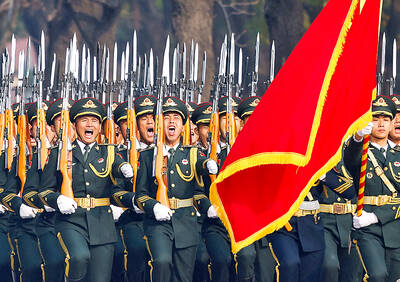
Conflict with Taiwan could leave China with “massive economic disruption, catastrophic military losses, significant social unrest, and devastating sanctions,” a US think tank said in a report released on Monday. The German Marshall Fund released a report titled If China Attacks Taiwan: The Consequences for China of “Minor Conflict” and “Major War” Scenarios. The report details the “massive” economic, military, social and international costs to China in the event of a minor conflict or major war with Taiwan, estimating that the Chinese People’s Liberation Army (PLA) could sustain losses of more than half of its active-duty ground forces, including 100,000 troops. Understanding Chinese
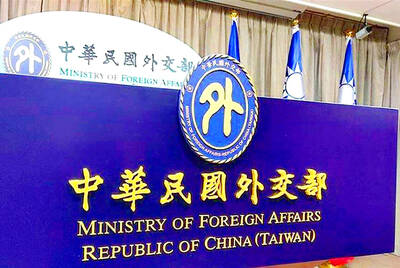
The Ministry of Foreign Affairs (MOFA) yesterday said it is closely monitoring developments in Venezuela, and would continue to cooperate with democratic allies and work together for regional and global security, stability, and prosperity. The remarks came after the US on Saturday launched a series of airstrikes in Venezuela and kidnapped Venezuelan President Nicolas Maduro, who was later flown to New York along with his wife. The pair face US charges related to drug trafficking and alleged cooperation with gangs designated as terrorist organizations. Maduro has denied the allegations. The ministry said that it is closely monitoring the political and economic situation

UNRELENTING: China attempted cyberattacks on Taiwan’s critical infrastructure 2.63 million times per day last year, up from 1.23 million in 2023, the NSB said China’s cyberarmy has long engaged in cyberattacks against Taiwan’s critical infrastructure, employing diverse and evolving tactics, the National Security Bureau (NSB) said yesterday, adding that cyberattacks on critical energy infrastructure last year increased 10-fold compared with the previous year. The NSB yesterday released a report titled Analysis on China’s Cyber Threats to Taiwan’s Critical Infrastructure in 2025, outlining the number of cyberattacks, major tactics and hacker groups. Taiwan’s national intelligence community identified a large number of cybersecurity incidents last year, the bureau said in a statement. China’s cyberarmy last year launched an average of 2.63 million intrusion attempts per day targeting Taiwan’s critical
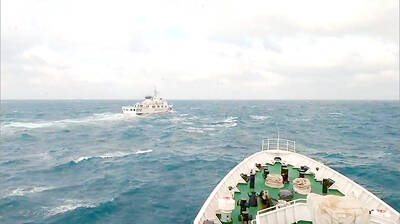
‘SLICING METHOD’: In the event of a blockade, the China Coast Guard would intercept Taiwanese ships while its navy would seek to deter foreign intervention China’s military drills around Taiwan this week signaled potential strategies to cut the nation off from energy supplies and foreign military assistance, a US think tank report said. The Chinese People’s Liberation Army (PLA) conducted what it called “Justice Mission 2025” exercises from Monday to Tuesday in five maritime zones and airspace around Taiwan, calling them a warning to “Taiwanese independence” forces. In a report released on Wednesday, the Institute for the Study of War said the exercises effectively simulated blocking shipping routes to major port cities, including Kaohsiung, Keelung and Hualien. Taiwan would be highly vulnerable under such a blockade, because it


 RSS
RSS