


The Legislative Yuan yesterday issued a letter to the Chinese-language China Times asking it to explain an incident on Wednesday last week in which one of its interns hurled water balloons at Democratic Progressive Party (DPP) lawmakers during a joint committee review of the budget for the Forward-looking Infrastructure Program.
The move came a day after the legislature said it would file charges against the intern, Han Fu-yu (韓福宇) — with video footage showing him throwing several water balloons at DPP lawmakers while filming himself using a cellphone — on suspicion of violating the Code of Criminal Procedure (刑事訴訟法) and the Social Order Maintenance Act (社會秩序維護法).
The legislature asked the China Times’ entertainment section deputy editor-in-chief, Chang Yi-wen (張怡文), who had brought Han and two other interns to the meeting, to give a thorough account of the incident, saying they had breached rules on visits to the legislature, as well as guidelines on the use of interview permits.
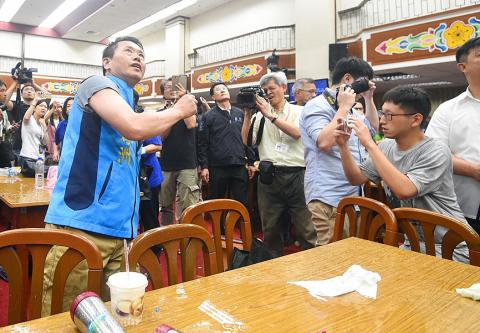
Photo: Liao Chen-huei, Taipei Times
“Han, who attacked the rostrum with water balloons, obstructed the proceedings and interfered with legislators exercising their authority, is suspected of having committed a serious violation,” Legislative Yuan Secretary-General Lin Chih-chia (林志嘉) said.
The China Times issued a three-point statement in response to the legislature amid speculation that Han, a Taiwanese student and recipient of a scholarship from Beijing’s Communication University of China, could be a spy working for Chinese intelligence authorities.
It is impossible that Han could be a spy for the Chinese Communist Party, as he is not a member of the Communist Youth League of China, the media outlet said.
Han once joined the Beijing Volunteer Association aimed at serving Chinese society, but he has withdrawn from the organization, it said.
It is regrettable that the incident, a young man’s impulsive act, has been exaggerated to the extent that some say it is a national security issue, it said.
“Legislators threw water balloons first and set a bad example for the interns, who were there to learn. The Legislative Yuan should take the lawmakers to court rather than hunt down a student,” the China Times said.
Chinese Nationalist Party (KMT) caucus secretary-general Lin Wei-chou (林為洲) called on the legislature not to be too severe on Han.
“We should be more tolerant of a young man’s impulsive behavior, just like how students that occupied the Executive Yuan during the Sunflower movement were treated with considerably more tolerance than they would have been treated under normal circumstances,” he said, referring to former premier Jiang Yi-huah (江宜樺) having dropped charges against Sunflower protesters.
Some netizens also drew a parallel between Han’s behavior and the Sunflower movement, accusing the DPP of applying double standards.
Others disagreed, saying they do not see the connection between the two incidents.
“If he was so upset, he could have launched a movement to occupy the legislature like they did during the Sunflower movement. Taking a selfie of yourself throwing water balloons at lawmakers shows an extreme lack of self-discipline and judgment,” a netizen said.
“Is what the Sunflower movement taught us tantamount to just three water balloons?” another said.
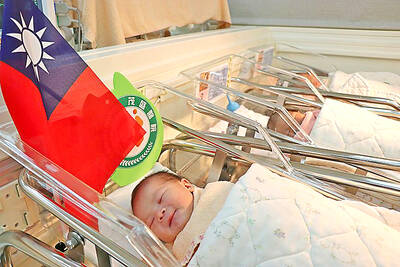
AGING: As of last month, people aged 65 or older accounted for 20.06 percent of the total population and the number of couples who got married fell by 18,685 from 2024 Taiwan has surpassed South Korea as the country least willing to have children, with an annual crude birthrate of 4.62 per 1,000 people, Ministry of the Interior data showed yesterday. The nation was previously ranked the second-lowest country in terms of total fertility rate, or the average number of children a woman has in her lifetime. However, South Korea’s fertility rate began to recover from 2023, with total fertility rate rising from 0.72 and estimated to reach 0.82 to 0.85 by last year, and the crude birthrate projected at 6.7 per 1,000 people. Japan’s crude birthrate was projected to fall below six,
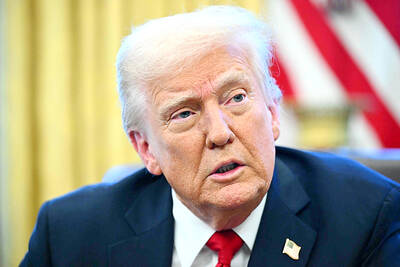
US President Donald Trump in an interview with the New York Times published on Thursday said that “it’s up to” Chinese President Xi Jinping (習近平) what China does on Taiwan, but that he would be “very unhappy” with a change in the “status quo.” “He [Xi] considers it to be a part of China, and that’s up to him what he’s going to be doing, but I’ve expressed to him that I would be very unhappy if he did that, and I don’t think he’ll do that. I hope he doesn’t do that,” Trump said. Trump made the comments in the context
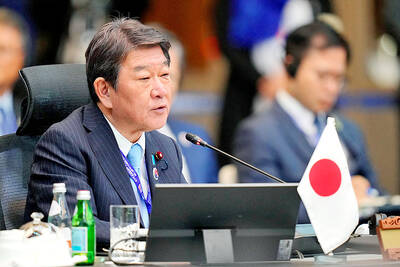
SELF-DEFENSE: Tokyo has accelerated its spending goal and its defense minister said the nation needs to discuss whether it should develop nuclear-powered submarines China is ramping up objections to what it sees as Japan’s desire to acquire nuclear weapons, despite Tokyo’s longstanding renunciation of such arms, deepening another fissure in the two neighbors’ increasingly tense ties. In what appears to be a concerted effort, China’s foreign and defense ministries issued statements on Thursday condemning alleged remilitarism efforts by Tokyo. The remarks came as two of the country’s top think tanks jointly issued a 29-page report framing actions by “right-wing forces” in Japan as posing a “serious threat” to world peace. While that report did not define “right-wing forces,” the Chinese Ministry of Foreign Affairs was

PREPAREDNESS: Given the difficulty of importing ammunition during wartime, the Ministry of National Defense said it would prioritize ‘coproduction’ partnerships A newly formed unit of the Marine Corps tasked with land-based security operations has recently replaced its aging, domestically produced rifles with more advanced, US-made M4A1 rifles, a source said yesterday. The unnamed source familiar with the matter said the First Security Battalion of the Marine Corps’ Air Defense and Base Guard Group has replaced its older T65K2 rifles, which have been in service since the late 1980s, with the newly received M4A1s. The source did not say exactly when the upgrade took place or how many M4A1s were issued to the battalion. The confirmation came after Chinese-language media reported


 RSS
RSS