


The government has created a legal loophole in the Forward-looking Infrastructure Development Program by rushing it through, allowing it to raise the program’s budget indefinitely, publisher and former national policy adviser Rex How (郝明義) said yesterday, calling for an amendment and an overhaul of the program.
There is no sunset clause in the Special Act on the Forward-looking Infrastructure Development Program (前瞻基礎建設特別條例), nor is there any clause specifying a budget cap, How said.
The act does not specify an end date and while it stipulates a four-year maximum budget of NT$420 billion (US$13.73 billion), which can be extended following legislative approval, there is no clear limitation on the timing and budget extension, How said.
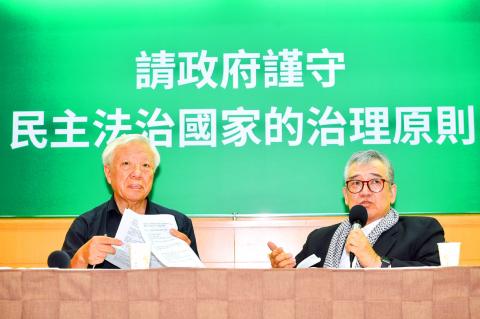
Photo: Peter Lo, Taipei Times
The draft proposal stipulated a maximum NT$882.4 billion budget over eight years, but the budget cap and the sunset provision are not included in the final version that has been passed into law, he said.
“The act will have a permanent effect before the Legislative Yuan abolishes it, and the [budget extension] clause will allow the ruling party — regardless of which party it is — to raise a budget of NT$420 billion every four years,” How said, citing National Taiwan University politics professor Liu Ching-yi’s (劉靜怡) criticism of the act.
Following the passage of the act on Wednesday last week, Liu and civic groups raised doubts over the apparent flaw in the legislation, but the Cabinet rejected their accusations as “false” and “unfounded,” with Executive Yuan spokesman Hsu Kuo-yung (徐國勇) accusing Liu of “rumormongering” and asking the public “not to be too picky about the wording” of the legislation.
“The government has either discredited its critics or explained away the criticism made against it,” How said.
The Executive Yuan should have requested a reconsideration of the act given the apparent flaw, but President Tsai Ing-wen (蔡英文) promulgated the act on Friday, How said.
“The top priority of running a democratic nation is procedural [justice]. It violates the principles of a democratic nation if government leaders only care about the effectiveness [of a policy] at the expense of procedural [justice],” How said.
“If the government continues to act without checks and balances, it will become an autocracy,” he said.
How asked the Legislative Yuan to amend the law to include a sunset clause and a budget cap, and asked the Executive Yuan to propose a new infrastructure program that takes public opinion into consideration.
How’s suggestions have been endorsed by former Democratic Progressive Party (DPP) legislator Lin Choi-shui (林濁水) and Academia Sinica sociologist Chiu Hei-yuan (瞿海源).
Chiu said he had relayed How’s suggestions to Tsai during the National Congress on Judicial Reform on Monday, adding that she reacted positively to the suggestions.
While asking the DPP to propose an amendment to include a sunset provision and a budget cap, Chiu also urged the Chinese Nationalist Party (KMT) not to boycott a review of the proposed budgets, but to ensure a thorough review.
At a separate news conference, New Power Party Executive Chairman Huang Kuo-chang (黃國昌) also lambasted the Executive Yuan for rushing the infrastructure program budget review.
Presidential Office spokesman Sidney Lin (林鶴明) said the government has taken note of the suggestions voiced by How and others, and the Cabinet had already responded by providing correct and complete information.
The legislature is to debate the infrastructure budget during the budget review, Sidney Lin added.
Additional reporting by Su Fang-ho and Yang Chun-hui

PREPAREDNESS: Given the difficulty of importing ammunition during wartime, the Ministry of National Defense said it would prioritize ‘coproduction’ partnerships A newly formed unit of the Marine Corps tasked with land-based security operations has recently replaced its aging, domestically produced rifles with more advanced, US-made M4A1 rifles, a source said yesterday. The unnamed source familiar with the matter said the First Security Battalion of the Marine Corps’ Air Defense and Base Guard Group has replaced its older T65K2 rifles, which have been in service since the late 1980s, with the newly received M4A1s. The source did not say exactly when the upgrade took place or how many M4A1s were issued to the battalion. The confirmation came after Chinese-language media reported
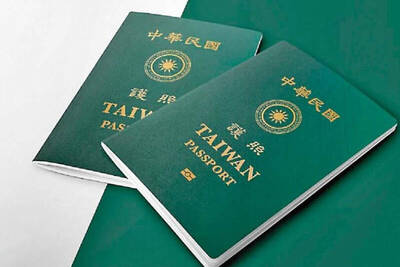
The Taiwanese passport ranked 33rd in a global listing of passports by convenience this month, rising three places from last month’s ranking, but matching its position in January last year. The Henley Passport Index, an international ranking of passports by the number of designations its holder can travel to without a visa, showed that the Taiwan passport enables holders to travel to 139 countries and territories without a visa. Singapore’s passport was ranked the most powerful with visa-free access to 192 destinations out of 227, according to the index published on Tuesday by UK-based migration investment consultancy firm Henley and Partners. Japan’s and
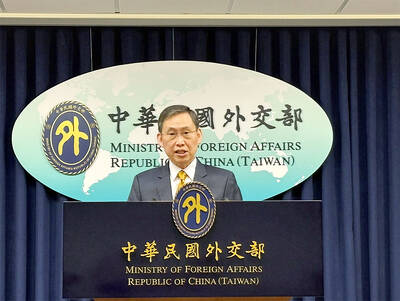
A Ministry of Foreign Affairs official yesterday said that a delegation that visited China for an APEC meeting did not receive any kind of treatment that downgraded Taiwan’s sovereignty. Department of International Organizations Director-General Jonathan Sun (孫儉元) said that he and a group of ministry officials visited Shenzhen, China, to attend the APEC Informal Senior Officials’ Meeting last month. The trip went “smoothly and safely” for all Taiwanese delegates, as the Chinese side arranged the trip in accordance with long-standing practices, Sun said at the ministry’s weekly briefing. The Taiwanese group did not encounter any political suppression, he said. Sun made the remarks when

BROAD AGREEMENT: The two are nearing a trade deal to reduce Taiwan’s tariff to 15% and a commitment for TSMC to build five more fabs, a ‘New York Times’ report said Taiwan and the US have reached a broad consensus on a trade deal, the Executive Yuan’s Office of Trade Negotiations said yesterday, after a report said that Washington is set to reduce Taiwan’s tariff rate to 15 percent. The New York Times on Monday reported that the two nations are nearing a trade deal to reduce Taiwan’s tariff rate to 15 percent and commit Taiwan Semiconductor Manufacturing Co (TSMC, 台積電) to building at least five more facilities in the US. “The agreement, which has been under negotiation for months, is being legally scrubbed and could be announced this month,” the paper said,


 RSS
RSS