


Following a US diplomatic faux pas in which Chinese President Xi Jinping (習近平) was referred to as “President Xi of the Republic of China,” the Ministry of Foreign Affairs said it has been using both “the Republic of China (ROC)” and “Taiwan” alternatively as the nation’s name since President Tsai Ing-wen (蔡英文) took office.
A White House transcript of US President Donald Trump’s public remarks with Xi in Hamburg, Germany, was released — before the two men met on the sidelines of the G20 summit — by White House press secretary Sean Spicer, referring to Xi as the president of the Republic of China.
The White House did not immediately comment on the diplomatic blunder, but it later corrected Xi’s title to “President Xi of China” without issuing a notice of retraction.
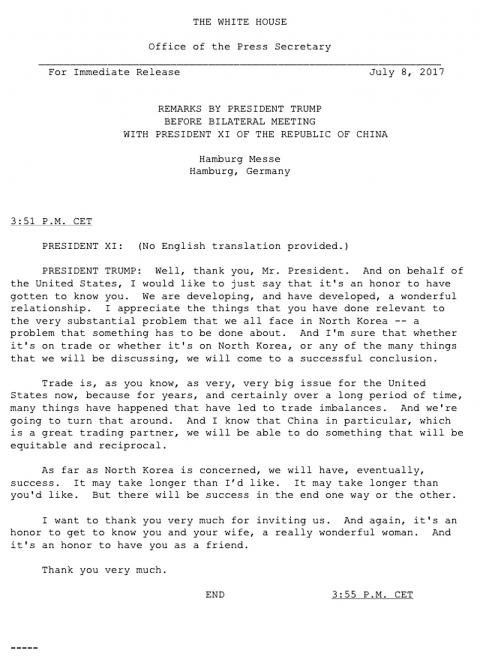
Photo: CNA
Since Tsai took office, the ministry said it has begun calling foreign dignitaries’ visits to Taiwan in its news releases as “fang tai” (訪台) — which means visiting Taiwan — instead of “fang hua” (訪華), which mean visiting Zhonghua Minguo (中華民國), the ROC.
The Legislative Yuan’s Foreign and National Defense Committee last year advised the ministry to make as many references to Taiwan as possible in its communications with foreign governments to help counter China’s claims that Taiwan belongs to it.
At the time, the ministry responded positively, saying that it did not foresee any obstacles to implementing the policy and that it would do so when circumstances permit.
Democratic Progressive Party (DPP) Legislator Tsai Shih-ying (蔡適應) yesterday said the ministry’s policy favoring the use of the name Taiwan in communications is appropriate, as Taiwan is a “neutral geographic term.”
“As proven by the fact that polls show more than half of the nation’s population agrees that ‘Taiwan’ should someday replace ‘the Republic of China’ as the name of the nation, Taiwanese identify with their land far more than with the fictitious ROC. This issue is separate from declaring a ‘Republic of Taiwan,’ and it will prevent foreign allies from confusing us with China,” the lawmaker said.
In related news, DPP Tainan City Councilor Lee Wen-cheng (李文正) yesterday said the continued use of the term “China” as part of the nation’s name can foster confusion with the People’s Republic of China.
Members of the public had complained that the Web site of Malaysia’s national railways company, KTM, identifies Taiwan as “Province of Taiwan” and “Taiwan, Province of China,” while Hong Kong is identified simply as “Hong Kong.”
It is saddening that the nation’s foreign affairs officials are idle at their posts while collecting their salaries, he said.
The public must understand that Taiwan’s sovereignty “will not fall from the heavens into our laps or be granted through Chinese charity,” he said, adding that he would call on Malaysia’s representative office to urge the Web site be corrected.
The ministry last night said that it had ordered its representative office in Kuala Lumpur to demand that the Malaysian Ministry of Transport make corrections.
“As long as Taiwan uses the name ‘Republic of China,’ we will be associated with China. China does not care how much goodwill we show to it, because it can tell the world that Taiwan is its province, as seen with KTM. For Taiwan to be respected, the fundamental solution is to tell the world that the nation is not part of the ROC or China, without ambiguity,” Tsai said.

‘NO SECURITY RISK’: The Railway Bureau reassured the public that the technicians’ activities were limited to technical guidance and did not involve sensitive systems The Railway Bureau yesterday said it had invited eight Chinese technicians to assist with an airport MRT construction project. The bureau issued the confirmation after an Internet user said Chinese nationals had entered the construction zone of Taiwan Taoyuan International Airport’s Terminal 3 project. They asked why “individuals from an enemy state” were allowed access to such a major national infrastructure project, which raised serious concerns over Taiwan’s industrial safety, sensitive systems and information security. The bureau’s Northern Region Engineering Branch Office said subcontractor Taiwan Handle Industrial Co (台灣手把工業) of the Taoyuan airport MRT’s “Contract No. CU05 Project A14 Station Civil, MEP &

A US uncrewed surface vessel (USV) encountered multiple Chinese warships during an autonomous transit of the Taiwan Strait, US defense company Seasats said in a statement on Wednesday. Seasats announced that a Lightfish USV had completed the first autonomous transit of the Taiwan Strait. Over five days, the USV traversed the entire length of the Strait while constantly monitoring surface vessel traffic, the company said. The Lightfish encountered multiple Chinese warships, one of which was a Chinese People’s Liberation Army Navy (PLAN) Type 056 corvette, it said. The Chinese vessels were operating “well within Taiwan’s exclusive economic zone without transmitting their identity via the
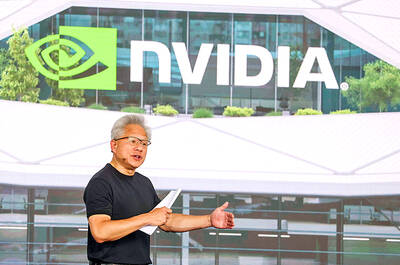
‘BOOMING’: ’ The number of partners we have here is incredible. You can see from their stock prices. They’re doing so well, they’re so happy,’ Jensen Huang said Nvidia Corp’s spending in Taiwan has ballooned to about US$150 billion a year, 10 times the US$10 billion to US$15 billion the company spent five years ago, Nvidia chief executive officer Jensen Huang (黃仁勳) said yesterday, suggesting Taiwan’s strategic importance in the global artificial intelligence (AI) supply chain. “Taiwan is the epicenter of the AI revolution. This is where the chips come, packaging comes. This is where the systems are made. This is where AI supercomputers were created,” Huang said at a meeting for the company’s employees in Beitou-Shilin Technology Park (北投士林科技園區) in Taipei, the planned site of Nvidia’s Taipei headquarters. “Taiwan
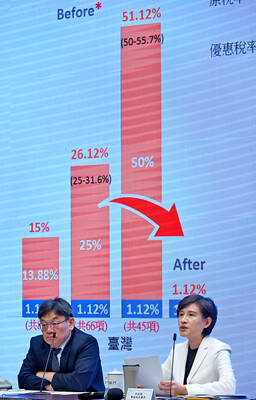
GREATER REACH? Auto parts and wood products would face tariffs of up to 15%, matching those targeting the EU, Japan and South Korea, Vice Premier said The US has announced that preferential tariff treatment for Taiwan’s non-semiconductor Section 232 goods would take effect retroactively from May 1, the Executive Yuan said yesterday. The US government yesterday posted a notice on the Federal Register’s public inspection Web site previewing tariff concessions for Taiwan under a memorandum of understanding (MOU) on Taiwan-US investment after two months of negotiations. The MOU signed on Jan. 15 stipulated three major preferential tariff arrangements: a 15 percent “reciprocal” tariff rate for Taiwan without stacking most-favored nation (MFN) rates; preferential Section 232 treatment for semiconductors and related products; and preferential Section 232 treatment for non-semiconductor


 RSS
RSS