


The special act on the Forward-looking Infrastructure Development Program yesterday cleared a third reading at the legislature, with lawmakers passing a Democratic Progressive Party (DPP) motion to adjust the program’s budget from NT$882.49 billion (US$28.93 billion) over eight years to NT$420 billion over four years.
The legislature met in plenary session to review the bill after the DPP caucus on Tuesday made a concession to adjust the program’s budget and time frame during cross-caucus negotiations, ending the Chinese Nationalist Party’s (KMT) occupation of the legislative speaker’s podium that began on Monday morning.
The DPP, KMT and People First Party (PFP) caucuses on the same day signed on a DPP motion to divide the program into two stages of four years each, with a NT$420 billion special budget for stage one.
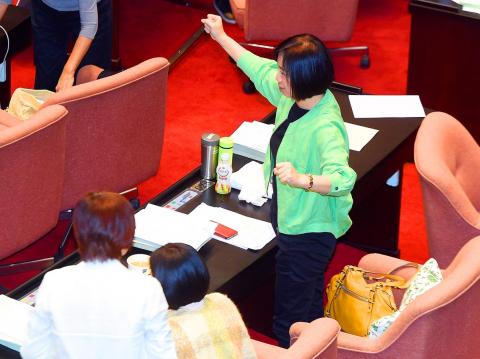
Photo: Liao Chen-huei, Taipei Times
Budget requests for the second stage are to be delivered to the legislature for review with the proviso that its size and time frame does not exceed the first budget.
The motion added three projects — establishing friendly nursing rooms in response to low birth rates; measures to ensure food safety; and nurturing talent and boosting employment — to the five projects outlined by the Executive Yuan: Rail construction, digital infrastructure, “green” energy, urban-rural development and aquatic infrastructure.
The National Development Council is to oversee the program, while Cabinet-level agencies are to be responsible for planning budgets for projects outlined in the program and local governments entrusted with a project should plan budgets accordingly, the motion said.
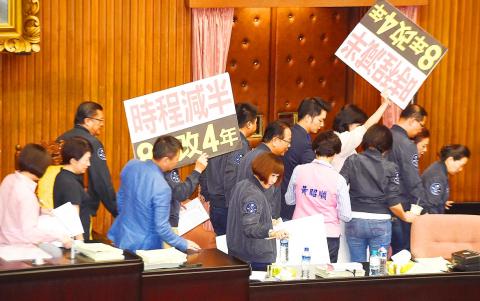
Photo: Liao Chen-huei, Taipei Times
Central government agencies must conduct environmental impact assessments, and viability and cost-effectiveness plans, and submit the reports to the Executive Yuan for approval before a budget is allocated.
The debt ceiling for the overall spending of the entire program is set at 15 percent of the government’s annual expenditure, in accordance with the Public Debt Act (公共債務法).
Should a specific project run under budget, the excess funds should be returned to the central government, the motion said.
A draft article — proposed in response to New Power Party (NPP) and KMT demands — which says the Control Yuan and concerned agencies should punish officials found to be involved in illegal activity that causes a project to fall behind the 80 percent completed mark was also passed yesterday.
Land expropriation carried out for a project must be done according to due procedure on the condition that it is necessary and it serves the public interest.
The council should regularly update the progress of the projects on the Executive Yuan’s Web site.
Citing the low utilization rate of the Kaohsiung Mass Rapid Transit (MRT) system, KMT legislators criticized the government’s plan to dole out large sums — previously about NT$420 billion — to construct railway systems, prompting a war of words with the DPP caucus.
“The MRT might be taken for granted by Taipei residents, but for people living in the south of the nation it has remained a luxury,” DPP Legislator Rosalia Wu (吳思瑤) said, adding that a MRT system should not be a privilege of Taipei residents.
“The final version of the bill was rendered in response to overwhelming public pressure and strong criticism,” KMT Legislator Lee Yen-hsiu (李彥秀) said.
With budget proposals set to be reviewed by the legislature next week, the DPP had better be prudent over its budget allocation to avoid triggering a backlash, she said.

A magnitude 7.0 earthquake struck off Yilan at 11:05pm yesterday, the Central Weather Administration (CWA) said. The epicenter was located at sea, about 32.3km east of Yilan County Hall, at a depth of 72.8km, CWA data showed There were no immediate reports of damage. The intensity of the quake, which gauges the actual effect of a seismic event, measured 4 in Yilan County area on Taiwan’s seven-tier intensity scale, the data showed. It measured 4 in other parts of eastern, northern and central Taiwan as well as Tainan, and 3 in Kaohsiung and Pingtung County, and 2 in Lienchiang and Penghu counties and 1

A car bomb killed a senior Russian general in southern Moscow yesterday morning, the latest high-profile army figure to be blown up in a blast that came just hours after Russian and Ukrainian delegates held separate talks in Miami on a plan to end the war. Kyiv has not commented on the incident, but Russian investigators said they were probing whether the blast was “linked” to “Ukrainian special forces.” The attack was similar to other assassinations of generals and pro-war figures that have either been claimed, or are widely believed to have been orchestrated, by Ukraine. Russian Lieutenant General Fanil Sarvarov, 56, head

FOREIGN INTERFERENCE: Beijing would likely intensify public opinion warfare in next year’s local elections to prevent Lai from getting re-elected, the ‘Yomiuri Shimbun’ said Internal documents from a Chinese artificial intelligence (AI) company indicated that China has been using the technology to intervene in foreign elections, including propaganda targeting Taiwan’s local elections next year and presidential elections in 2028, a Japanese newspaper reported yesterday. The Institute of National Security of Vanderbilt University obtained nearly 400 pages of documents from GoLaxy, a company with ties to the Chinese government, and found evidence that it had apparently deployed sophisticated, AI-driven propaganda campaigns in Hong Kong and Taiwan to shape public opinion, the Yomiuri Shimbun reported. GoLaxy provides insights, situation analysis and public opinion-shaping technology by conducting network surveillance
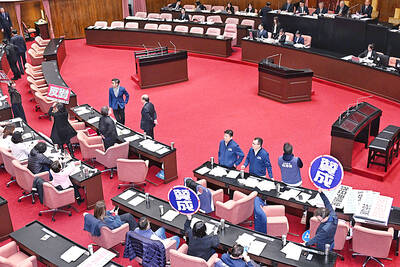
‘POLITICAL GAME’: DPP lawmakers said the motion would not meet the legislative threshold needed, and accused the KMT and the TPP of trivializing the Constitution The Legislative Yuan yesterday approved a motion to initiate impeachment proceedings against President William Lai (賴清德), saying he had undermined Taiwan’s constitutional order and democracy. The motion was approved 61-50 by lawmakers from the main opposition Chinese Nationalist Party (KMT) and the smaller Taiwan People’s Party (TPP), who together hold a legislative majority. Under the motion, a roll call vote for impeachment would be held on May 19 next year, after various hearings are held and Lai is given the chance to defend himself. The move came after Lai on Monday last week did not promulgate an amendment passed by the legislature that


 RSS
RSS