


China and Europe yesterday pledged to unite to save “Mother Earth” in the face of US President Donald Trump’s decision to take the world’s largest carbon polluter out of the Paris climate change pact.
Others, including Russia, India and Mexico, quickly signaled their commitment to the accord, although a Kremlin aide said it would not be viable without US participation.
France said it would work with US states and cities — some of which have broken with Trump’s decisions — to keep up the fight against climate change.
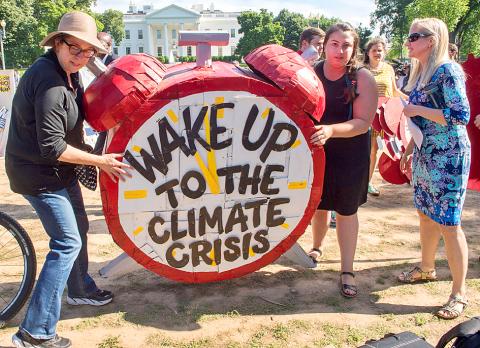
Photo: AFP
The World Meteorological Organization sought to quantify Trump’s decision, estimating that US withdrawal from the emissions-cutting accord could add 0.3°C to global temperatures by the end of the century in a worst-case scenario.
Trump, tapping into the “America first” message he used when he was elected president last year, said he would withdraw the US from the landmark 2015 global agreement on tackling global warming.
He said that participating would undermine the US economy, wipe out US jobs, weaken US national sovereignty and put the country at a permanent disadvantage to other countries.
The move was met with a mix of dismay and anger around the world — from many in industry, as well as governments, which scrambled to renew their commitment to curbing global warming.
German Chancellor Angela Merkel, a pastor’s daughter who is usually intensely private about her faith, said the accord was needed “to preserve our Creation.”
“To everyone for whom the future of our planet is important, I say let’s continue going down this path so we’re successful for our Mother Earth,” she said to applause from lawmakers.
In Paris, the venue for the pact, French President Emmanuel Macron turned Trump’s “Make America Great Again” campaign slogan on its head, saying in a rare English-language statement that it was time to “make the planet great again.”
A long-scheduled meeting yesterday between Chinese Premier Li Keqiang (李克強) and top EU officials in Brussels was dominated by Trump’s decision.
The meeting was to end with a joint statement pledging full implementation of the Paris deal, committing China and the EU to cutting back on fossil fuels, developing more “green” technology and helping raise US$100 billion per year by 2020 to help poorer countries reduce their high-polluting emissions.
China has emerged as Europe’s unlikely partner in this and other areas — underlining Trump’s isolation on many issues.
“There is no reverse gear to energy transition. There is no backsliding on the Paris agreement,” European Commission President Jean-Claude Juncker said.
Russia struck a rare negative note.
While Russian Deputy Prime Minister Arkady Dvorkovich said he did not think Trump’s decision would prompt Russia to rethink its own stance, the Kremlin suggested the withdrawal could be fatal to the pact.
Kremlin aide Andrei Belousov said the US move punched a gaping hole in the Paris accord.
“It’s obvious that without the participation of the United States the Paris agreement will be unworkable, because the United States is one of the biggest generator of emissions,” he said.

AGING: As of last month, people aged 65 or older accounted for 20.06 percent of the total population and the number of couples who got married fell by 18,685 from 2024 Taiwan has surpassed South Korea as the country least willing to have children, with an annual crude birthrate of 4.62 per 1,000 people, Ministry of the Interior data showed yesterday. The nation was previously ranked the second-lowest country in terms of total fertility rate, or the average number of children a woman has in her lifetime. However, South Korea’s fertility rate began to recover from 2023, with total fertility rate rising from 0.72 and estimated to reach 0.82 to 0.85 by last year, and the crude birthrate projected at 6.7 per 1,000 people. Japan’s crude birthrate was projected to fall below six,
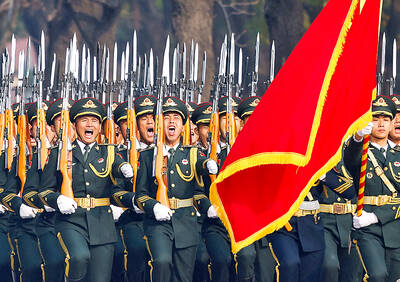
Conflict with Taiwan could leave China with “massive economic disruption, catastrophic military losses, significant social unrest, and devastating sanctions,” a US think tank said in a report released on Monday. The German Marshall Fund released a report titled If China Attacks Taiwan: The Consequences for China of “Minor Conflict” and “Major War” Scenarios. The report details the “massive” economic, military, social and international costs to China in the event of a minor conflict or major war with Taiwan, estimating that the Chinese People’s Liberation Army (PLA) could sustain losses of more than half of its active-duty ground forces, including 100,000 troops. Understanding Chinese
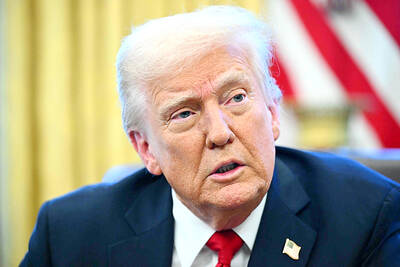
US President Donald Trump in an interview with the New York Times published on Thursday said that “it’s up to” Chinese President Xi Jinping (習近平) what China does on Taiwan, but that he would be “very unhappy” with a change in the “status quo.” “He [Xi] considers it to be a part of China, and that’s up to him what he’s going to be doing, but I’ve expressed to him that I would be very unhappy if he did that, and I don’t think he’ll do that. I hope he doesn’t do that,” Trump said. Trump made the comments in the context
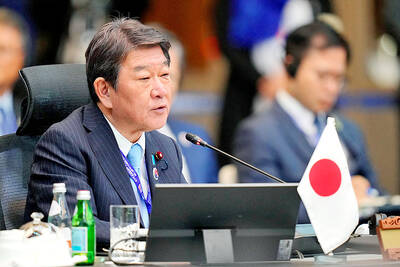
SELF-DEFENSE: Tokyo has accelerated its spending goal and its defense minister said the nation needs to discuss whether it should develop nuclear-powered submarines China is ramping up objections to what it sees as Japan’s desire to acquire nuclear weapons, despite Tokyo’s longstanding renunciation of such arms, deepening another fissure in the two neighbors’ increasingly tense ties. In what appears to be a concerted effort, China’s foreign and defense ministries issued statements on Thursday condemning alleged remilitarism efforts by Tokyo. The remarks came as two of the country’s top think tanks jointly issued a 29-page report framing actions by “right-wing forces” in Japan as posing a “serious threat” to world peace. While that report did not define “right-wing forces,” the Chinese Ministry of Foreign Affairs was


 RSS
RSS