


The WHO yesterday left open the possibility that Taiwan could still attend its World Health Assembly (WHA), saying talks are continuing, despite China’s insistence that a delegation from Taiwan be excluded for the first time since 2009.
The WHA, the decisionmaking body of the WHO, on Monday closed its online registration for the May 22 to 31 event.
Taiwan’s exclusion is widely seen as the latest move by China to clamp down on the nation’s international participation.
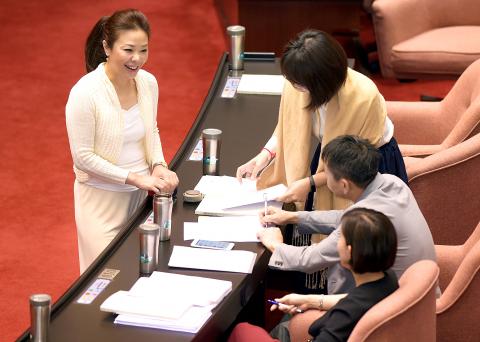
Photo: Huang Yao-cheng, Taipei Times
Tim Armstrong, who heads the WHO’s department of governing bodies, said that for now, WHO Director-General Margaret Chan (陳馮富珍), who is from Hong Kong, “is not in a position to issue an invitation for Taiwanese observers to attend to the World Health Assembly.”
However, Armstrong said that “negotiations are still ongoing,” adding: “Anything is possible.”
Meanwhile, in Taipei, the Legislative Yuan failed to reach a cross-caucus resolution on issuing a protest against China’s action to block the nation’s participation at the WHA, with the Chinese Nationalist Party (KMT) caucus refusing to attend the negotiation.
The Democratic Progressive Party (DPP) called for talks in the hope of achieving a legislature-wide consensus and resolution condemning China’s obstruction.
Health is a basic human right and as diseases know no national borders, there should not be a gap in disease prevention, the DPP caucus said, adding that Taiwan’s participation in the WHA is indispensable for the world’s health and its disease prevention system.
“The purpose of the cross-caucus talks was for the nation’s highest representative institution to present a united front and statement in the face of the difficulty and [China’s] unreasonable suppression,” Deputy Legislative Speaker Tsai Chi-chang (蔡其昌), who presided over the negotiation, said 15 minutes after its scheduled start time.
“However, as the KMT caucus refuses to attend, we do not have a cross-caucus consensus or a conclusion today,” Tsai said before announcing the meeting was closed.
In addition to the DPP caucus, New Power Party Legislator Freddy Lim (林昶佐) and People First Party caucus whip Lee Hung-chun (李鴻鈞) also attended the meeting.
On Wednesday, China’s Taiwan Affairs Office spokesman An Fengshan (安峰山) said that Taiwan’s epidemic prevention information exchange channels with the WHO are good, that Taiwan can attend technical WHO meetings and WHO experts can visit Taiwan if needed.
The health of Taiwanese and Taiwan’s exclusion from the meeting are two different matters, An told a regular news briefing.
Mainland Affairs Council Deputy Minister Chiu Chui-cheng (邱垂正) accused the Chinese official of dishonesty, saying Beijing is seeking to downgrade the nation’s sovereign status.
Due to China’s obstruction, Taiwan has not received invitations to more than 50 percent of the technical WHO meetings it has applied to attend, Chiu said.
Even WHO experts who are invited to attend meetings in Taiwan have to obtain approval from China before coming, Chiu said, adding that in this climate, Taiwan generally does not have access to real-time epidemic information.
All of this proves that China does not care about the health and well-being of Taiwanese, he said.
Chiu said the council has twice sent a statement to China indicating Taiwan’s willingness to settle differences through dialogue, but received no response.
Taipei will work until the last minute to secure an invitation to the WHA and will view this as an indicator of cross-strait relations, Chiu said.
The rate of requests to attend technical meetings being turned down has been relatively high.
In 2009, two requests to attend WHO technical meetings were accepted; in 2010, 12 of the 16 requests were rejected; in 2011, 10 out of 17 requests were turned down; in 2012, 15 out of 21; in 2013, 22 out of 30; in 2014, 11 out of 20; in 2015, 11 out of 17; and last year seven out of 13 were denied, sources said.
Additional reporting by Lin Liang-sheng and AP

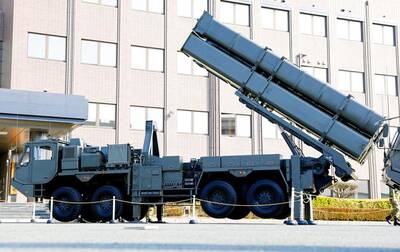
Japan has deployed long-range missiles in a southwestern region near China, the Japanese defense minister said yesterday, at a time when ties with Beijing are at their lowest in recent years. The missiles were installed in Kumamoto in the southern region of Kyushu, as Japan is attempting to shore up its military capacity as China steps up naval activity in the East China Sea. “Standoff defense capabilities enable us to counter the threat of enemy forces attempting to invade our country ... while ensuring the safety of our personnel,” Japanese Minister of Defense Shinjiro Koizumi said. “This is an extremely important initiative for

MORE POPULAR: Taiwan Pass sales increased by 59 percent during the first quarter compared with the same period last year, the Tourism Administration said The Tourism Administration yesterday said that it has streamlined the Taiwan Pass, with two versions available for purchase beginning today. The tourism agency has made the pass available to international tourists since 2024, allowing them to access the high-speed rail, Taiwan Railway Corp services, four MRT systems and four Taiwan Tourist Shuttles. Previously, five types of Taiwan Pass were available, but some tourists have said that the offerings were too complicated. The agency said only two types of Taiwan Pass would be available, starting from a three-day pass with the high-speed rail and a three-day pass with Taiwan Railway Corp. The former costs NT$2,800

NEW LOW: The council in 2024 based predictions on a pessimistic estimate for the nation’s total fertility rate of 0.84, but last year that rate was 0.69, 17 percent lower An expected National Development Council (NDC) report expects the nation’s population to drop below 12 million by 2065, with the old-age dependency ratio to top 100 percent sooner than 2070, sources said yesterday. The council is slated to release its latest population projections in August, using an ultra-low fertility model, the sources said. The previous report projected that Taiwan’s population would fall to 14.37 million by 2070, but based on a new estimate of the total fertility rate (TFR) — the average number of children born to a woman over her lifetime — the population is expected to reach 12 million by

COUNTERING HOSTILITY: The draft bill would require the US to increase diplomatic pressure on China and would impose sanctions on those who sabotage undersea cable networks US lawmakers on Thursday introduced a bipartisan bill to bolster the resilience of Taiwan’s submarine cables to counter China’s hostile activities. The proposal, titled the critical undersea infrastructure resilience initiative act, was cosponsored by Republican representatives Mike Lawler and Greg Stanton, and Democratic Representative Dave Min. US Senators John Curtis and Jacky Rosen also introduced a companion bill in the US Senate, which has passed markup at the chamber’s Committee on Foreign Relations. The House’s version of the bill would prioritize the deployment of sensors to detect disruptions or potential sabotage in real-time and enhance early warning capabilities through global intelligence sharing frameworks,


 RSS
RSS