


Chinese Nationalist Party (KMT) lawmakers yesterday again occupied the legislative speaker’s podium as they urged their colleagues to retract a bill to implement the Forward-looking Infrastructure Development Plan.
With the Economics Committee scheduled to lead a second joint-committee review of the bill today, the KMT caucus staged a protest against what it called the NT$880 billion (US$29.3 billion) “money-pit bill,” demanding a redrafting of the bill to reduce the expenditure and shorten its target period from eight years to four.
KMT caucus secretary-general Alicia Wang (王育敏) said the plan is “unreasonable and unjust” and that, as a responsible opposition party, the KMT is obliged to block a bill that is “destined to accrue a great debt that will be shouldered by our children.”
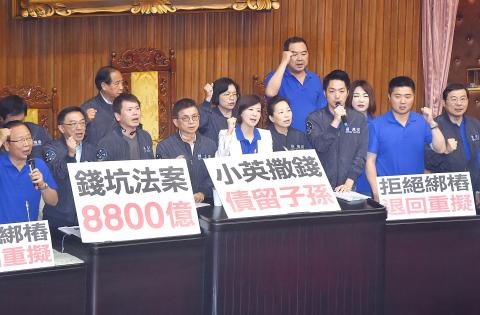
Photo: Liao Chen-huei, Taipei Times
“We would be saving the nation NT$100 billion if we cut it down by NT$100 billion, or saving NT$200 billion if NT$200 billion is blocked,” KMT Legislator Lin Wei-chou (林為洲) said.
The review scheduled for today and tomorrow would be a second-round review of the bill, as Democratic Progressive Party (DPP) Legislator Chiu Yi-ying (邱議瑩), a convener of the Economics Committee who presided over the review last week, promised to restart deliberations this week after acknowledging procedural flaws in last week’s controversial approval of the bill.
Legislative Speaker Su Jia-chyuan (蘇嘉全) said that since the review is to be restarted, he had no idea why the KMT had to boycott the general assembly meeting, adding that occupying the podium should be seen as a last resort.
“Using the tactic frivolously will only incur public disapproval,” Su said.
In the cross-caucus negotiation shunned by the KMT caucus, People First Party caucus whip Lee Hong-chun (李鴻鈞) called on the DPP caucus to guarantee that the bill would not be passed “as a package” and that revisions would be allowed to ensure the KMT caucus’ cooperation.
DPP caucus secretary-general Lee Chun-yi (李俊俋) said that the committee review is being held to allow for a clause-by-clause review of the bill.
“In the notice for [today’s] meeting, the words ‘extensive discussion’ has been included,” DPP caucus chief executive Yeh Yi-chin (葉宜津) said.
Per the KMT’s request, Chiu has also been replaced by DPP Legislator Gao Jyh-peng (高志鵬), the other Economics Committee convener, Yeh said.
DPP caucus whip Ker Chien-ming (柯建銘) said that during the negotiations, it was “very clear that the KMT’s tactics, for both the pension reform and the infrastructure development plan, are simply to cause chaos.”
“What they are calling for, such as an accountability mechanism [for the plan], can all be discussed and added in the bill during the committee review,” Ker said.
Infrastructure plans proposed during the administrations of former presidents Chen Shui-bian (陳水扁) and Ma Ying-jeou (馬英九) were not obstructed by the legislature when the DPP was the legislative minority, he added.
“For the KMT, it is easy to be an opposition party,” because they simply oppose whatever the ruling party proposes, Ker said, adding: “There would be no chance for [the KMT] to rise again.”
New Power Party (NPP) caucus convener Hsu Yung-ming (徐永明) said that the party favors a rigorous review of the bill and would consider the KMT caucus’ call for a partial redraft.
“Since the plan is composed of three parts — the special statute, the substantive content of the plan and the budget plan — the Executive Yuan could consider reviewing the content of the development project as the public has misgivings about it,” Hsu said. “The NPP suggests that the plan be divided into two stages of four years each, with the latter stage to be discussed later.”
“What we are dealing with now is precisely the statute [or the legal framework], without which the plan content and the budget could not follow,” Lee said. “It is nonsensical for the KMT to say that the plan [as a whole] had been passed within seconds.”

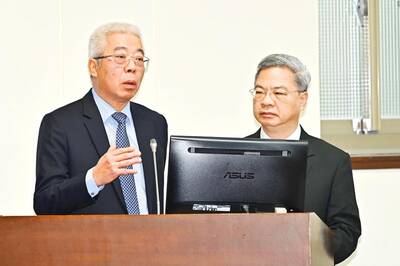
Taiwan has arranged for about 8 million barrels of crude oil, or about one-third of its monthly needs, to be shipped from the Red Sea this month to bypass the Strait of Hormuz and ease domestic supply pressures, CPC Corp, Taiwan (CPC, 台灣中油) said yesterday. The state-run oil company has worked with Middle Eastern suppliers to secure routes other than the Strait of Hormuz, through which about 20 percent of the world’s oil and liquefied natural gas typically passes, CPC chairman Fang Jeng-zen (方振仁) said at a meeting of the legislature’s Economics Committee in Taipei. Suppliers in Saudi Arabia have indicated they
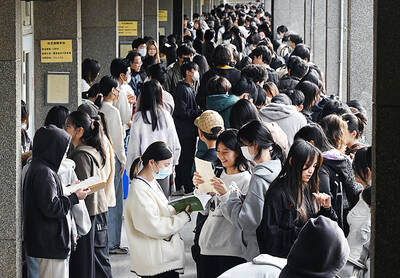
A global survey showed that 60 percent of Taiwanese had attained higher education, second only to Canada, the Ministry of the Interior said. Taiwan easily surpassed the global average of 43 percent and ranked ahead of major economies, including Japan, South Korea and the US, data from the Organisation for Economic Co-operation and Development (OECD) for 2024 showed. Taiwan has a high literacy rate, data released by the ministry showed. As of the end of last year, Taiwan had 20.617 million people aged 15 or older, accounting for 88.5 percent of the total population, with a literacy rate of 99.4 percent, the data

CCP ‘PAWN’? Beijing could use the KMT chairwoman’s visit to signal to the world that many people in Taiwan support the ‘one China’ principle, an academic said Chinese Nationalist Party (KMT) Chairwoman Cheng Li-wun (鄭麗文) yesterday arrived in China for a “peace” mission and potential meeting with Chinese President Xi Jinping (習近平), while a Taiwanese minister detailed the number of Chinese warships currently deployed around the nation. Cheng is visiting at a time of increased Chinese military pressure on Taiwan, as the opposition-dominated Legislative Yuan stalls a government plan for US$40 billion in extra defense spending. Speaking to reporters before going to the airport, Cheng said she was going on a “historic journey for peace,” but added that some people felt uneasy about her trip. “If you truly love Taiwan,

NEW LOW: The council in 2024 based predictions on a pessimistic estimate for the nation’s total fertility rate of 0.84, but last year that rate was 0.69, 17 percent lower An expected National Development Council (NDC) report expects the nation’s population to drop below 12 million by 2065, with the old-age dependency ratio to top 100 percent sooner than 2070, sources said yesterday. The council is slated to release its latest population projections in August, using an ultra-low fertility model, the sources said. The previous report projected that Taiwan’s population would fall to 14.37 million by 2070, but based on a new estimate of the total fertility rate (TFR) — the average number of children born to a woman over her lifetime — the population is expected to reach 12 million by


 RSS
RSS