


US lawmakers yesterday unveiled a huge US$1 trillion-plus spending bill that would fund most government operations through September, but would deny US President Donald Trump money for a border wall and rejects his proposed cuts to popular domestic programs.
The 1,665-page bill agreed to on Sunday is the product of weeks of negotiations. It was made public in the predawn hours yesterday and is tentatively scheduled for a House of Representatives vote tomorrow.
The catchall spending bill would be the first major piece of bipartisan legislation to advance during Trump’s short tenure in the White House. While losing on funding for the wall along the US-Mexico border, Trump won a US$15 billion down payment on his request to strengthen the military, though that too fell short of what he requested.

Photo: AP
The measure funds the remainder of the current fiscal year, through Sept. 30, rejecting cuts to popular domestic programs targeted by Trump, such as medical research and infrastructure grants.
Successful votes later this week would also clear away any remaining threat of a government shutdown — at least until the Oct. 1 start of the 2018 budget year.
Trump has submitted a partial 2018 budget promising a US$54 billion, 10 percent increase for the Pentagon from current levels, financed by cutting to foreign aid and other nondefense programs by an equal amount.
However, negotiators rejected a smaller US$18 billion package of cuts and instead slightly increased funding for domestic programs.
Democrats were quick to praise the deal.
“This agreement is a good agreement for the American people, and takes the threat of a government shutdown off the table,” said Senate Minority Leader Chuck Schumer, a Democrat and a key force in the talks. “The bill ensures taxpayer dollars aren’t used to fund an ineffective border wall, excludes poison pill riders, and increases investments in programs that the middle class relies on, like medical research, education and infrastructure.”
However, some Republican conservatives were wary.
“I think you’re going to see conservatives have some real concerns with this legislation,” US Representative Jim Jordan said on CNN, citing domestic spending obtained by Democrats and other issues. “We told [voters] we were going to do a short-term spending bill that was going to come due at the end of April so that we could fight on these very issues, and now it looks like we’re not going to do that.”
The measure is assured of winning bipartisan support in votes this week; the House and Senate have until midnight on Friday to pass the measure to avert a government shutdown.
Democrats played a strong hand in the talks since their votes are needed to pass the bill, even though Republicans control both the White House and Congress. As a result, the measure does not look much different than the deal that could have been struck on former US president Barack Obama’s watch.
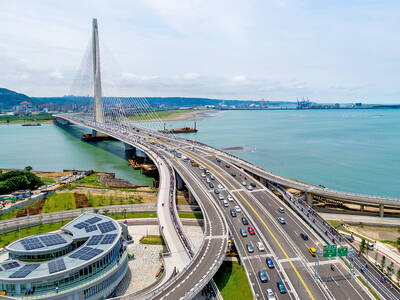
The Ministry of Transportation and Communications yesterday inaugurated the Danjiang Bridge across the Tamsui River in New Taipei City, saying that the structure would be an architectural icon and traffic artery for Taiwan. Feted as a major engineering achievement, the Danjiang Bridge is 920m long, 211m tall at the top of its pylon, and is the longest single-pylon asymmetric cable-stayed bridge in the world, the government’s Web site for the structure said. It was designed by late Iraqi-British architect Zaha Hadid. The structure, with a maximum deck of 70m, accommodates road and light rail traffic, and affords a 200m navigation channel for boats,
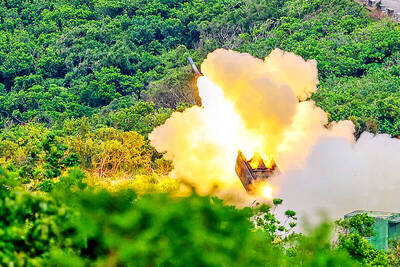
PRECISION STRIKES: The most significant reason to deploy HIMARS to outlying islands is to establish a ‘dead zone’ that the PLA would not dare enter, a source said A High Mobility Artillery Rocket System (HIMARS) would be deployed to Penghu County and Dongyin Island (東引) in Lienchiang County (Matsu) to force the Chinese military to retreat at least 100km from the coastline, a military source said yesterday. Taiwan has been procuring HIMARS and Army Tactical Missile Systems (ATACMS) from the US in batches. Once all batches have been delivered, Taiwan would possess 111 HIMARS units and 504 ATACMS, which have a range of 300km. Considering that “offense is the best defense,” the military plans to forward-deploy the systems to outlying islands such as Penghu and Dongyin so that

Taiwan Semiconductor Manufacturing Co (TSMC, 台積電), the world’s largest foundry service provider, yesterday said that global semiconductor revenue is projected to hit US$1.5 trillion in 2030, after the figure exceeds US$1 trillion this year, as artificial intelligence (AI) demand boosts consumption of token and compute power. “We are still at the beginning of the AI revolution, but we already see a significant impact across the whole semiconductor ecosystem,” TSMC deputy cochief operating officer Kevin Zhang (張曉強) said at the company’s annual technology symposium in Hsinchu City. “It is fair to say that in the past decade, smartphones and other mobile devices were

‘CLEAR MESSAGE’: The bill would set up an interagency ‘tiger team’ to review sanctions tools and other economic options to help deter any Chinese aggression toward Taiwan US Representative Young Kim has introduced a bill to deter Chinese aggression against Taiwan, calling for an interagency “tiger team” to preplan coordinated sanctions and economic measures in response to possible Chinese military or political action against Taiwan. “[Chinese President] Xi Jinping [習近平] has directed the People’s Liberation Army to be ready to invade Taiwan by 2027. China has a plan. America should have one too,” Kim said in a news release on Thursday last week. She introduced the “Deter PRC [People’s Republic of China] aggression against Taiwan act” to “ensure the US has a coordinated sanctions strategy ready should


 RSS
RSS