


Top executives of Foxconn Technology Group (富士康), including founder and chairman Terry Gou (郭台銘), visited the White House on Thursday, Taiwanese TV footage showed, as the Apple Inc supplier ponders a multibillion-dollar investment in a panel plant in the US.
Footage aired by TVBS yesterday showed Gou entering and leaving one of the entry gates of the White House with senior company executives, including Foxconn vice chairman Tai Jeng-wu (戴正吳), also head of Japanese firm Sharp Corp, in which Foxconn holds a two-thirds stake.
When asked by reporters on his way out of the White House if he had met with US President Donald Trump, Gou said: “My memory is not good. Maybe I already forgot.”
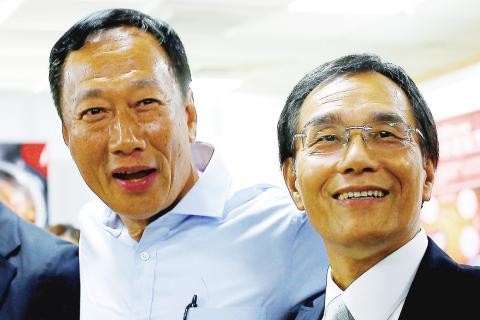
Photo: Reuters/Tyrone Siu
Gou was at the White House for about three hours, TVBS said.
Foxconn, the world’s largest contract electronics maker which is known as Hon Hai Precision Industry Co (鴻海精密) in Taiwan, declined to comment on the TV footage.
Gou in January said that Foxconn was mulling setting up a US plant making flat panels with an investment that would exceed US$7 billion.
Gou made the comment after Foxconn’s business partner, Masayoshi Son, the head of Japan’s Softbank Group Corp, pledged to invest US$50 billion in the US when he met Trump in December last year, accidentally showing reporters papers that had Foxconn’s logo on them.
While Foxconn has not disclosed a timeline for a decision on the plant, it would depend on many factors, such as investment conditions that would have to be negotiated at the state and federal levels, Gou has said.
An unnamed source in February told reporters that Sharp might start building the plant in the first half of this year.
Foxconn is also one of the suitors looking to acquire Toshiba Corp’s chip business, but people familiar with the matter have told reporters that would be considered a national security risk due to its ties with China, where it has vast manufacturing facilities and employs about 1 million people.
The bidding has also been complicated by Toshiba’s US partner, Western Digital Corp, which has said it should be given exclusive negotiating rights.

PREPAREDNESS: Given the difficulty of importing ammunition during wartime, the Ministry of National Defense said it would prioritize ‘coproduction’ partnerships A newly formed unit of the Marine Corps tasked with land-based security operations has recently replaced its aging, domestically produced rifles with more advanced, US-made M4A1 rifles, a source said yesterday. The unnamed source familiar with the matter said the First Security Battalion of the Marine Corps’ Air Defense and Base Guard Group has replaced its older T65K2 rifles, which have been in service since the late 1980s, with the newly received M4A1s. The source did not say exactly when the upgrade took place or how many M4A1s were issued to the battalion. The confirmation came after Chinese-language media reported
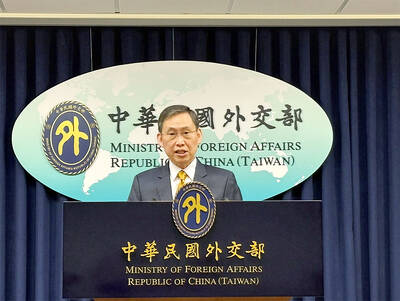
A Ministry of Foreign Affairs official yesterday said that a delegation that visited China for an APEC meeting did not receive any kind of treatment that downgraded Taiwan’s sovereignty. Department of International Organizations Director-General Jonathan Sun (孫儉元) said that he and a group of ministry officials visited Shenzhen, China, to attend the APEC Informal Senior Officials’ Meeting last month. The trip went “smoothly and safely” for all Taiwanese delegates, as the Chinese side arranged the trip in accordance with long-standing practices, Sun said at the ministry’s weekly briefing. The Taiwanese group did not encounter any political suppression, he said. Sun made the remarks when
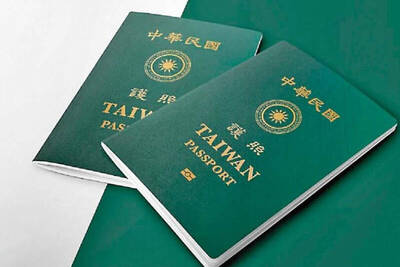
The Taiwanese passport ranked 33rd in a global listing of passports by convenience this month, rising three places from last month’s ranking, but matching its position in January last year. The Henley Passport Index, an international ranking of passports by the number of designations its holder can travel to without a visa, showed that the Taiwan passport enables holders to travel to 139 countries and territories without a visa. Singapore’s passport was ranked the most powerful with visa-free access to 192 destinations out of 227, according to the index published on Tuesday by UK-based migration investment consultancy firm Henley and Partners. Japan’s and
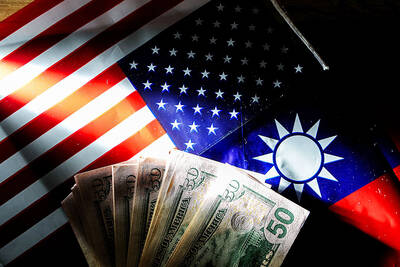
BROAD AGREEMENT: The two are nearing a trade deal to reduce Taiwan’s tariff to 15% and a commitment for TSMC to build five more fabs, a ‘New York Times’ report said Taiwan and the US have reached a broad consensus on a trade deal, the Executive Yuan’s Office of Trade Negotiations said yesterday, after a report said that Washington is set to reduce Taiwan’s tariff rate to 15 percent. The New York Times on Monday reported that the two nations are nearing a trade deal to reduce Taiwan’s tariff rate to 15 percent and commit Taiwan Semiconductor Manufacturing Co (TSMC, 台積電) to building at least five more facilities in the US. “The agreement, which has been under negotiation for months, is being legally scrubbed and could be announced this month,” the paper said,


 RSS
RSS